
Tylodinus pinguis Luna-Cozar, 2014
|
publication ID |
https://dx.doi.org/10.11646/zootaxa.3788.1 |
|
publication LSID |
lsid:zoobank.org:pub:7484832A-025B-41FA-9696-DF7531C01AA4 |
|
DOI |
https://doi.org/10.5281/zenodo.4914164 |
|
persistent identifier |
https://treatment.plazi.org/id/C27E87FF-FFA6-6131-FF14-DAA627A1FA5D |
|
treatment provided by |
Felipe |
|
scientific name |
Tylodinus pinguis Luna-Cozar |
| status |
sp. nov. |
36. Tylodinus pinguis Luna-Cozar , sp. nov.
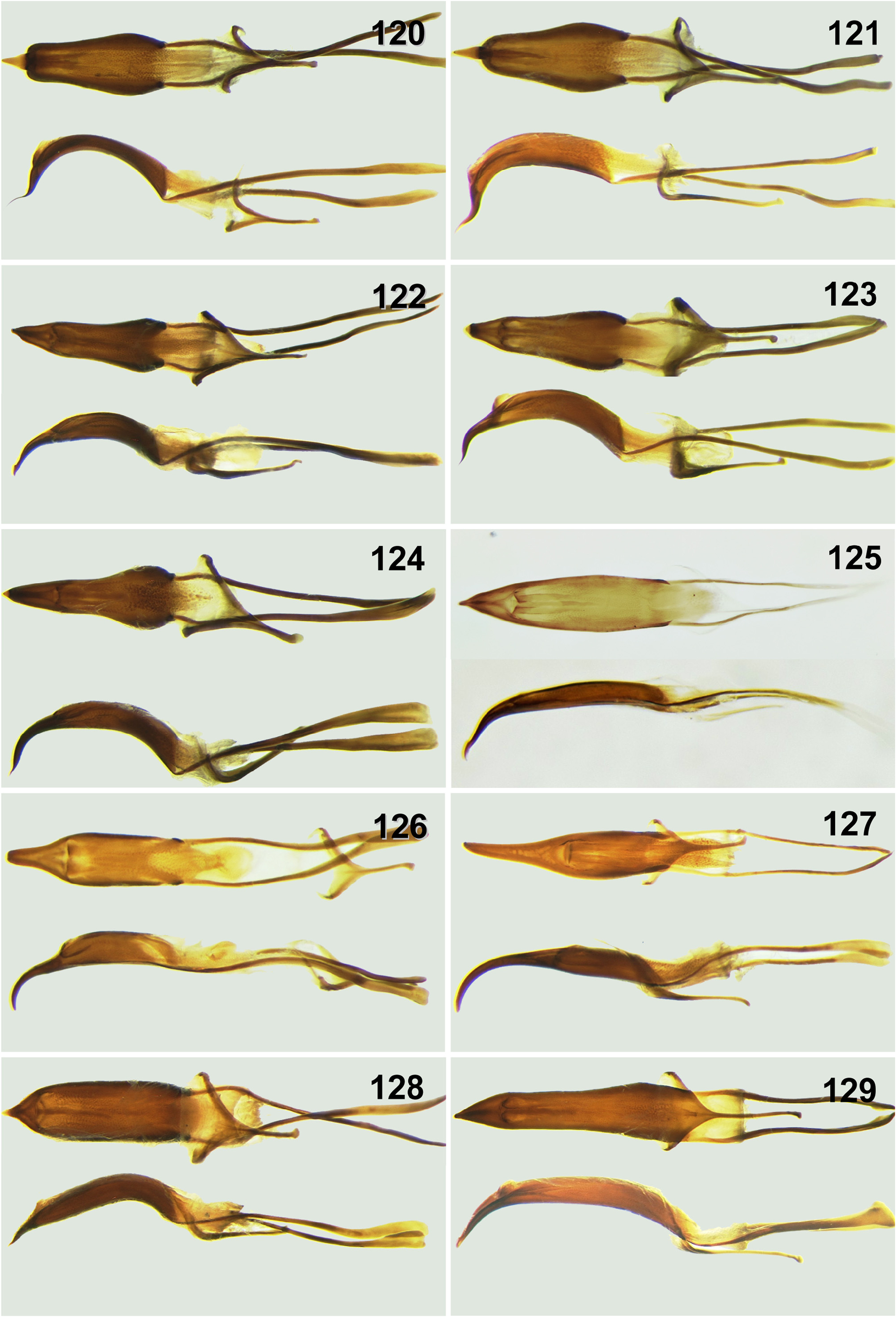
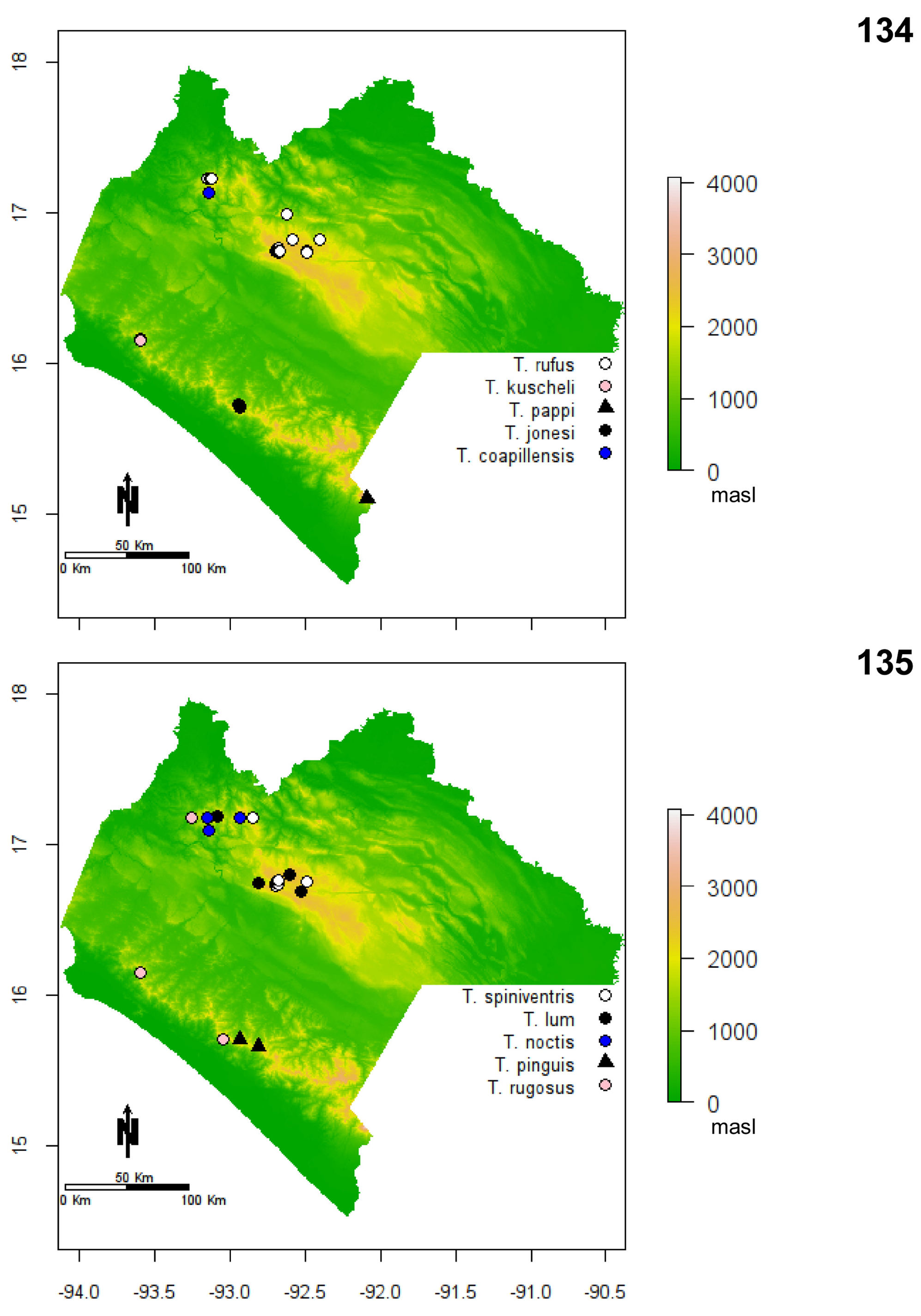
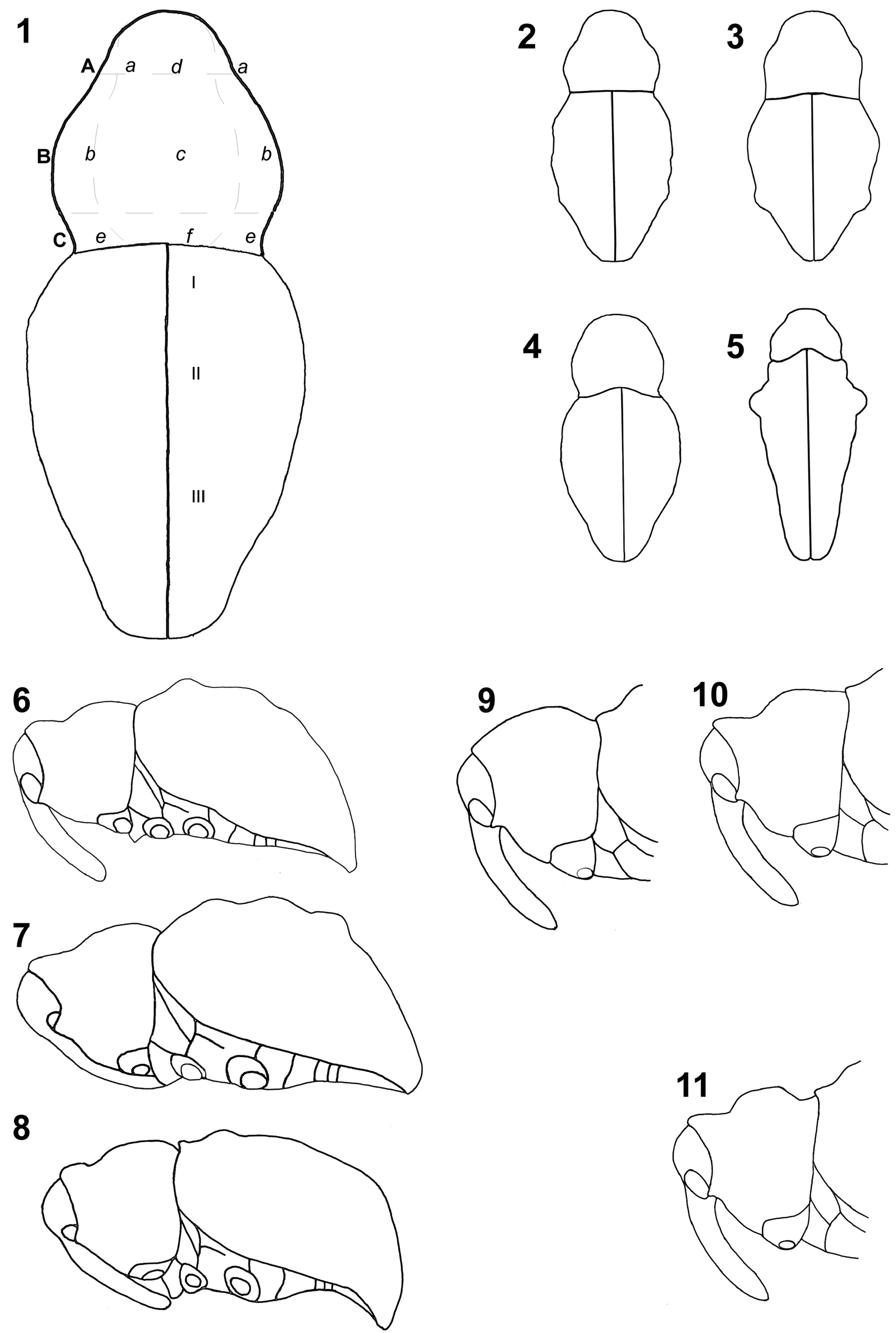
( Figures 96–97 View FIGURES 92–99. 92–99 , 129 View FIGURES 120–129 , 135 View FIGURES 134–135 )
Diagnosis. Length male 4.8–4.9 mm. Width male 2.2–2.3 mm. Body 2.2x longer than wide, black. Head clothed with dark brown scales, punctures similar to punctures on rostrum; vertex with two patches of overlapping scales, whitish or pale yellow color, light brown on lateral margin; frons moderately concave; rostrum moderately robust, weakly carinate, apical area punctuate, eyes moderately convex. Pronotum in lateral view strongly convex, outline with anterior constriction, without posterior constriction ( Figures 10 View FIGURES 1–11. 1–5 , 97 View FIGURES 92–99. 92–99 ), in dorsal view with sides slightly divergent from base to midlength, then convergent to apex, constricted beyond middle; disc somewhat hollowed medially, punctures dense to contiguous at base and progressively more widely spaced, smaller and shallower to apex ( Figures 14 View FIGURES 12–19. 12 , 96 View FIGURES 92–99. 92–99 ); surface granulate. Elytra with tubercles as follows: I2 with round and large tubercle at declivity base; I3 with two tubercles, first subbasal, second smaller, round at middle of elytra; I4 with laminate tubercle beyond declivity; I5 with two small tubercles in same position as tubercles on I3; I7 with two tubercles in same position as tubercles on I5. Metasternum moderately concave, median section glabrous. Male abdomen with ventrite 1 moderately concave, squamous; ventrite 2 feebly concave, longer than ventrites 3–4 combined, squamous; ventrite 5 flat, without impressions, as long as ventrites 1–2. Femora armed, hind femur reaching elytral apex, tibiae with inner margin slightly sinuate, premucro present. Male genitalia ( Figure 129 View FIGURES 120–129 ) with median lobe in lateral view weakly curved, slender; in ventral view as long as apodemes, lateral sides moderately swollen at 0.25 length from the base, convergent, apex acute; apical process in lateral view moderately large (0.26–0.34 as long as body of median lobe), straight, moderately curved downward; in ventral view not constricted beyond median orifice, lateral sides convergent.
Geographic distribution. México ( Chiapas).
Habitat and elevation. Specimens were collected from leaf litter in high elevation cloud forest between 2000–2200 m.
Derivation of specific name. Name derived from the Latin word pinguis = fat.
Material examined. Total 2 males. Holotype male ( CMNC): México: Chiapas, Angel Albino Corzo, Reserva El Triunfo , Polígono 1, elev. 2050 m ( 15°39'25.56''N, 92°48'32.4''W), 16–21.xi.2002, coll. R GoogleMaps . S. Anderson. Paratype: México: Chiapas, La Concordia, 4.3 km SE Custepec, Campamento El Quetzal , elev. 2160 m ( 15°42'N, 92°55'59.9''W), 18.vii.2007, coll. M. G. Branstetter, 1 male ( CMNC) GoogleMaps .


| R |
Departamento de Geologia, Universidad de Chile |
No known copyright restrictions apply. See Agosti, D., Egloff, W., 2009. Taxonomic information exchange and copyright: the Plazi approach. BMC Research Notes 2009, 2:53 for further explanation.
|
Kingdom |
|
|
Phylum |
|
|
Class |
|
|
Order |
|
|
Family |
|
|
Genus |