
Mimapsilopa rugosa Mathis
|
publication ID |
https://dx.doi.org/10.11646/zootaxa.3926.4.3 |
|
publication LSID |
lsid:zoobank.org:pub:8C078FEF-60FC-41A1-A305-E0DBA2B8DAF5 |
|
persistent identifier |
https://treatment.plazi.org/id/3B032554-E41F-478C-B629-8576330D5988 |
|
taxon LSID |
lsid:zoobank.org:act:3B032554-E41F-478C-B629-8576330D5988 |
|
treatment provided by |
Plazi |
|
scientific name |
Mimapsilopa rugosa Mathis |
| status |
|
Mimapsilopa rugosa Mathis , Costa & Marinoni n. sp.
Figs. 31 –38 View FIGURES 31 – 33 View FIGURES 34 – 38 , 47 View FIGURES 46 – 51 , 52 View FIGURE 52 .
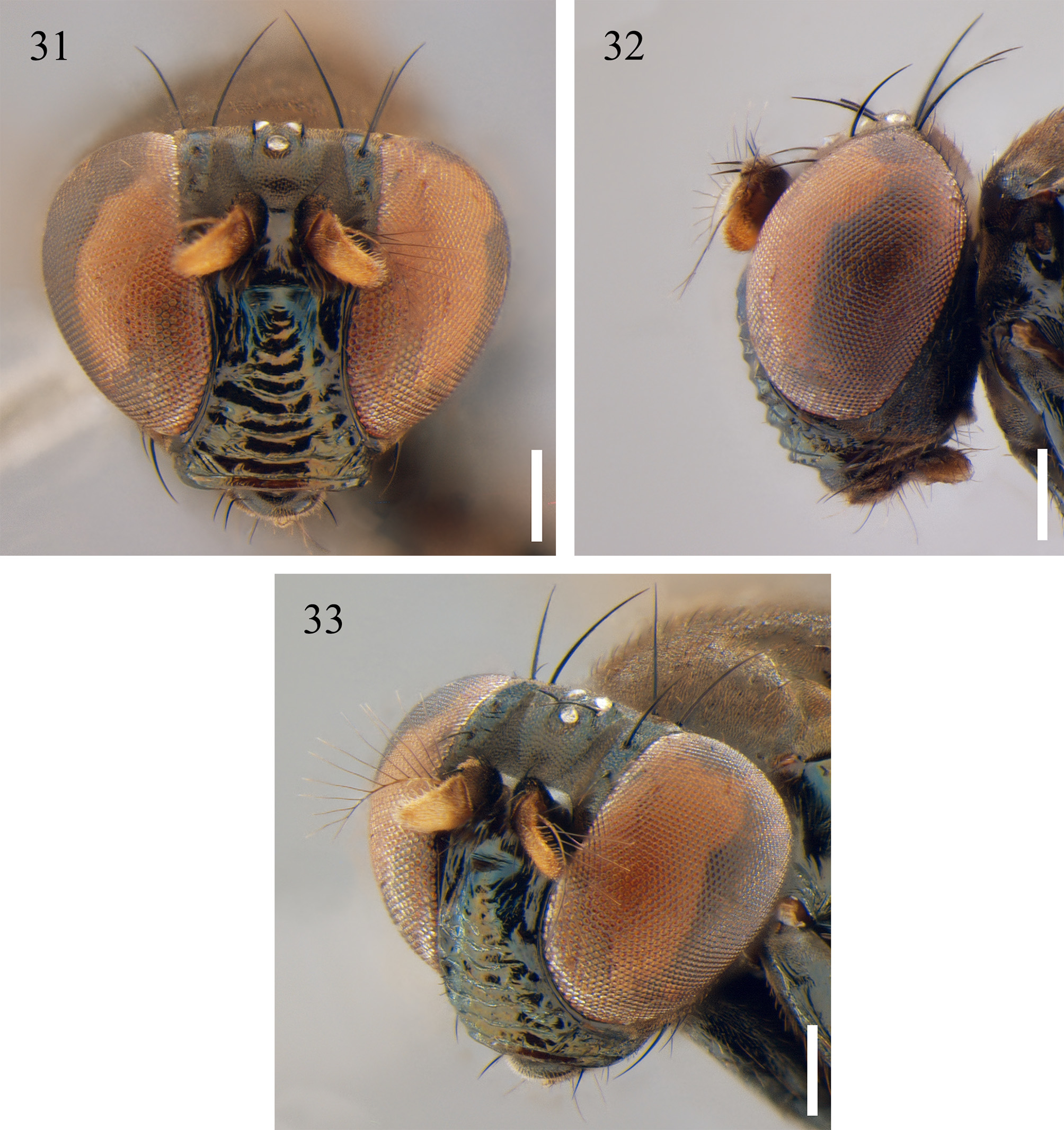
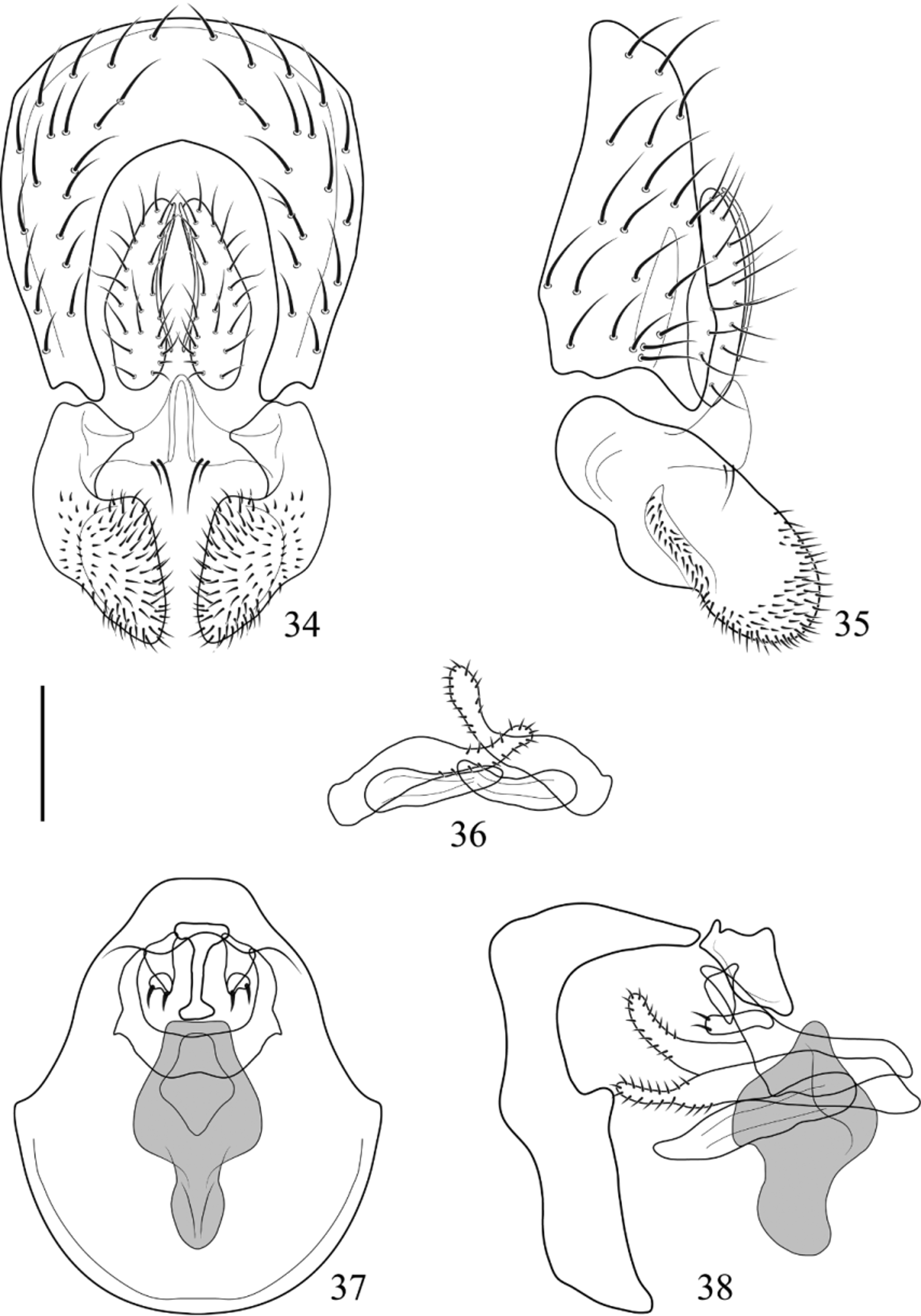
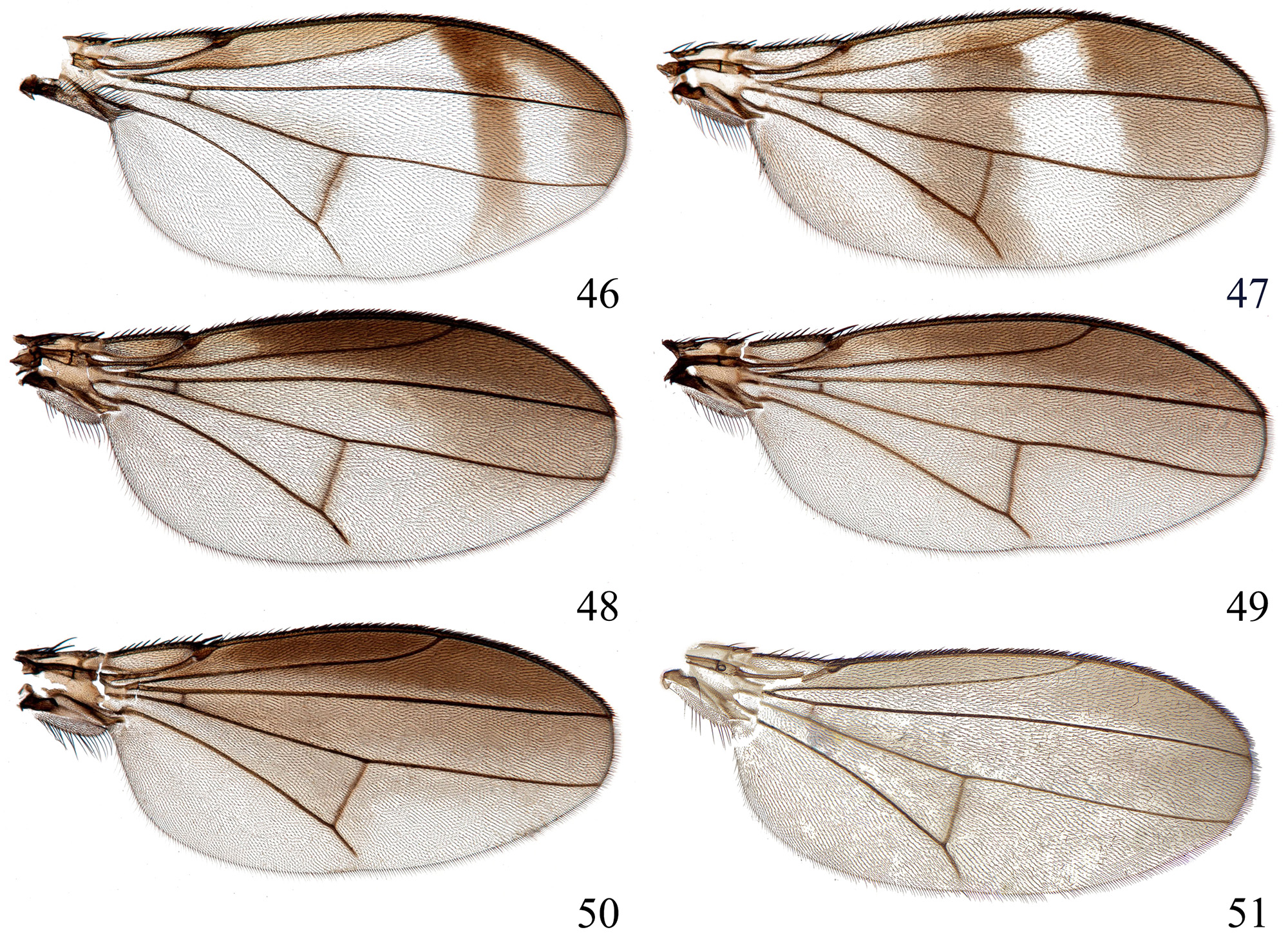
Diagnosis. This species is distinguished from congeners by the following combination of characters: Mostly shiny black; small to medium-sized shore flies, body length 1.65–3.90 mm. Head ( Figs. 31–33 View FIGURES 31 – 33 ): Frons black, moderately microtomentose, subshiny to partially dull; 1 proclinate fronto-orbital seta, about length of reclinate seta, inserted anterior of reclinate. Basal flagellomere mostly yellowish, ventrobasally darkened, length only slightly greater than height, apex broadly rounded; arista with 10–11 dorsal rays. Face black, shiny, conspicuously transversely rugose, rugosity moderately deep. Clypeus exposed, black; maxillary palpus black. Eye ratio: 0.64–64; gena-to-eye ratio: 0.14–0.16. Thorax: Mesonotum microsculptured; anepisternum black, shiny. Wing ( Fig. 47 View FIGURES 46 – 51 ) with distinct and conspicuous pattern; costal cell hyaline; cell r 1 tannish brown; apical 1 / 3 of wing brown except for broad, completely hyaline, transverse band extended posteriorly from apex of vein R 2 + 3; immediately basad of hyaline band with slightly darker, transverse, brown band; wing length 1.60–2.95 mm; costal ratio 0.88–0.92; M vein ratio 0.58–0.72. Knob of halter whitish yellow, stem yellow. Foreleg entirely black except for apical 3 tarsomeres, tarsomere 3 darkened basally; mid- and hindfemora mostly black, apex yellowish; mid- and hindtibiae and tarsi yellowish brown to yellowish, apical tarsomere brownish black. Abdomen: Tergites sparsely microtomentose to mostly bare, shiny; tergites 1–2 subequal in length; length of tergite 3 subequal to combined length of tergites 1 and 2; tergite 4 slightly longer than 3; length of tergite 5 slightly more than half that of tergite 4; tergite 5 of male trapezoidal, bare, shiny. Male terminalia ( Figs. 34–38 View FIGURES 34 – 38 ): Epandrium in posterior view ( Fig. 34 View FIGURES 34 – 38 ) setulose with short, moderately stout setulae, shape as an inverted, thick-walled U, especially dorsal portion above cercal cavity, becoming gradually narrower toward ventral apices of arms, in lateral view ( Fig. 35 View FIGURES 34 – 38 ) more or less rectangular with height about twice width, dorsal margin sloped ventrad posteriorly, widest subventrally; cercus in posterior view ( Fig. 34 View FIGURES 34 – 38 ) elongate, more or less narrowly oval, both apices rounded, in lateral view ( Fig. 35 View FIGURES 34 – 38 ) semi-hemispherical; presurstylus symmetrical, in posterior view ( Fig. 34 View FIGURES 34 – 38 ) with lateral margin curved, more or less evenly, medial margin with sub-basal, moderately wide invagination, thereafter ventrally tapered, base with 2 well-developed setulae from basal arm, in lateral view ( Fig. 35 View FIGURES 34 – 38 ) lobate, fringed with short, closely set setulae, apex rounded; postsurstylus symmetrical, in lateral view ( Fig. 38 View FIGURES 34 – 38 ) elongate, tapered irregularly to apex, apical fourth narrowed, digitiform, bearing elongate, well sclerotized, rod-like process extended subapically, process pointed apically; subepandrial plate in ventral view broadly U-shaped, basal portion nearly flat, each arm tapered to point, in lateral view ( Fig. 38 View FIGURES 34 – 38 ) robustly L-shaped; aedeagus in lateral view ( Fig. 38 View FIGURES 34 – 38 ) somewhat quadrate on basal half, apical portion as thumb-like extension, in ventral view ( Fig. 37 View FIGURES 34 – 38 ) base wide, apical portion abruptly narrowed, narrowly rounded apically; phallapodeme in lateral view ( Fig. 38 View FIGURES 34 – 38 ) triangular, in ventral view ( Fig. 37 View FIGURES 34 – 38 ) elongate, slender, Ishaped, apical crossbar longer than basal bar; pregonite in lateral view ( Fig. 38 View FIGURES 34 – 38 ) small, rod-like, bearing 2 setulae apically; postgonite in lateral view narrow, elongate, curved on apical portion, apical portion digitiform; lateral postsurstylar process enlarged, elongate, nearly parallel sided, apex with right angle at one corner, rounded at other; hypandrium in lateral view ( Fig. 38 View FIGURES 34 – 38 ) moderately deeply pocket-like, more or less elongate, rectangular, posterior margin shallowly concave on basal portion, base oriented posterior, narrowly pointed.
Type material. The holotype male is labeled PERU. Madre de Dios: Manu, Rio Manu, 250 m [,] Pakitza, 12 ° 7 'S, 70 ° 58 'W [ 11 ° 56.6 'S, 71 ° 16.9 'W], 9–23 Sep 1988 [,] Wayne N. Mathis/ USNM ENT 0 0 118303 [plastic bar code label]/ Holotype ♂ Mimapsilopa rugosa Mathis , Costa,&Marinoni USNM [red]. The holotype is double mounted (minuten in a block of plastic of plastic), is in excellent condition, and is deposited in USNM. Thirty-nine paratypes ( 22 ♂, 17 ♀; DZUP, USNM) bear the same label data as the holotype. Other paratypes are as follows: PERU. Loreto: Iquitos ( 12 km W; 0 3 ° 48.4 'S, 73 ° 20.5 'W), 16 Feb 1984, W. N. Mathis ( 1 ♂; USNM). Madre de Dios: Río Manu, Pakitza ( 5 km E; Aguajal; 11 ° 58.2 'S, 71 ° 17 'W; 250 m), 19 Sep 1988, W. N. Mathis ( 1 ♀; USNM); Río Manu, Erika (near Salvación; 12 ° 50.7 'S, 71 ° 23.3 'W; 550 m), 5–6 Sep 1988, A. Freidberg ( 6 ♂, 10 ♀; USNM).
Type locality. Peru. Madre de Dios: Río Manu, Pakitza ( 11 ° 56.6 'S, 71 ° 16.9 'W; 250 m).
Other specimens examined.— GUYANA. Conservation of Ecological Interactions and Biotic Associations ( CEIBA; ca 40 km S Georgetown; 0 6 ° 29.9 'N, 58 ° 13.1 'W), 13 Apr– 29 Aug 1994, 1997, W. N. Mathis ( 18 ♂, 16 ♀; USNM).
BRAZIL. Amazonas: Reserva Ducke ( 02° 55.8 'S, 59 ° 58.5 'W; 40 m), 5 May 2010, D. & W. N. Mathis ( 1 ♂; USNM). Bahia: “Cururipe (= Cururupe; 14 ° 51 'S, 39 °03'W), 13 Oct 1920, R. C. Shannon ( 1 ♂; USNM). Pará: Fazenda Taperinha, Santarém ( 02° 31.9 'S, 54 ° 17.7 'W), Nov 1970, Expedição Permanente da Amazônia ( 1 ♂; MZUSP).
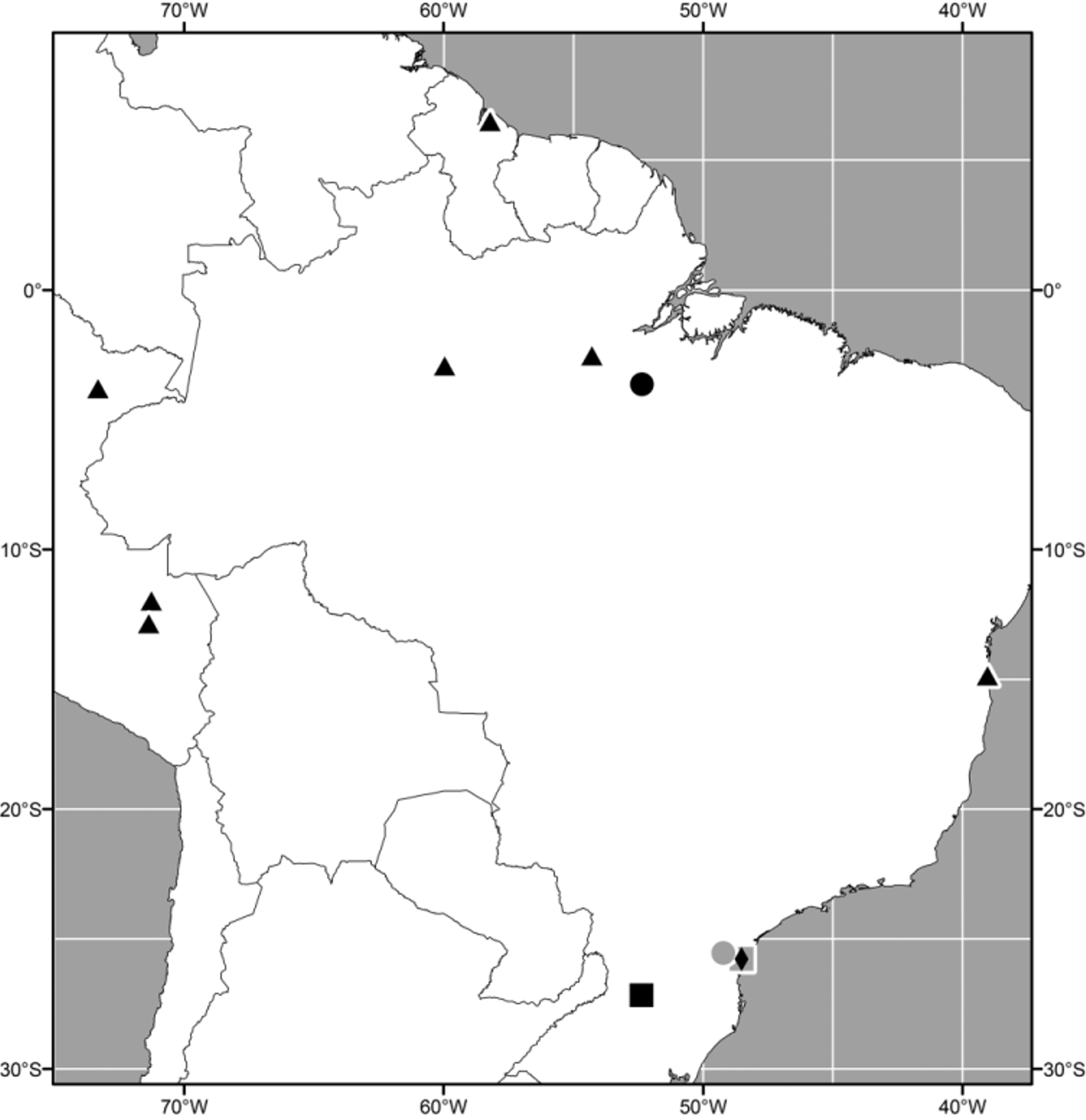
Distribution ( Fig. 52 View FIGURE 52 ). Neotropical: Brazil (Amazonas, Bahia, Pará), Guyana, Peru (Loreto, Madre de Dios).
Etymology. The species epithet, rugosa , is of Latin derivation and means wrinkled, referring to the transversely wrinkled face of this species.
Remarks. This is the most widespread species of Mimapsilopa and as would be expected for such a widespread species, there is some variation, which we interpret to be intraspecific. Although similar to other species with subapical and apical transverse bands, such as M. xingu , this species is easily distinguished from congeners, including M. xingu , by the wing pattern, facial rugosity, and yellowish, apical tarsomeres of the foreleg.
No known copyright restrictions apply. See Agosti, D., Egloff, W., 2009. Taxonomic information exchange and copyright: the Plazi approach. BMC Research Notes 2009, 2:53 for further explanation.
|
Kingdom |
|
|
Phylum |
|
|
Class |
|
|
Order |
|
|
Family |
|
|
Genus |