
Charinus bordoni ( Ravelo, 1977 ) Charinus brescoviti Giupponi & Miranda, 2016 Charinus bromeliaea Jocqué & Giupponi, 2012
|
publication ID |
https://doi.org/10.5852/ejt.2021.772.1505 |
|
publication LSID |
lsid:zoobank.org:pub:9B82A32F-0A07-47E3-8684-FED7C8EBF1E9 |
|
persistent identifier |
https://treatment.plazi.org/id/8F431375-FFB7-FFFC-A541-FEE7FC91DDDF |
|
treatment provided by |
Felipe |
|
scientific name |
Charinus bordoni ( Ravelo, 1977 ) Charinus brescoviti Giupponi & Miranda, 2016 Charinus bromeliaea Jocqué & Giupponi, 2012 |
| status |
|
Charinus bordoni ( Ravelo, 1977)
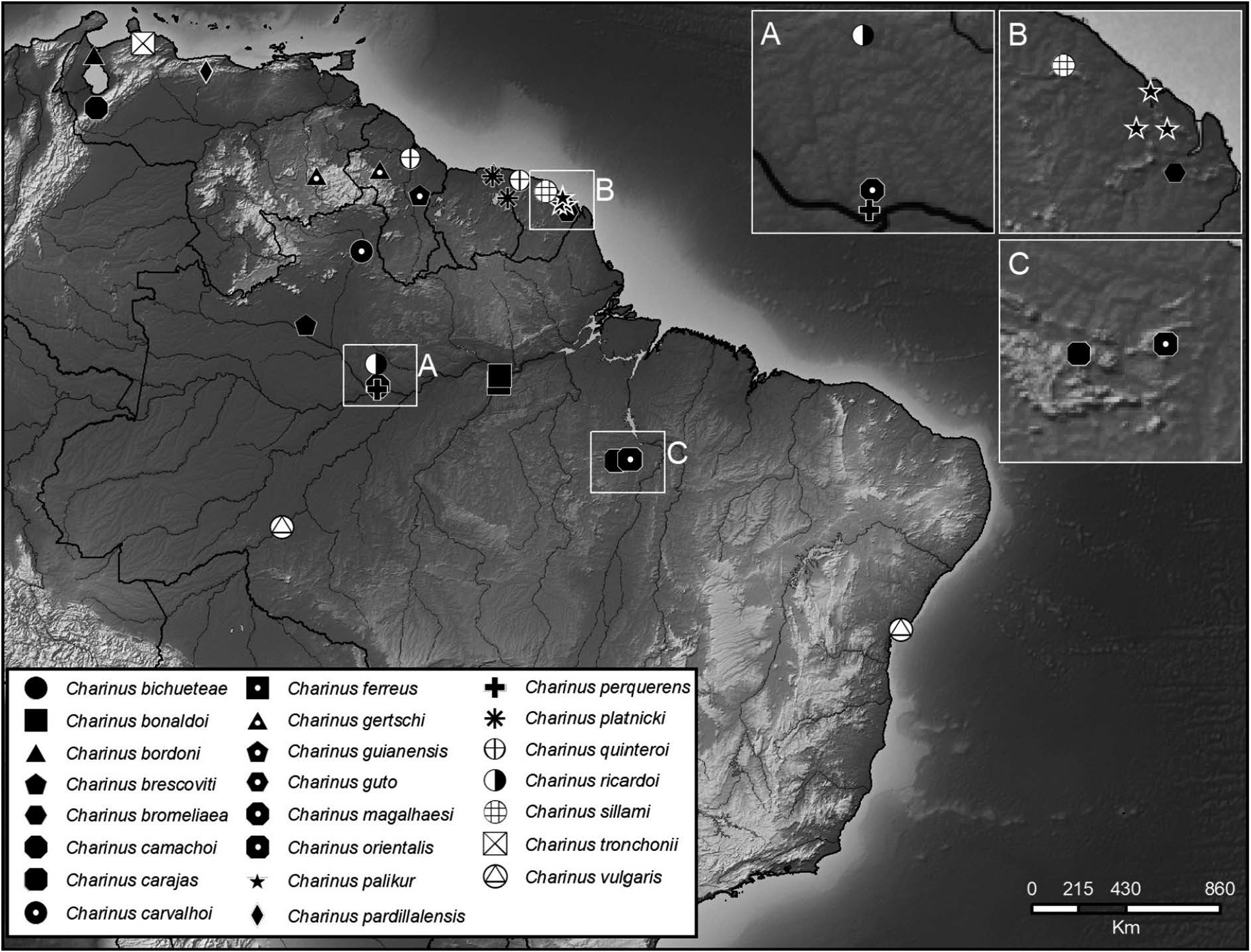
Fig. 27 View Fig ; Table 2
Speleophrynus bordoni Ravelo, 1977: 18–25 , figs 1–2, 3a–c, 4a–d.
Charinides bordoni – Quintero 1983: 28. — González-Sponga 1998: 2, map 1.
Charinus bordoni – Delle Cave 1986: 162, fig. II. — Weygoldt 1994: 242, 244. — Harvey 2003: 4. — Galán & Herrera 2006: 42, 48. — Miranda & Giupponi 2011: 66, fig. 13. — Jocqué & Giupponi 2012: 55. — Vasconcelos et al. 2013: 497. — Torres-Contreras et al. 2015: 148. — Miranda et al. 2016c: 31.
Diagnosis
Ravelo (1977) provided a diagnosis of the species in which it was compared only with Charinus tronchonii ( Ravelo, 1975) . The diagnosis is updated here based on the original description. This species may be separated from other Charinus in Amazonia and northern South America by means of the following combination of characters: median and lateral eyes absent; cheliceral claw with five teeth; tibia of leg I with 23 articles, tarsus I with “a bit more than 40 articles”; pedipalp femur with two dorsal spines and two ventral spines decreasing in size from proximal to distal; pedipalp patella with three dorsal spines and two ventral spines, and with large setiferous tubercle between spine I and distal margin; pedipalp tibia with two dorsal spines; leg IV basitibia with three articles ( Ravelo 1977 considered the leg IV basitibia to have four articles as he (and Quintero 1983) counted the distitibia as part of the basitibia); leg IV distitibia trichobothrium bc situated closer to sbf than to bf; sc and sf, series each with five trichobothria.
Etymology
Patronym honoring Carlos Bordón, founder of the Venezuelan Society of Speleology and collector of the type series ( Ravelo 1977).
Type material
Holotype VENEZUELA • ♂; Zulia, Maracaibo district, Cerro Verde Cave ; [ 10°39′16.02″ N, 71°42′53.26″ W]; MBSVE 606 [not examined]. GoogleMaps
Paratypes VENEZUELA • 1 ♂; same collection data as for holotype MBSVE 607 [not examined] GoogleMaps • 1 ♀; same collection data as for holotype; MBSVE 605 ) [not examined] GoogleMaps • 1 ♂; same collection data as for holotype; MBSVE 608 [not examined] GoogleMaps • 1 ♀; same collection data as for holotype; MBSVE 609 [not examined] GoogleMaps • 1 juv. ♀; same collection data as for holotype; MBSVE 6010 [not examined] GoogleMaps .
Measurements
See Table 2.
Distribution
Known only from the type locality.
Natural history
Charinus bordoni was found only inside caves in the aphotic zone which, in combination with the complete absence of eyes, indicates it a troglobitic species ( Ravelo 1977; Delle Cave 1986).
Remarks
Ravelo (1977) described this species in the genus Speleophrynus . Quintero (1983) revised topotypes of Speleophrynus bordoni Ravelo, 1977 and Speleophrynus tronchonii , and considered them to be Charinides based on the number of pseudo-articles in the basitibia of leg IV. Delle Cave (1986) was the first to place in doubt the classification based on the number of pseudo-articles in the basitibia of leg IV and transferred S. bordoni and S. tronchonii to Charinus .
Charinus brescoviti Giupponi & Miranda, 2016
Fig. 27 View Fig ; Table 2
Charinus brescoviti Giupponi & Miranda, 2016: 3–6 , figs 1a–e, 2a, 3a, 4a.
Diagnosis
This species may be separated from other Charinus in Amazonia and northern South America by means of the following combination of characters: tegument brownish-yellow in color; median and lateral eyes well developed; tetra- and pentasternum small, rounded; cushion-like gonopods, lateral projections directed posteriorly and internal seminal receptacles; basal spine on pedipalp tarsus large, two-thirds length of distal spine; ventral row of setae of cleaning organ with 28 setae; leg IV basitibia with two pseudo-articles; leg IV basitibia trichobothrium bt situated in proximal third; leg IV distitibia with 16 trichobothria, basal trichobothria, bf, bc and sbf, equidistant.
Etymology
Patronym honoring Dr Antônio D. Brescovit ( Giupponi & Miranda 2016).
Type material
Holotype BRAZIL • ♀; Amazonas , Piaçaba, Araçá River; [ 00°25′17.75″ S, 62°54′30.24″ W]; 18 May 1982; B. Mascarenhas leg.; IBSP 149 View Materials . GoogleMaps
Paratypes BRAZIL • 1 ♀; same collection data as for holotype; IBSP 149 View Materials GoogleMaps • 1 ♀, 1 juv.; same collection data as for holotype; MNRJ 9186 View Materials GoogleMaps .
Measurements
See Table 2.
Distribution
Known only from the type locality.
Natural history
Epigean, found close to a river.
Remarks
See Giupponi & Miranda (2016) for a comparison and discussion of this species.
Charinus bromeliaea Jocqué & Giupponi, 2012
Fig. 27 View Fig ; Table 2
Charinus bromeliaea Jocqué & Giupponi, 2012: 55–58 View Cited Treatment , figs 1–5.
Charinus bromeliaea – Vasconcelos et al. 2013: 497. — Réveillion & Maquart 2015: 190–192, fig. 1e–f. — Armas et al. 2016: 48. — Miranda et al. 2016c: 29.
Diagnosis
Based on Jocqué & Giupponi (2012), this species may be separated from other Charinus in Amazonia and northern South America by means of the following combination of characters: tegument pale yellow-brown; median eyes and median ocular tubercle present; lateral eyes well developed; pedipalp femur with three dorsal spines and three ventral spines; pedipalp patella with three dorsal spines and two ventral spines; pedipalp tibia with two small dorsal spines; tibia of leg I with 23 articles, tarsus I with 25 articles; leg IV basitibia with two pseudo-articles; leg IV distitibia trichobothrium bc situated closer to sbf than to bf; sc and sf series each with four trichobothria.
According to Jocqué & Giupponi (2012), the distitibia of leg IV possesses four trichobothria in the sc and sf series, a count otherwise observed only in C. alagoanus sp. nov., from which C. bromeliaea can be distinguished by the number of pseudo-articles on basitibia IV and number of articles on the tarsus of leg I. Jocqué & Giupponi (2012: 55) mention that the “median and lateral eyes [are] reduced in comparison to average size for the genus”, but the development of the eyes is similar to that in other species of Charinus with fully developed eyes. Jocqué & Giupponi (2012) also described the pedipalp patella C. bromeliaea as possessing five dorsal spines, but considered the distal spine and the relatively long proximal setiferous tubercle as spines in their counts, inflating the true number from three. The basitibia of leg IV consists of two pseudo-articles in C. bromeliaea , as in C. bichuetteae , C. bonaldoi , C. brescoviti , C. camachoi , C. carvalhoi sp. nov., C. pardillalensis , C. platnicki , C. quinteroi and C. ricardoi , but C. bromeliaea can be distinguished from these species, except for C. brescoviti , by the presence of median eyes and a median ocular tubercle. The sucker-like female gonopod further separates C. bromeliaea from C. brescoviti , in which the gonopod is cushion-like. Charinus bromeliaea superficially resembles C. platnicki , but is larger, light brown in color, with the basal spine of the pedipalp tibia about two-thirds the length of the medial spine, rather than about one-quarter its length, as in C. platnicki . Additionally, the distitibia of leg IV possesses four trichobothria in C. bromeliaea and five in C. platnicki .
Etymology
Noun refering to the habitat of the species, bromeliads ( Jocqué & Giupponi 2012).
Type material
Holotype FRENCH GUIANA • ♀; Savanna Roche La Virginie ; 04°11′24″ N, 52°09′ W; 20 Aug. 2008; M. Jocqué leg.; in Achmea cf. melionii bromeliads; MNRJ 9185 View Materials . GoogleMaps
Paratypes FRENCH GUIANA • 3 ♀♀; same collection data as for holotype; MNRJ 9185 View Materials GoogleMaps .
Measurements
See Table 2.
Distribution
Known only from the type locality.
Natural history
Inhabits bromeliads.
Charinus brescoviti Giupponi & Miranda, 2016
Fig. 27 View Fig ; Table 2
Charinus brescoviti Giupponi & Miranda, 2016: 3–6 , figs 1a–e, 2a, 3a, 4a.
Diagnosis
This species may be separated from other Charinus in Amazonia and northern South America by means of the following combination of characters: tegument brownish-yellow in color; median and lateral eyes well developed; tetra- and pentasternum small, rounded; cushion-like gonopods, lateral projections directed posteriorly and internal seminal receptacles; basal spine on pedipalp tarsus large, two-thirds length of distal spine; ventral row of setae of cleaning organ with 28 setae; leg IV basitibia with two pseudo-articles; leg IV basitibia trichobothrium bt situated in proximal third; leg IV distitibia with 16 trichobothria, basal trichobothria, bf, bc and sbf, equidistant.
Etymology
Patronym honoring Dr Antônio D. Brescovit ( Giupponi & Miranda 2016).
Type material
Holotype BRAZIL • ♀; Amazonas , Piaçaba, Araçá River; [ 00°25′17.75″ S, 62°54′30.24″ W]; 18 May 1982; B. Mascarenhas leg.; IBSP 149 View Materials . GoogleMaps
Paratypes BRAZIL • 1 ♀; same collection data as for holotype; IBSP 149 View Materials GoogleMaps • 1 ♀, 1 juv.; same collection data as for holotype; MNRJ 9186 View Materials GoogleMaps .
Measurements
See Table 2.
Distribution
Known only from the type locality.
Natural history
Epigean, found close to a river.
Remarks
See Giupponi & Miranda (2016) for a comparison and discussion of this species.
Charinus bromeliaea Jocqué & Giupponi, 2012
Fig. 27 View Fig ; Table 2
Charinus bromeliaea Jocqué & Giupponi, 2012: 55–58 View Cited Treatment , figs 1–5.
Charinus bromeliaea – Vasconcelos et al. 2013: 497. — Réveillion & Maquart 2015: 190–192, fig. 1e–f. — Armas et al. 2016: 48. — Miranda et al. 2016c: 29.
Diagnosis
Based on Jocqué & Giupponi (2012), this species may be separated from other Charinus in Amazonia and northern South America by means of the following combination of characters: tegument pale yellow-brown; median eyes and median ocular tubercle present; lateral eyes well developed; pedipalp femur with three dorsal spines and three ventral spines; pedipalp patella with three dorsal spines and two ventral spines; pedipalp tibia with two small dorsal spines; tibia of leg I with 23 articles, tarsus I with 25 articles; leg IV basitibia with two pseudo-articles; leg IV distitibia trichobothrium bc situated closer to sbf than to bf; sc and sf series each with four trichobothria.
According to Jocqué & Giupponi (2012), the distitibia of leg IV possesses four trichobothria in the sc and sf series, a count otherwise observed only in C. alagoanus sp. nov., from which C. bromeliaea can be distinguished by the number of pseudo-articles on basitibia IV and number of articles on the tarsus of leg I. Jocqué & Giupponi (2012: 55) mention that the “median and lateral eyes [are] reduced in comparison to average size for the genus”, but the development of the eyes is similar to that in other species of Charinus with fully developed eyes. Jocqué & Giupponi (2012) also described the pedipalp patella C. bromeliaea as possessing five dorsal spines, but considered the distal spine and the relatively long proximal setiferous tubercle as spines in their counts, inflating the true number from three. The basitibia of leg IV consists of two pseudo-articles in C. bromeliaea , as in C. bichuetteae , C. bonaldoi , C. brescoviti , C. camachoi , C. carvalhoi sp. nov., C. pardillalensis , C. platnicki , C. quinteroi and C. ricardoi , but C. bromeliaea can be distinguished from these species, except for C. brescoviti , by the presence of median eyes and a median ocular tubercle. The sucker-like female gonopod further separates C. bromeliaea from C. brescoviti , in which the gonopod is cushion-like. Charinus bromeliaea superficially resembles C. platnicki , but is larger, light brown in color, with the basal spine of the pedipalp tibia about two-thirds the length of the medial spine, rather than about one-quarter its length, as in C. platnicki . Additionally, the distitibia of leg IV possesses four trichobothria in C. bromeliaea and five in C. platnicki .
Etymology
Noun refering to the habitat of the species, bromeliads ( Jocqué & Giupponi 2012).
Type material
Holotype FRENCH GUIANA • ♀; Savanna Roche La Virginie ; 04°11′24″ N, 52°09′ W; 20 Aug. 2008; M. Jocqué leg.; in Achmea cf. melionii bromeliads; MNRJ 9185 View Materials . GoogleMaps
Paratypes FRENCH GUIANA • 3 ♀♀; same collection data as for holotype; MNRJ 9185 View Materials GoogleMaps .
Measurements
See Table 2.
Distribution
Known only from the type locality.
Natural history
Inhabits bromeliads.
Charinus bromeliaea Jocqué & Giupponi, 2012
Fig. 27 View Fig ; Table 2
Charinus bromeliaea Jocqué & Giupponi, 2012: 55–58 View Cited Treatment , figs 1–5.
Charinus bromeliaea – Vasconcelos et al. 2013: 497. — Réveillion & Maquart 2015: 190–192, fig. 1e–f. — Armas et al. 2016: 48. — Miranda et al. 2016c: 29.
Diagnosis
Based on Jocqué & Giupponi (2012), this species may be separated from other Charinus in Amazonia and northern South America by means of the following combination of characters: tegument pale yellow-brown; median eyes and median ocular tubercle present; lateral eyes well developed; pedipalp femur with three dorsal spines and three ventral spines; pedipalp patella with three dorsal spines and two ventral spines; pedipalp tibia with two small dorsal spines; tibia of leg I with 23 articles, tarsus I with 25 articles; leg IV basitibia with two pseudo-articles; leg IV distitibia trichobothrium bc situated closer to sbf than to bf; sc and sf series each with four trichobothria.
According to Jocqué & Giupponi (2012), the distitibia of leg IV possesses four trichobothria in the sc and sf series, a count otherwise observed only in C. alagoanus sp. nov., from which C. bromeliaea can be distinguished by the number of pseudo-articles on basitibia IV and number of articles on the tarsus of leg I. Jocqué & Giupponi (2012: 55) mention that the “median and lateral eyes [are] reduced in comparison to average size for the genus”, but the development of the eyes is similar to that in other species of Charinus with fully developed eyes. Jocqué & Giupponi (2012) also described the pedipalp patella C. bromeliaea as possessing five dorsal spines, but considered the distal spine and the relatively long proximal setiferous tubercle as spines in their counts, inflating the true number from three. The basitibia of leg IV consists of two pseudo-articles in C. bromeliaea , as in C. bichuetteae , C. bonaldoi , C. brescoviti , C. camachoi , C. carvalhoi sp. nov., C. pardillalensis , C. platnicki , C. quinteroi and C. ricardoi , but C. bromeliaea can be distinguished from these species, except for C. brescoviti , by the presence of median eyes and a median ocular tubercle. The sucker-like female gonopod further separates C. bromeliaea from C. brescoviti , in which the gonopod is cushion-like. Charinus bromeliaea superficially resembles C. platnicki , but is larger, light brown in color, with the basal spine of the pedipalp tibia about two-thirds the length of the medial spine, rather than about one-quarter its length, as in C. platnicki . Additionally, the distitibia of leg IV possesses four trichobothria in C. bromeliaea and five in C. platnicki .
Etymology
Noun refering to the habitat of the species, bromeliads ( Jocqué & Giupponi 2012).
Type material
Holotype FRENCH GUIANA • ♀; Savanna Roche La Virginie ; 04°11′24″ N, 52°09′ W; 20 Aug. 2008; M. Jocqué leg.; in Achmea cf. melionii bromeliads; MNRJ 9185 View Materials . GoogleMaps
Paratypes FRENCH GUIANA • 3 ♀♀; same collection data as for holotype; MNRJ 9185 View Materials GoogleMaps .
Measurements
See Table 2.
Distribution
Known only from the type locality.
Natural history
Inhabits bromeliads.
| IBSP |
Brazil,Sao Paulo, Sao Paulo, Instituto Butantan |
| MNRJ |
Brazil, Rio de Janeiro, Sao Cristovao, Universidade do Rio Janeiro, Museu Nacional |
No known copyright restrictions apply. See Agosti, D., Egloff, W., 2009. Taxonomic information exchange and copyright: the Plazi approach. BMC Research Notes 2009, 2:53 for further explanation.
|
Kingdom |
|
|
Phylum |
|
|
Class |
|
|
Order |
|
|
Family |
|
|
Genus |

Charinus bordoni ( Ravelo, 1977 ) Charinus brescoviti Giupponi & Miranda, 2016 Charinus bromeliaea Jocqué & Giupponi, 2012
| Miranda, Gustavo Silva de, Giupponi, Alessandro P. L., Prendini, Lorenzo & Scharff, Nikolaj 2021 |
Charinus brescoviti
| Giupponi A. P. L. & Miranda G. S. 2016: 6 |
Charinus bromeliaea
| Armas L. F. & Palomino-Cardenas A. C. & Castillo-Espinoza M. 2016: 48 |
| Miranda G. S. & Milleri-Pinto M. & Goncalves-Souza T. & Giupponi A. P. L. & Scharff N. 2016: 29 |
| Reveillion F. & Maquart P. O. 2015: 190 |
| Vasconcelos A. C. & Giupponi A. P. L. & Ferreira R. L. 2013: 497 |
Charinus bordoni
| Miranda G. S. & Milleri-Pinto M. & Goncalves-Souza T. & Giupponi A. P. L. & Scharff N. 2016: 31 |
| Torres-Contreras R. & Garcia D. M. A. & Armas L. F. 2015: 148 |
| Vasconcelos A. C. & Giupponi A. P. L. & Ferreira R. L. 2013: 497 |
| Jocque M. & Giupponi A. P. L. 2012: 55 |
| Miranda G. S. & Giupponi A. P. L. 2011: 66 |
| Galan C. & Herrera F. F. 2006: 42 |
| Harvey M. S. 2003: 4 |
| Weygoldt P. 1994: 242 |
| Delle Cave L. 1986: 162 |
Charinides bordoni
| Gonzalez-Sponga M. A. 1998: 2 |
| Quintero D. J. 1983: 28 |
Speleophrynus bordoni
| Ravelo P. O. 1977: 25 |