
Acanthocinini, Blanchard, 1845
|
publication ID |
https://doi.org/10.11646/zootaxa.4863.1.1 |
|
publication LSID |
lsid:zoobank.org:pub:66DCE172-2486-450B-AD2C-2D80F573348E |
|
persistent identifier |
https://treatment.plazi.org/id/7E7087AC-FFD2-FFD2-6CBE-FCD843CE304B |
|
treatment provided by |
Plazi |
|
scientific name |
Acanthocinini |
| status |
|
Key to South American genera of Acanthocinini without erect setae on elytral surface
1. Metafemora remarkably swollen, and elytra without dorsal carina ( Fig. 1 View FIGURES 1–15. 1 )....................... Megamiros Audureau, 2013 – Metafemora not notably swollen or swollen but elytra with dorsal carina.............................................. 2
2(1). Each elytron with two or three well-marked carinae............................................................ 3 – Each elytron with one carina, lateral or dorsal (sometimes, dorsal carina slightly marked), or lacking carina.................. 7
3(2). Each elytron with one dorsal carina ( Fig. 2 View FIGURES 1–15. 1 ).......................................... Nealcidion Monné, 1977 (part) – Each elytron with two or more dorsal carinae.................................................................... 4
4(3). Sides of the prothorax lacking tubercle or with rounded tubercle ( Fig. 3 View FIGURES 1–15. 1 )................... Nealcidion Monné, 1977 (part) – Sides of the prothorax with large, conical tubercle................................................................ 5
5(4). Elytral apex oblique, outer angle strongly spiniform ( Fig. 7 View FIGURES 1–15. 1 )............................... Tropidocoleus Monné, 2009 – Elytral apex rounded or truncate, unarmed...................................................................... 6
6(5). Centrobasal crest of the elytra with dense setae ( Figs. 8–9 View FIGURES 1–15. 1 )............................... Xylergatoides Gilmour, 1962 – Centrobasal crest of the elytra (when distinct) not densely setose ( Figs. 10–11 View FIGURES 1–15. 1 )................ Lagocheirus Dejean, 1835 (part)
7(2). Each elytron with two large spiniform projections on posterior half ( Figs. 13–14 View FIGURES 1–15. 1 )................ Beloesthes Thomson, 1864 – Elytra without large spiniform projections on posterior half......................................................... 8
8(7). Elytra with both, centrobasal crest and humeral carina.......................................................... 9 – Elytra with centrobasal crest and without humeral carina, or with humeral carina and without centrobasal crest, or without both. 15
9(8). Sides of the prothorax rounded or with obtuse protuberance..................................................... 10 – Sides of the prothorax with distinct acute tubercle............................................................... 11
10(9). Elytra with or without distinct humeral carina........................................ Nealcidion Monné, 1977 (part) – Elytra with distinct humeral carina ( Fig. 15 View FIGURES 1–15. 1 )............................................ Lathroeus Thomson, 1864 (part)
Note: Problematic group of species needing full revision for eventual separation
11(9). Centrobasal crest of the elytra longer than metatarsomere I..................................................... 12 – Centrobasal crest of the elytra shorter or as long as metatarsomere I................................................. 13
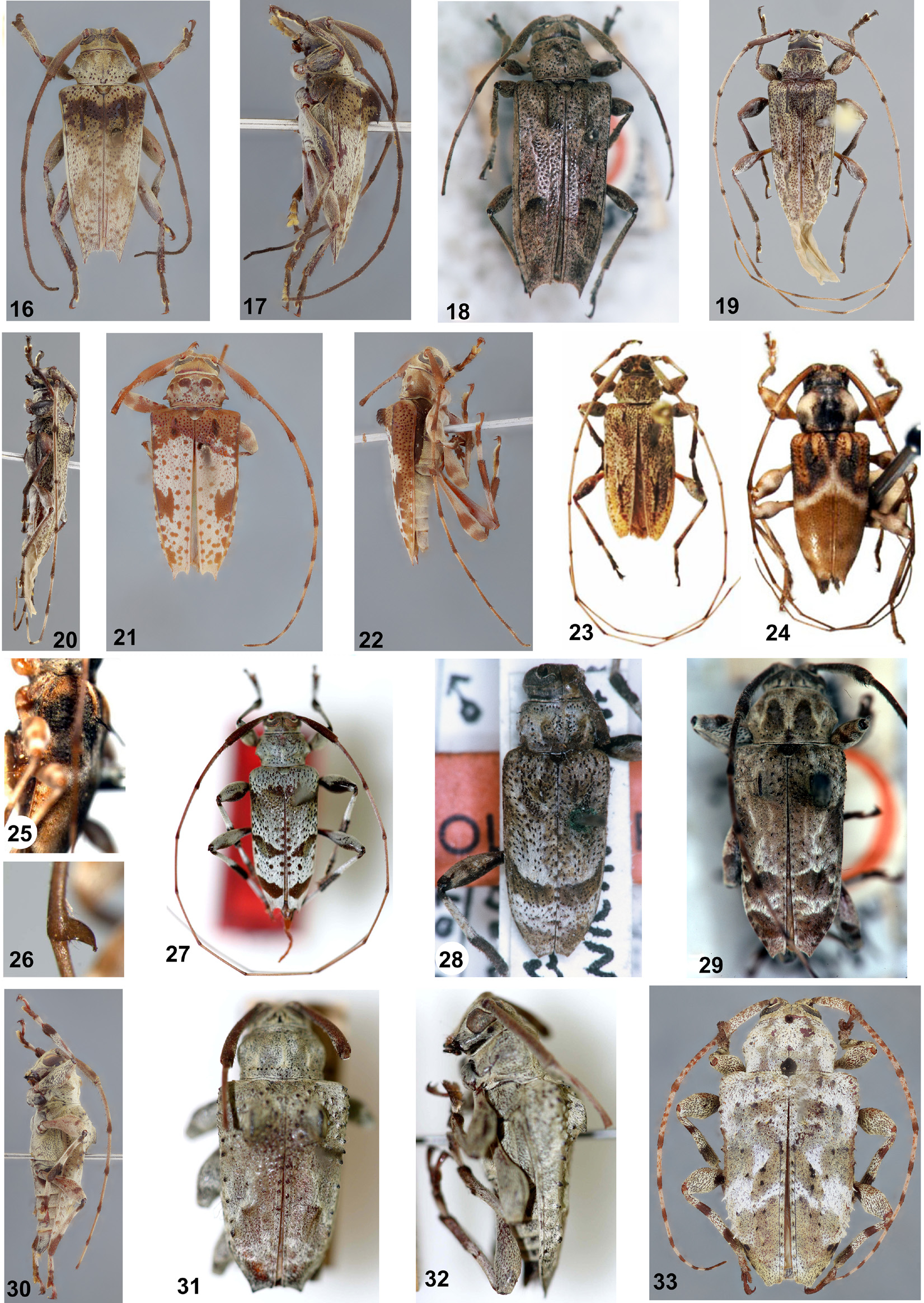
12(11). Centrobasal crest of the elytra projected backward at its superior apex ( Figs. 16–17 View FIGURES 16–33. 16–17 )... Acanthodoxus Martins & Monné, 1974 – Centrobasal crest of the elytra projected at its apex ( Figs. 18–20 View FIGURES 16–33. 16–17 )................................ Cleodoxus Thomson, 1864
13(11). Lateral tubercles of the prothorax with blunt apex................................... Lathroeus Thomson, 1864 (part) – Lateral tubercles of the prothorax with acute apex............................................................... 14
14(13). Prothorax rounded laterally between anterolateral angles and lateral tubercle ( Figs. 21–22 View FIGURES 16–33. 16–17 )................................................................................................. Tropidozineus Monné & Martins, 1976
– Prothorax with sides straight or nearly so between anterolateral angles and lateral tubercle ( Fig. 23 View FIGURES 16–33. 16–17 )............................................................................................... Paracleodoxus Monné & Monné, 2010
15(8). Elytra with centrobasal crest or distinct gibbosity............................................................ 16
– Elytra without centrobasal crest or distinct gibbosity............................................................. 29
16(15). Elytra with a pointed paintbrush-shaped centrobasal crest, with long setae on top ( Figs. 24–26 View FIGURES 16–33. 16–17 )... Odontozineus Monné, 2009
– Centrobasal crest or gibbosity of the elytra wider, with setae on top shorter or absent.................................... 17
17(16). Apex of the centrobasal crest of the elytra projected backward................................................. 18
– Apex of the centrobasal crest of the elytra not projected backward, or elytra with gibbosity............................... 20
18(17). Sides of prothorax with distinct tubercle, acute at apex ( Figs. 27–28 View FIGURES 16–33. 16–17 )....................... Hamatastus Gilmour, 1957
– Sides of prothorax without tubercle or, at most, with rounded protuberance........................................... 19
19(18). Elytra about as long as twice the width across humeri ( Fig. 29–30 View FIGURES 16–33. 16–17 )........................... Anisolophia Melzer, 1934
– Elytra distinctly shorter than twice the width across humeri ( Figs. 31–32 View FIGURES 16–33. 16–17 )............................. Pucallpa Lane, 1959
20(17). Mesoventral process with tubercle ( Figs. 33–34 View FIGURES 16–33. 16–17 View FIGURES 34–50. 34 )........................................ .. Erphaea Erichson, 1847
– Mesoventral process without tubercle......................................................................... 21
21(20). Centrobasal crest of the elytra transverse ( Fig. 35 View FIGURES 34–50. 34 )........................................ Amniscites Gilmour, 1957
– Centrobasal crest or gibbosity of the elytra longitudinal........................................................... 22
22(21). Scape with spiniform projection at inner apex ( Fig. 36 View FIGURES 34–50. 34 )................................. Alcathousiella Monné, 2005
– Scape not spiniform at apex................................................................................. 23
23(22). Antennomere III with spiniform projection in males (in some species with dense set of setae on inner side) ( Figs. 37–38 View FIGURES 34–50. 34 )................................................................................... Xenocona Gilmour, 1960
– Antennomere III without projection in both sexes.................................................................24
24(23). Lateral tubercle of the prothorax triangular, not directed backward..............................................25
– Lateral tubercle of the prothorax spiniform, directed backward..................................................... 28
25(24). Metafemora slender in both sexes, distinctly surpassing elytral apex in male ( Figs. 39–42 View FIGURES 34–50. 34 )................................................................................................. Paranisopodus Monné & Martins, 1976
– Metafemora stouter and not surpassing elytral apex in both sexes................................................... 26
26(25). Apex of the elytra with outer angle not spiniform ( Figs. 43–47 View FIGURES 34–50. 34 )............................. Lophopoeum Bates, 1863
– Apex of the elytra with outer angle spiniform or distinctly projected................................................. 27
27(26). Scape clavate ( Figs. 48–49 View FIGURES 34–50. 34 )....................................................... Sympagus Bates, 1881 (part)
– Scape not clavate ( Fig. 50 View FIGURES 34–50. 34 )............................................................ Trypanidius Blanchard, 1847
Note: Currently, Trypanidius includes species with different elytral apex, with or without erect setae on elytra, with or without centrobasal crest, mesoventral process with or without tubercles, etc. Hence, only the type species of Trypanidus is considered here.
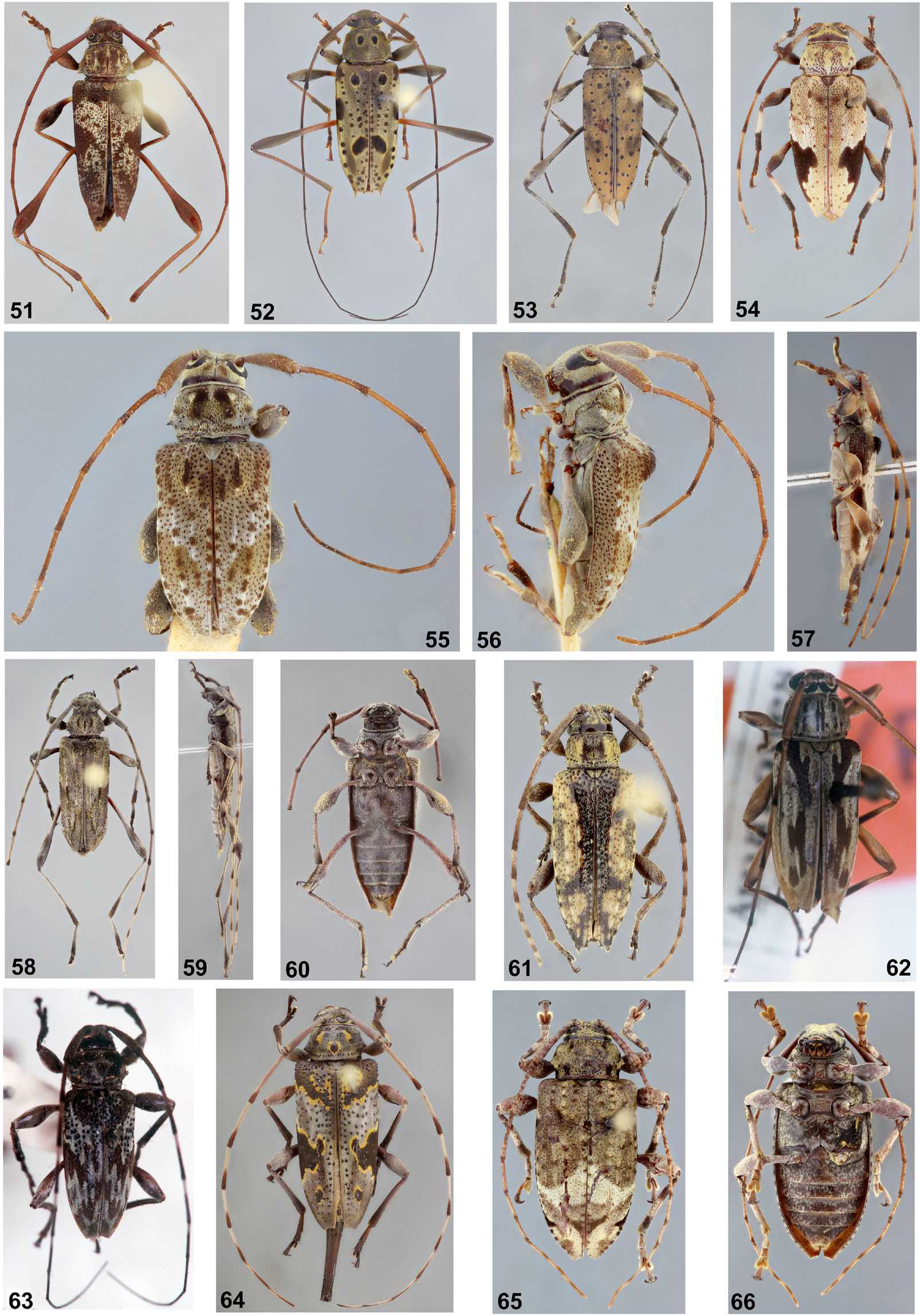
28(24). Centrobasal crest of the elytra gibbosity-shaped, without erect setae ( Figs. 51–53 View FIGURES 51–66. 51 )............... Anisopodus White, 1855
– Centrobasal crest of the elytra narrowed, elevated, with erect setae ( Figs. 54–57 View FIGURES 51–66. 51 )................... Sternacutus Gilmour, 1961
Note 1: Anisopodus is a genus encompassing species belonging to different genera (different pronotal and metafemoral shapes; with or without humeral carina; with or without projections in some antennomeres, etc.). Therefore, it is only possible to include the type species of the genus in the key.
Note 2: Sternacutus , due to the different shape of the scape, metafemora, and body width of the included species, probably includes more than one genus.
29(15). Lateral tubercle of the prothorax wide, truncate or bifid at apex ( Fig. 58–60 View FIGURES 51–66. 51 )............. Tropanisopodus Tippmann, 1960
– Lateral tubercle of the prothorax absent or with apex neither truncate nor bifid........................................ 30
30(29). Scape with modifications.............................................................................. 31
– Scape without modifications................................................................................. 33
31(30). Scape notched on the basal inner side, lacking apical cicatrix ( Fig. 61 View FIGURES 51–66. 51 )...................... Periestola Breuning, 1943
– Scape not notched, with apical cicatrix........................................................................ 32
32(31). Elytra with humeral carina ( Fig. 62 View FIGURES 51–66. 51 )................................................. Nyssocarinus Gilmour, 1960
– Elytra without humeral carina ( Figs. 63–64 View FIGURES 51–66. 51 )...................................................... Hylettus Bates, 1864
33(30). Sides of the prothorax rounded, parallel or divergent backwards (sometimes, with slightly distinct, small protubercance on posterior half)....................................................................................... 34
– Sides of the prothorax with distinct projection or tubercle on posterior half (sometimes on posterolateral angle).............. 39
34(33). Elytra with granules ( Fig. 65–66 View FIGURES 51–66. 51 )............................................... Leptostylus LeConte, 1852 (part)
– Elytra without granules.................................................................................... 35
35(34). Elytra carinate dorsally ( Figs. 67–68 View FIGURES 67–81. 67 )................................................. Cobelura Erichson, 1847
– Elytra not carinate dorsally.................................................................................. 36
36(35). Prothorax distinctly conical frustum-shaped (fig.69)................................ Colobeutrypanus Tippmann , 195l
– Prothorax not distinctly conical frustum-shaped................................................................. 37
37(36). Ovopositor longer than basal width of the prothorax ( Figs. 70–71 View FIGURES 67–81. 67 )............................. Toronaeus Bates, 1864
– Ovopositor distinctly shorter than basal width of the prothorax..................................................... 38
Note: There is no realiable feature separating males of Toronaeus and Stenolis .
38(37). Frons quadrate ( Figs. 48–49 View FIGURES 34–50. 34 )...................................................... Sympagus Bates, 1881 (part)
– Frons transverse ( Fig. 72 View FIGURES 67–81. 67 ).................................................................... Stenolis Bates, 1864
39(33). Prothorax with the lateral tubercles placed on posterolateral angles or nearly so................................... 40
– Prothorax with lateral tubercles placed medially or on posterior third before posterolateral angles.......................... 41
40(39). Male antennae with internal projection on apex of some antennomeres, or with this area distinctly tumid ( Figs. 74– 75 View FIGURES 67–81. 67 )…......……..…………….. Pattalinus Bates, 1881
– Male antennae without internal projection on apex of the antennomeres ( Figs. 76–77 View FIGURES 67–81. 67 ).............. Lepturges ( Lepturges) (part)
Note: Females of Lepturges ( Lepturges) do not differ from those of Pattalinus
41(39). Antennae 12-segmented ( Fig. 78 View FIGURES 67–81. 67 )......................................... Longilepturges Monné & Monné, 2011
– Antennae 11-segmented.................................................................................... 42
42(41). Profemora in male strongly dilated; female (only from South America ) with profemora longer than than meso- and metafemora, or scape with apical projection, or head strongly narrowed behind eyes.......................................... 43
– Male and females with other features......................................................................... 44
43(42). Profemora in male with ventral spine ( Fig. 79 View FIGURES 67–81. 67 ); female with apical projection on apex of scape or with profemora distinctly longer than meso- and metafemora ( Fig. 79 View FIGURES 67–81. 67 )........................................... Tomrogersia Fragoso, 1980
– Profemora in male without ventral spine ( Fig. 80 View FIGURES 67–81. 67 ); female without apical projection on scape and profemora not distinctly longer than meso- and metafemora ( Figs. 80–81 View FIGURES 67–81. 67 ).................................................. Neseuterpia Villiers, 1980
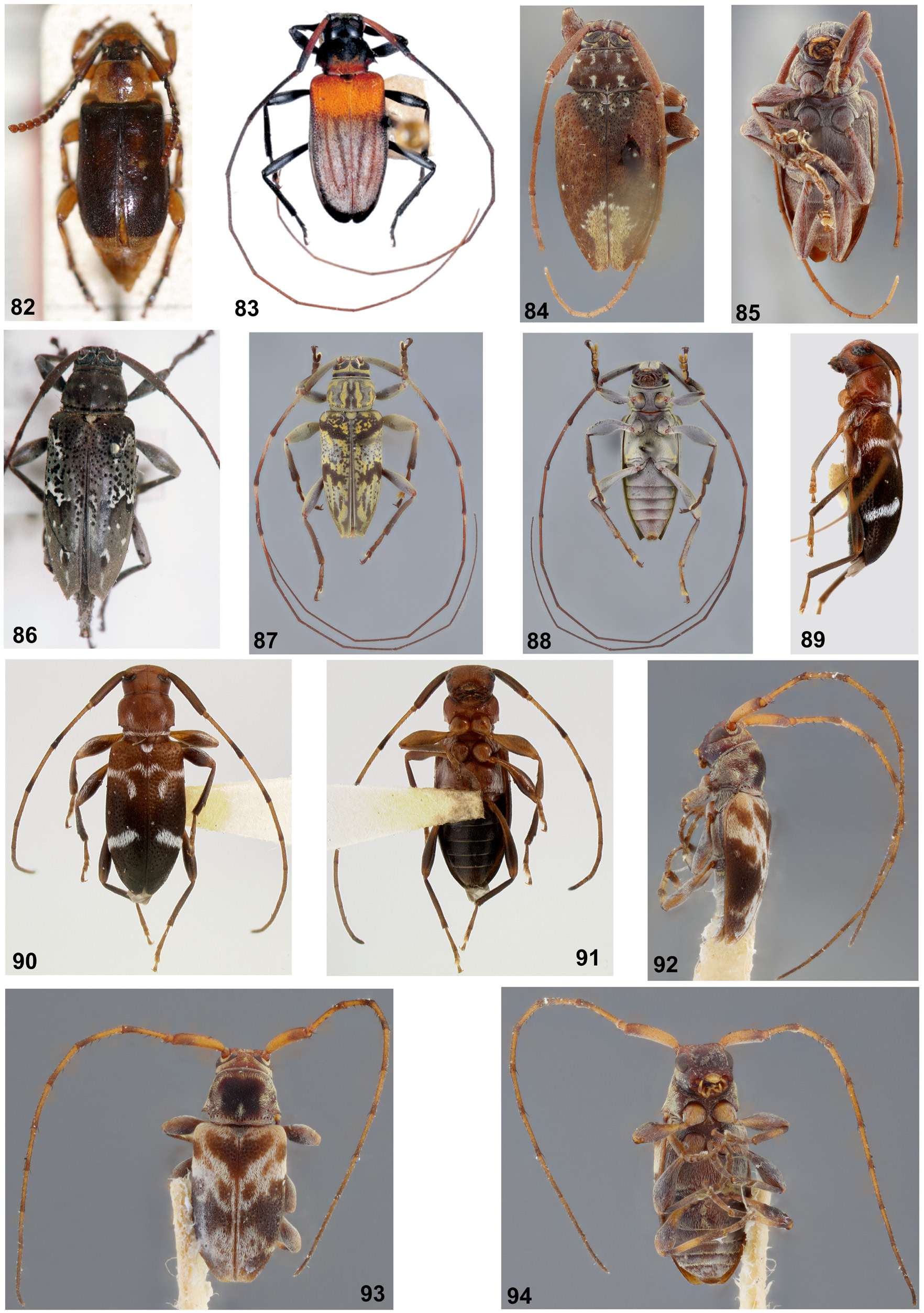
44(42). Antennomeres IV–XI moniliform ( Fig. 82 View FIGURES 82–94. 82 )............................................ Paratenthras Monné, 1998
– Antennomeres IV–XI not moniliform.......................................................................... 45
45(44). Elytra bicolorous, with basal area orangish and remaining surface dark ( Fig. 83 View FIGURES 82–94. 82 )... .. Alloeomorphus Monné & Monné, 2011
– Elytra with different color pattern............................................................................ 46
46(45). Lateral tubercle of the prothorax placed near posterolateral angle (closer to posterolateral angle than middle of the prothorax).................................................................................................. 47
– Lateral tubercle of the prothorax placed about middle or closer to middle than posterolateral angle......................... 55
47(46). Mesoventral process about as wide as mesocoxal cavity...................................................... 48
– Mesoventral process distinctly narrower than mesocoxal cavity.................................................... 49
48(47). Body stout, elytra shorter than twice the humeral width ( Figs. 84–85 View FIGURES 82–94. 82 ).......................... Carphontes Bates, 1881
– Body slender, elytra longer than twice the humeral width (South American species) ( Fig. 86–87 View FIGURES 82–94. 82 ).. Nyssodrysternum Gilmour, 1960
49(47). Transverse basal sulcus of the pronotum extends laterally behind the lateral tubercles of the prothorax................. 50
– Transverse basal sulcus of the pronotum does not extends laterally behind the lateral tubercles of the prothorax.............. 51
50(49). Lower eye lobes smaller than genae ( Fig. 89 View FIGURES 82–94. 82 )...................................... Pseudolepturges Gilmour, 1957
– Lower eye lobes at least as long as genae ( Fig. 92 View FIGURES 82–94. 82 )......................................... Urgleptes Dillon, 1956 (part)
Note: The separation between these two genera is problematic because Urgleptes includes several species with variable features.
51(49). Mesoventral process very narrow, usually narrower than 1/4 of the width of mesocoxal cavity ( Fig. 77 View FIGURES 67–81. 67 )..................................................................................... Lepturges ( Lepturges) Bates, 1863 (part)
– Mesoventral process at least as wide as 1/3 the width of mesocoxal cavity............................................ 52
52(51). Lateral tubercle of the prothorax very small ( Figs. 95–97 View FIGURES 95–109. 95 )............................... Nyssodrysilla Gilmour, 1962
– Lateral tubercle of the prothorax proportionally large............................................................. 53
53(52). Metatarsomere I at most as long as II and III together ( Fig. 98 View FIGURES 95–109. 95 )……………...…. ……………………………………………… …………………... Atrypanius Bates, 1864
– Metatarsomere I longer than II and III together.................................................................. 54
54(53). Elytra without humeral carina ( Figs. 100–101 View FIGURES 95–109. 95 )........................................... Eucharitolus Bates, 1885
– Elytra with humeral carina ( Figs. 102, 104 View FIGURES 95–109. 95 )............................................... Hyperplatys Haldeman, 1847
55(46). Apex of lateral tubercles of the prothorax spiniform......................................................... 56
– Apex of lateral tubercles of the prothorax different, not spiniform................................................... 57
56(55). General color orangish ( Fig. 106 View FIGURES 95–109. 95 )........................................... Luteolepturges Monné & Monné, 2012
– General color dark ( Fig. 107 View FIGURES 95–109. 95 ).......................................................... Lophopoenopsis Melzer, 1931
57(55). Antennomere III distinctly shorter than scape (fig. 108)......................... Trypanidiellus Monné & Delfino, 1980
– Antennomere III at most slightly shorter than scape.............................................................. 58
58(57). Elytra at least as long as twice the humeral width ( Fig. 109 View FIGURES 95–109. 95 )………………….… ……………………………………………… ………………. Eutrypanus Erichson, 1847
– Elytra shorter than twice the humeral width.................................................................... 59
59(58). Humeri granulated ( Figs. 10–12 View FIGURES 1–15. 1 )................................................ Lagocheirus Dejean, 1835 (part)
– Humeri not granulated..................................................................................... 60
60(59). Elytra with granules or not smooth ( Fig. 65 View FIGURES 51–66. 51 )...................................... Leptostylus LeConte, 1852 (part)
– Elytra without granules, smooth (not considering dorsal carina when present)......................................... 61
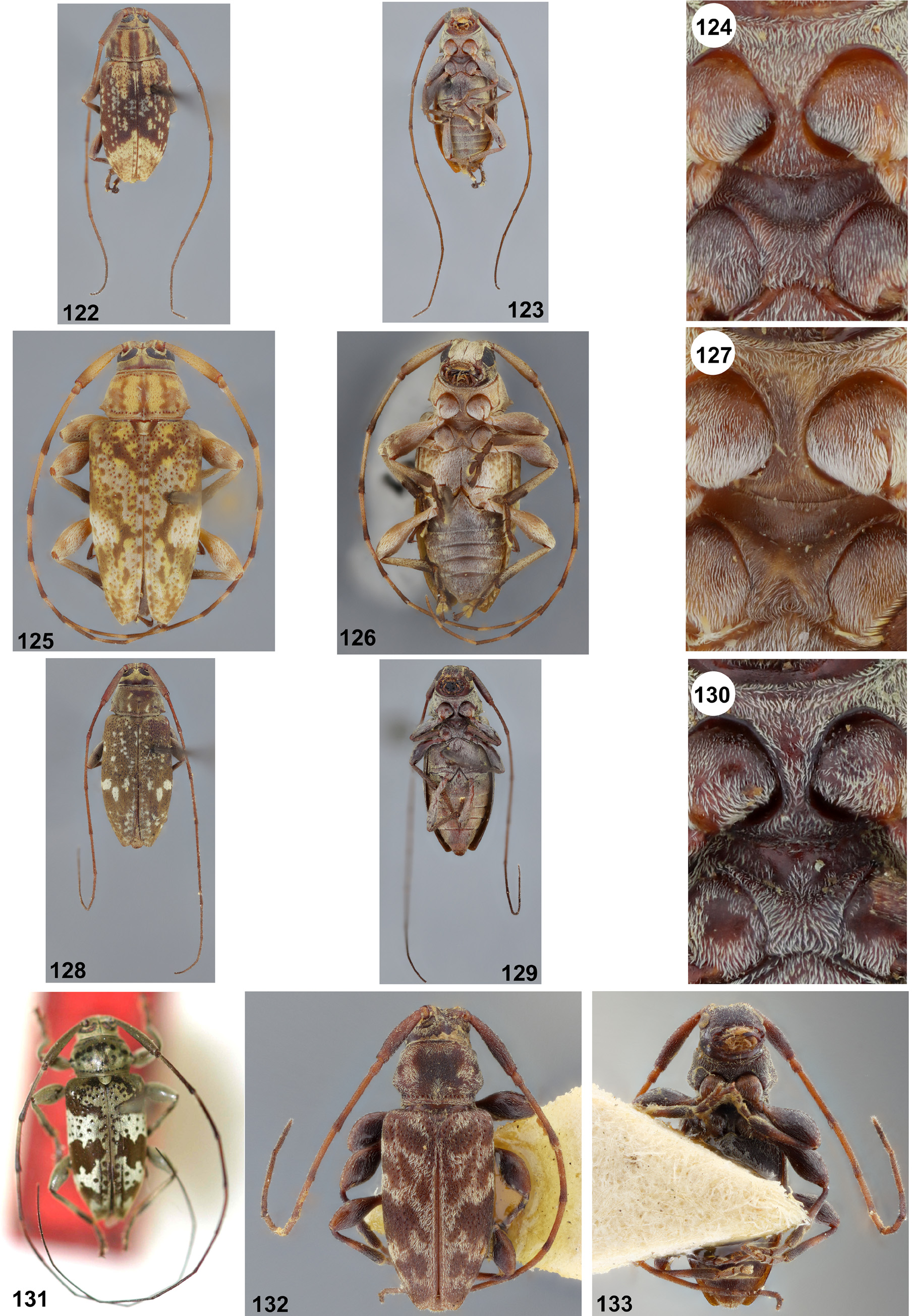
61(60). Elytra with longitudinal dorsal carina ( Fig. 131 View FIGURES 122–133. 122–124 )........................................ Atelographus Melzer, 1927
– Elytra without longitudinal dorsal carina ( Fig. 132 View FIGURES 122–133. 122–124 ).............................................. Nanustes Gilmour, 1960




No known copyright restrictions apply. See Agosti, D., Egloff, W., 2009. Taxonomic information exchange and copyright: the Plazi approach. BMC Research Notes 2009, 2:53 for further explanation.
|
Kingdom |
|
|
Phylum |
|
|
Class |
|
|
Order |
|
|
Family |