
Megaselia fujiokai, Hartop, Emily A., Brown, Brian V. & Disney, R. Henry L., 2015
|
publication ID |
https://dx.doi.org/10.11646/zootaxa.3941.4.1 |
|
publication LSID |
lsid:zoobank.org:pub:0282A923-893A-45BC-941A-6CDECBE36618 |
|
persistent identifier |
https://treatment.plazi.org/id/03FD8784-FFB0-FFEF-C5FA-FEE8FBF2FBF2 |
|
treatment provided by |
Plazi |
|
scientific name |
Megaselia fujiokai |
| status |
new species |
Megaselia fujiokai new species (Figs. 10, 42, 72, 102)
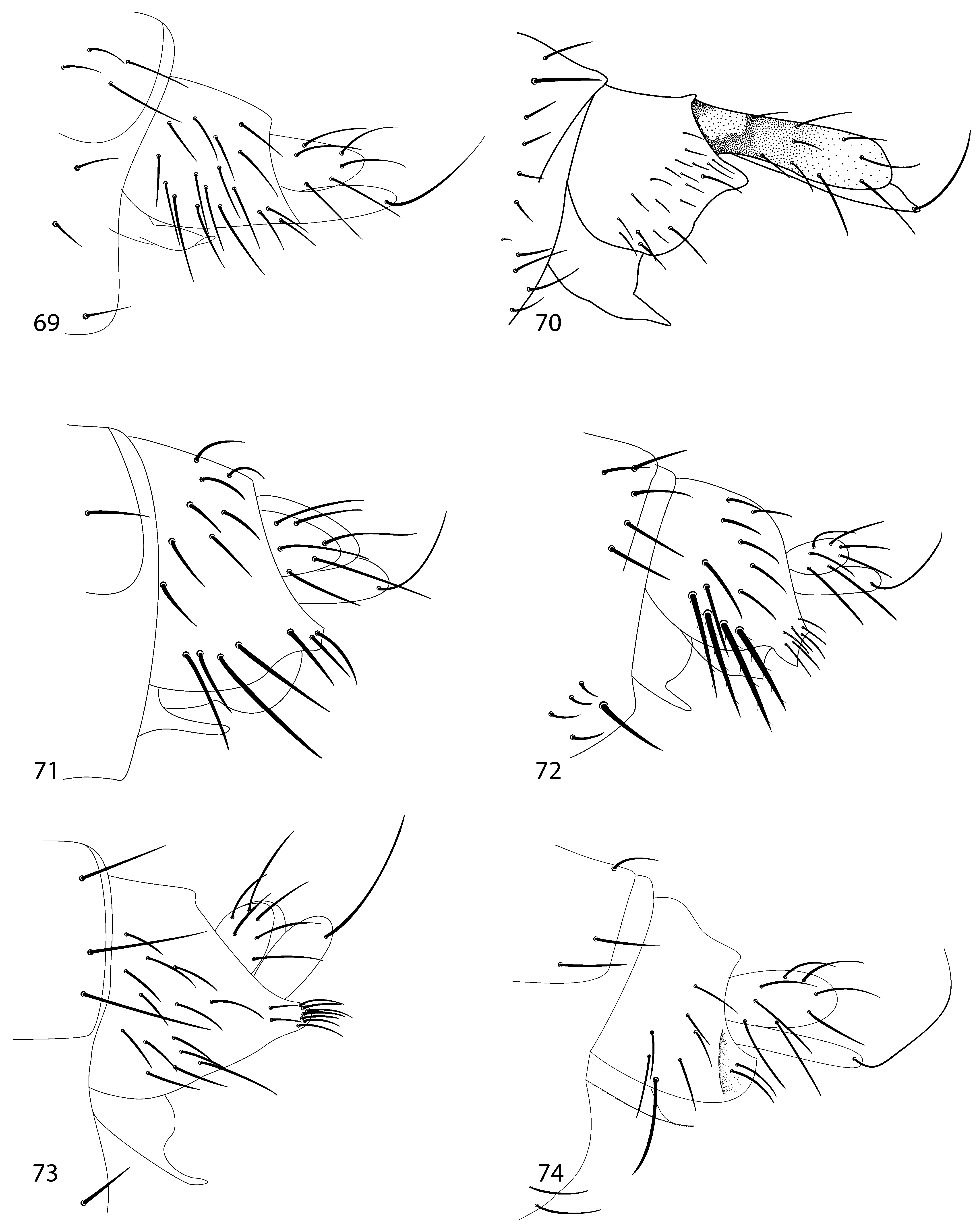
Diagnosis. Male. In the group VIII key of Borgmeier ( 1966), M. fujiokai keys to M. seticerca Borgmeier from which it differs in numerous ways. Most easily, M. fujiokai has a large, spheroid epandrium with medium hypoproct hairs ( Fig. 72 View FIGURES 69 – 74 ) in contrast to the medium sized epadrium with minute hypoproct hairs of M. seticerca . Additionally, M. fujiokai has 4 alular setae compared to the 3 on M. seticerca ( Fig. 42 View FIGURES 33 – 42 ).
Description. See Table 3.
Distribution. Los Angeles, California ( USA).
Etymology. Named in honor of Ray Fujioka, host of BioSCAN site 8.
Biology. Unknown.
Holotype. ♂, USA: CALIFORNIA: Los Angeles, Elysian Park, 3–10.V. 2014, Harding, Malaise trap ( LACM 329778)
Paratypes. 2 ♂, USA: CALIFORNIA: Los Angeles, Eagle Rock, 3–10.V. 2014, Keller, Malaise trap ( LACM 329779, LACM 329780), 2 ♂, USA: CALIFORNIA: Los Angeles, Atwater Village, 2–10.IV. 2014, Higgins, Malaise trap ( CUMZ).
Additional Material Examined. USA: CALIFORNIA: Los Angeles: Exposition Park, University Park, Los Feliz, Silverlake, Jefferson Park, Koreatown, Glendale, Elysian Park, Gardena, Hollywood, Glendale, Larchmont, Carthay, Burbank, Echo Park, Atwater Village, Eagle Rock, Pico-Union, Mid-Wilshire, Glassell Park, Highland Park, Mount Washington, 230 ♂, I–V. 2014, Maliase trap ( LACM, MCZC, USNM).

No known copyright restrictions apply. See Agosti, D., Egloff, W., 2009. Taxonomic information exchange and copyright: the Plazi approach. BMC Research Notes 2009, 2:53 for further explanation.