
Bebelis picta Pascoe, 1875
|
publication ID |
https://doi.org/10.11646/zootaxa.5092.4.1 |
|
publication LSID |
lsid:zoobank.org:pub:DC9F2DA8-DC30-454A-BAE8-D311DFEF958D |
|
persistent identifier |
https://treatment.plazi.org/id/03F12B63-046C-0D78-7591-FF1E79CDFCC2 |
|
treatment provided by |
Plazi |
|
scientific name |
Bebelis picta Pascoe, 1875 |
| status |
|
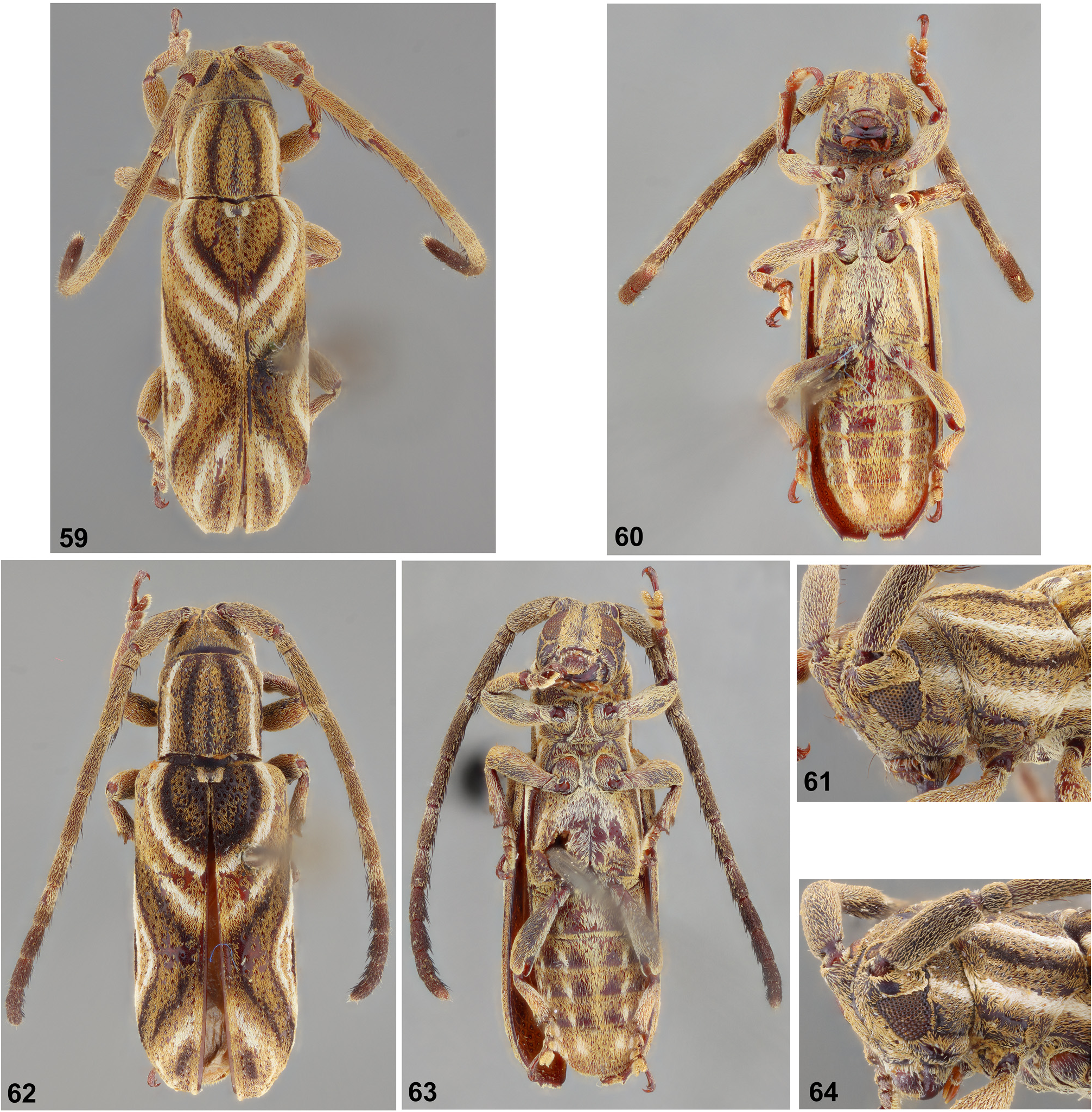
( Figs 59–64 View FIGURES 59–64 )
Bebelis picta Pascoe, 1875: 73 .
Dorcasta obtusa Bates, 1885: 372 .
Dorcasta schwarzi Fisher, 1947b: 37 ; Bruner, 1951: 86; Zayas, 1975: 219;. Syn. nov.
Bebelis schwarzi ; Breuning, 1971: 242; Monné & Giesbert, 1994: 186 (checklist); Monné, 1994: 11 (cat.); 2005: 293 (cat.); Peck, 2005: 175 (distr.); Monné & Hovore, 2006: 225 (checklist); Thomas & Turnbow, 2007: 586 (distr.); Lingafelter et al., 2014: 316; Devesa et al., 2019: 58.
Bebilis schwarzi ; Chemsak et al., 1992: 115 (distr.; misspelling); Turnbow & Thomas, 2008; 16 (distr.; misspelling).
Remarks. Pascoe (1975) described Bebelis picta based on syntypes from Brazil ( Rio de Janeiro). Bates (1885) described Dorcasta obtusa based on syntypes from Mexico and Guatemala. Gahan (1895) recorded D. obtusa from Saint Vincent Island ( Saint Vincent and the Grenadines), in the West Indies, and Leng & Mutchler (1914) reported it from Cuba. Fisher (1947b) described D. schwarzi from Cuba and reported that it differs from D. obtusa because it is possible to see in the figure provided by Bates (1885) that the former has black oblique bands near elytral apex, while they are absent in the latter. However, the oblique dark band on the posterior area of the elytra may or may not be distinct, and is present at least in a syntype of D. obtusa . This band is also present in a syntype of B. picta . Breuning (1971) synonymized D. obtusa with B. picta , and separated it from D. schwarzi as follows in his key (translated): “eyes strongly emarginate,” leading to B. schwarzi ; and “eyes subdivided,” leading to B. picta . However, this difference does not exist. Comparing specimens of B. picta ( Figs 59–61 View FIGURES 59–64 ) from continental America with specimens from Cuba, identified as D. schwarzi ( Figs 62–64 View FIGURES 59–64 ), it is possible to see that there are no differences between these species. Accordingly, they are synonymized. As the number of references to B. picta is very large, see Monné (2021) and Tavakilian & Chevillotte (2021) for full references on it.
Material examined (all specimens from MZSP). CUBA, Artemisa: Aspiro , 1 specimen, 3.II.1934, A. Bierig leg. ; Sierra del Rosario, Aspiro-Rangel , 1 male, 15.IV.1934, A. Bierig leg. COSTA RICA, Cartago: Turrialba , 1 male, 11–20.VII.1971, V.O. Becker leg. BRAZIL, Goiás: 1 male, no date indicated, Gounelle leg. Mato Grosso: J. Murtinho, 1 female, XI.1929, collector illegible . Minas Gerais: Machacalis , 1 female, XII.1954, no collector indicated . Espírito Santo: Córrego Itá , 1 female, X.1954, W. Zikán leg. Rio de Janeiro: Estrada Rio-São Paulo km 47, 1 male, 1942, D. Mendes leg. São Paulo: São Sebastião , 1 female, II.1956, A.P. Silva leg. Santa Catarina: Nova Teutonia , 1 male, 27º11’S, 52º23’W, VI.1945, F. Plaumann leg. GoogleMaps Rio Grande do Sul: Porto Alegre , 1 female, 1926, P. Buck leg. ARGENTINA, Misiones: Iguazú , 2 females, II.1976, R. Foerster leg. Buenos Aires: Otamendi , 1 male, 3.X.1999, Di Iorio leg.
| MZSP |
Sao Paulo, Museu de Zoologia da Universidade de Sao Paulo |
No known copyright restrictions apply. See Agosti, D., Egloff, W., 2009. Taxonomic information exchange and copyright: the Plazi approach. BMC Research Notes 2009, 2:53 for further explanation.
|
Kingdom |
|
|
Phylum |
|
|
Class |
|
|
Order |
|
|
Family |
|
|
Genus |

Bebelis picta Pascoe, 1875
| Santos-Silva, Antonio 2022 |
Bebelis picta
| Monne, M. A. & Giesbert, E. F. 1994: 186 |
| Zayas, F. 1975: 219 |
| Breuning, S. 1971: 242 |
| Bruner, S. C. 1951: 86 |
| Fisher, W. S. 1947: 37 |
| Bates, H. W. 1885: 372 |
| Pascoe, F. P. 1875: 73 |