
Leucophenga zebrina Huang & Chen, 2018
|
publication ID |
https://doi.org/10.11646/zootaxa.4503.1.1 |
|
publication LSID |
lsid:zoobank.org:pub:5F058E32-AEF1-4070-8CC8-177B4CE140BA |
|
persistent identifier |
https://treatment.plazi.org/id/03EE8C66-FFD6-FFAE-DE81-249ACEDFFAC8 |
|
treatment provided by |
Felipe |
|
scientific name |
Leucophenga zebrina Huang & Chen |
| status |
sp. nov. |
Leucophenga zebrina Huang & Chen , sp. nov.
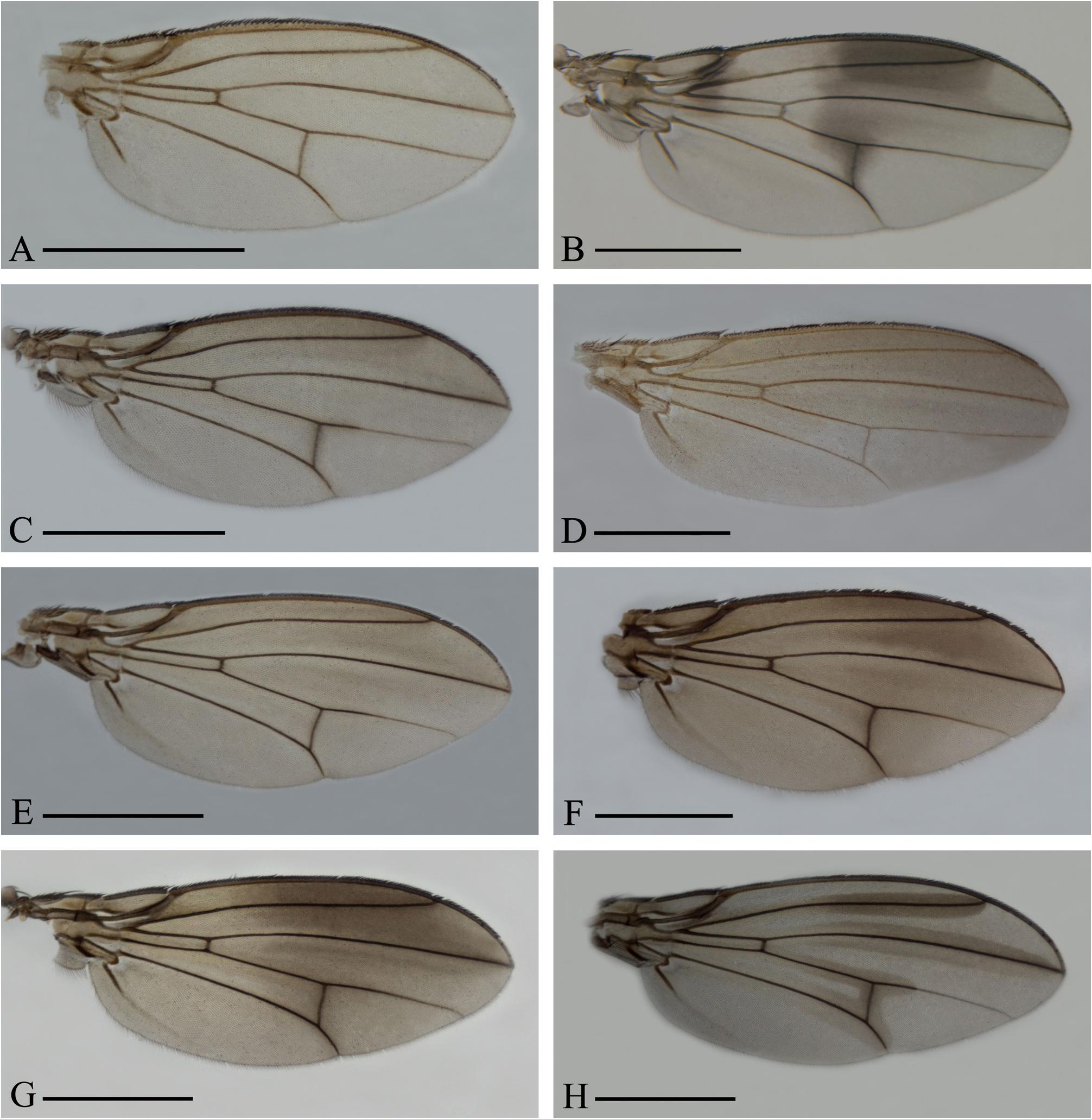
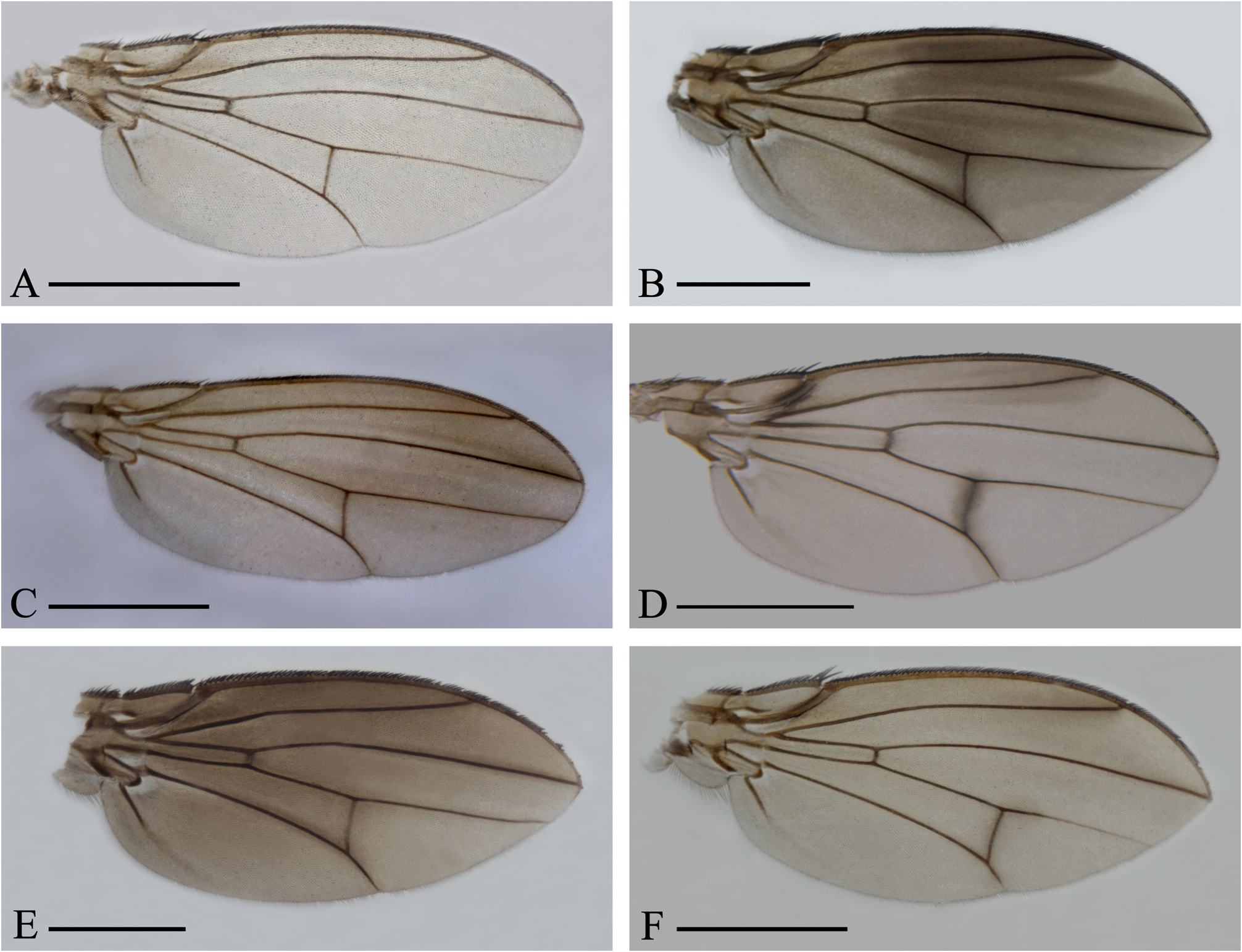
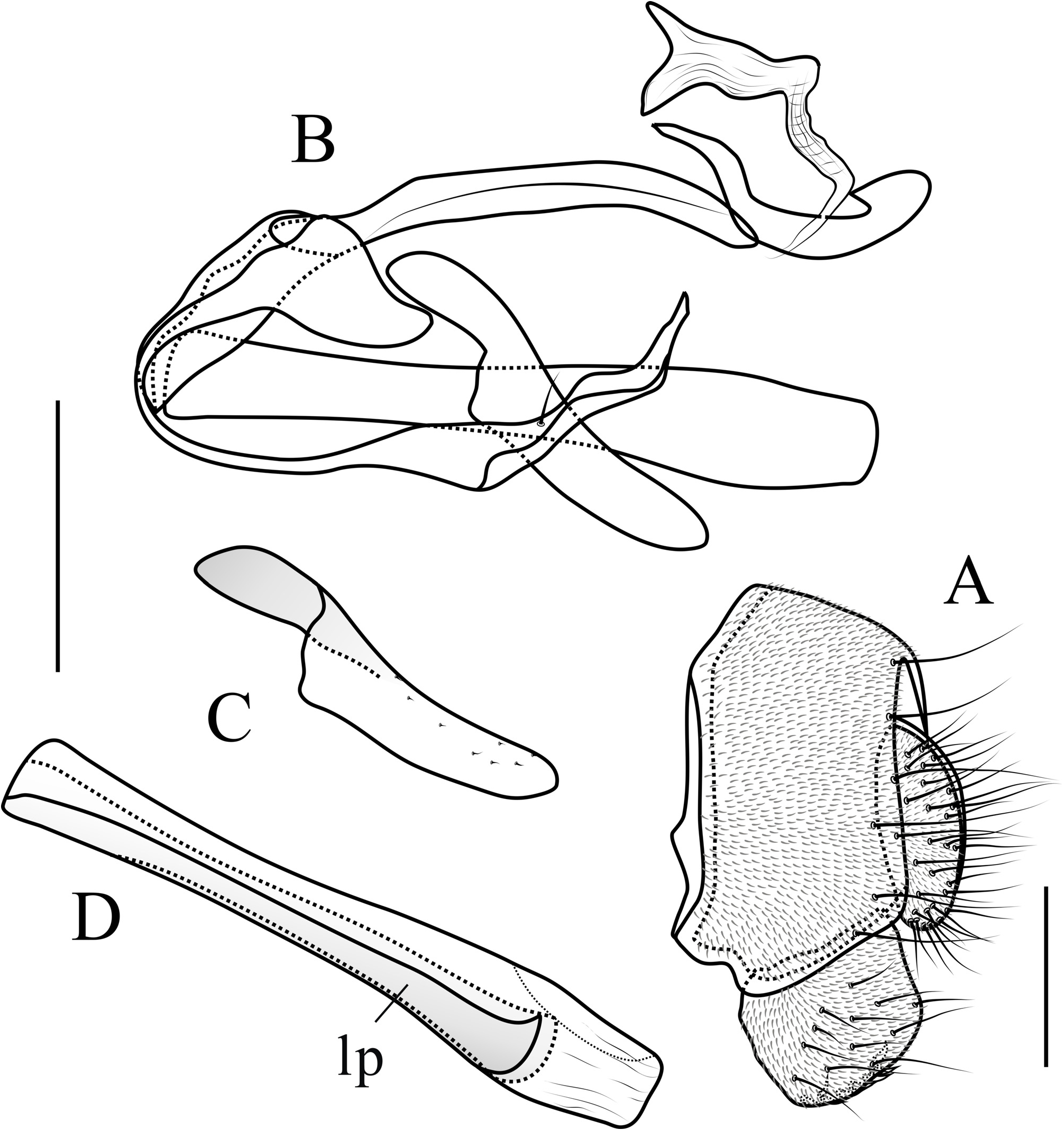
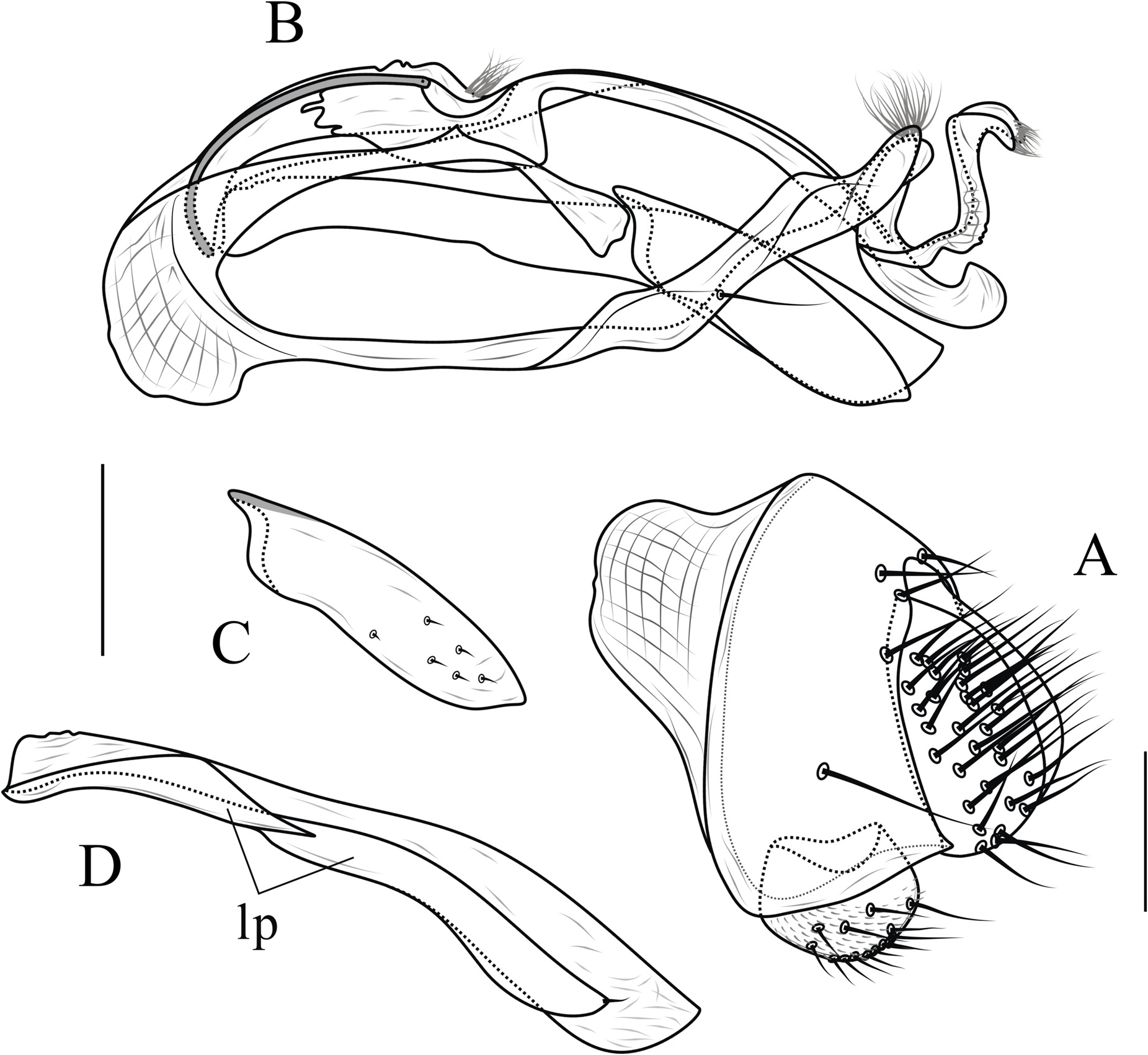
( Figs. 4F View FIGURE 4 , 8P–R View FIGURE 8 , 12E, 16K, 16L View FIGURE 16 , 37 View FIGURE 37 )
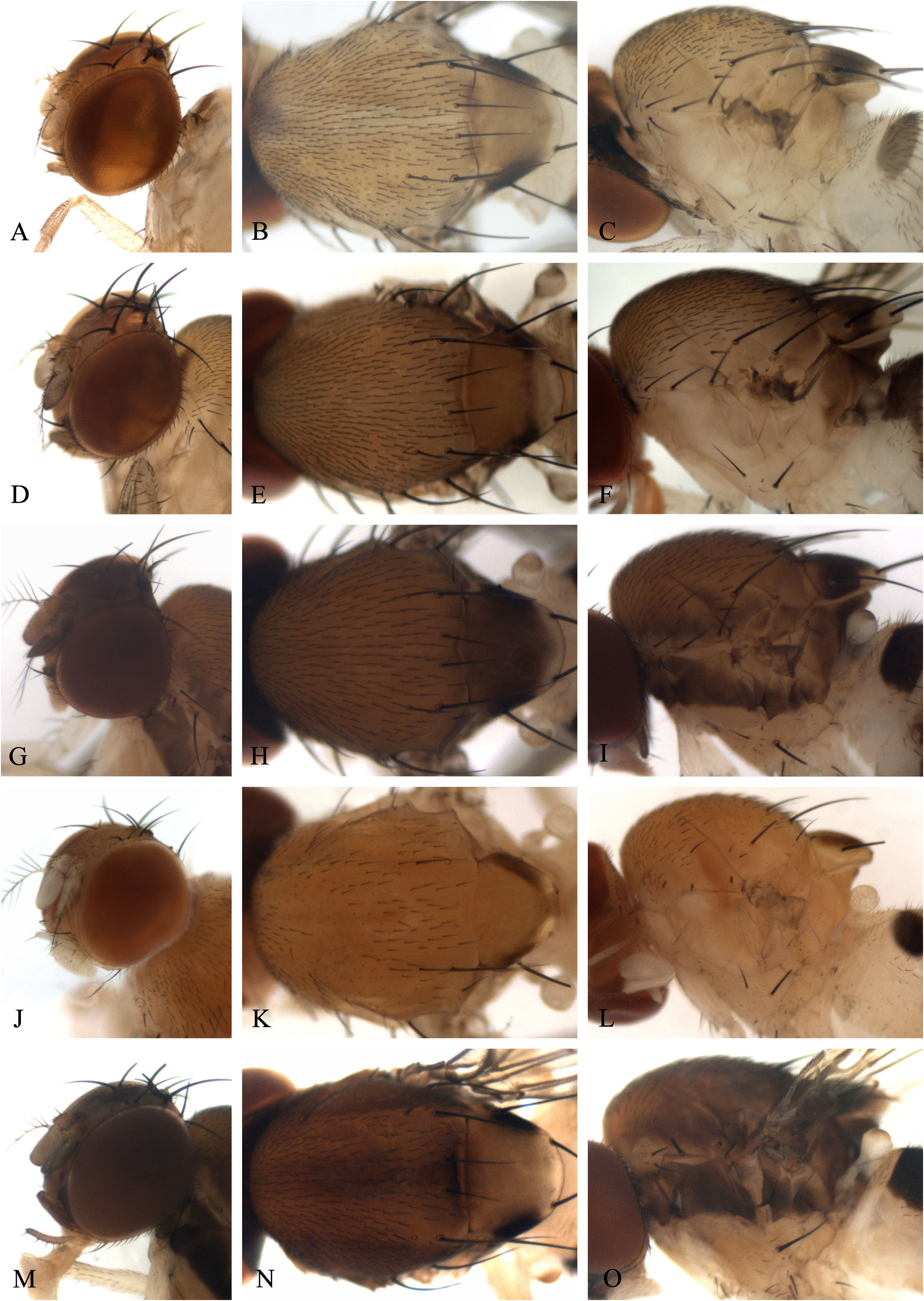
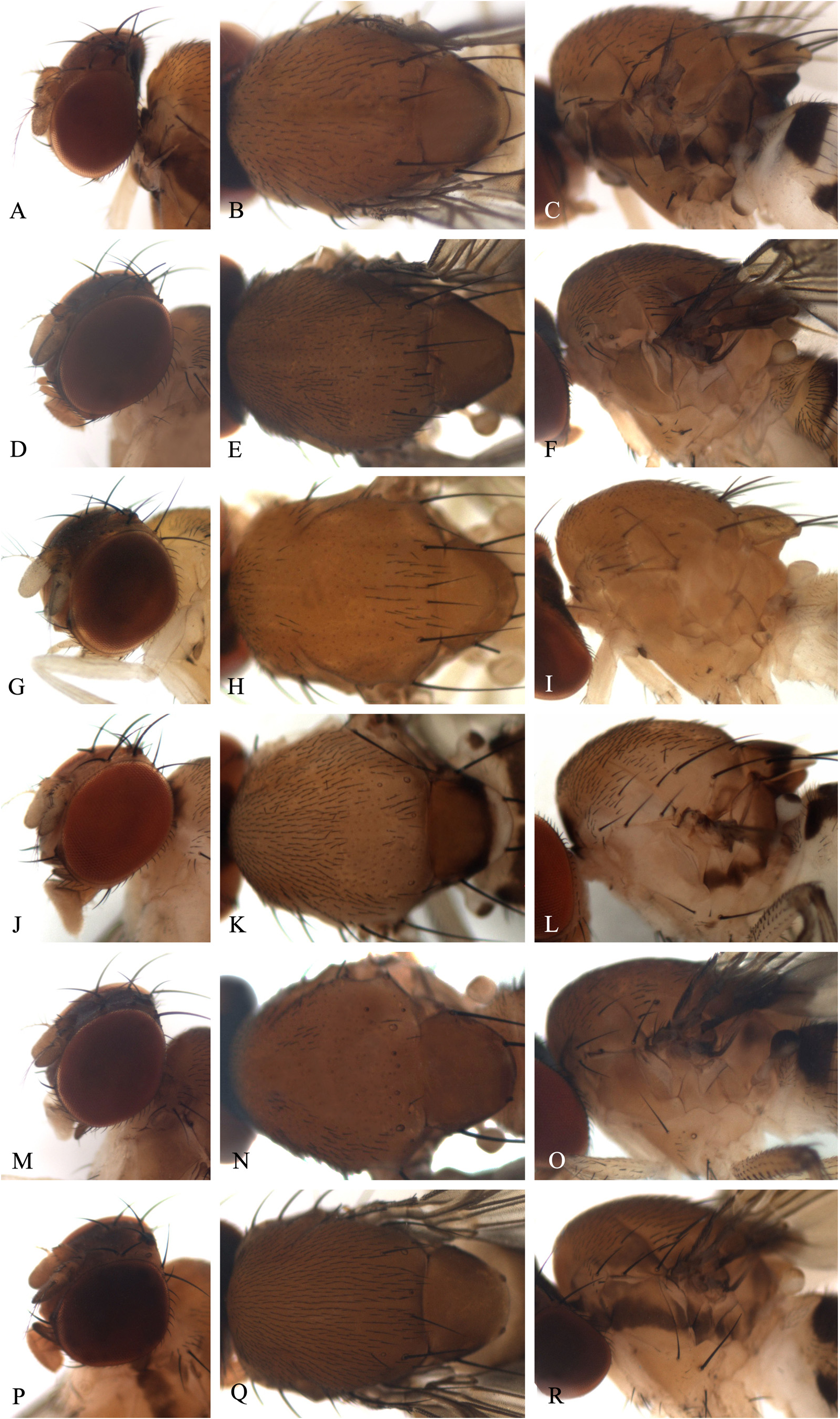
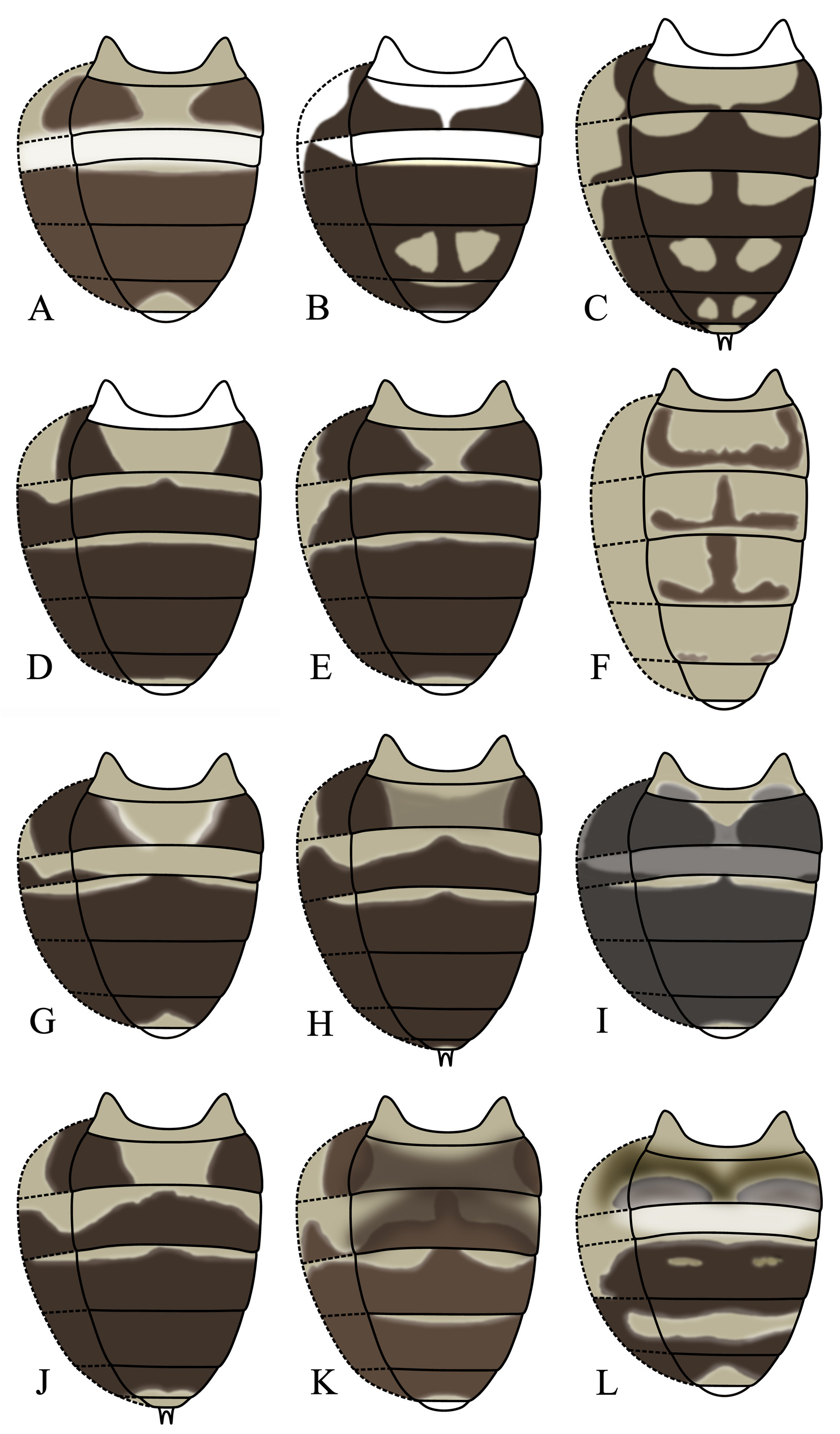
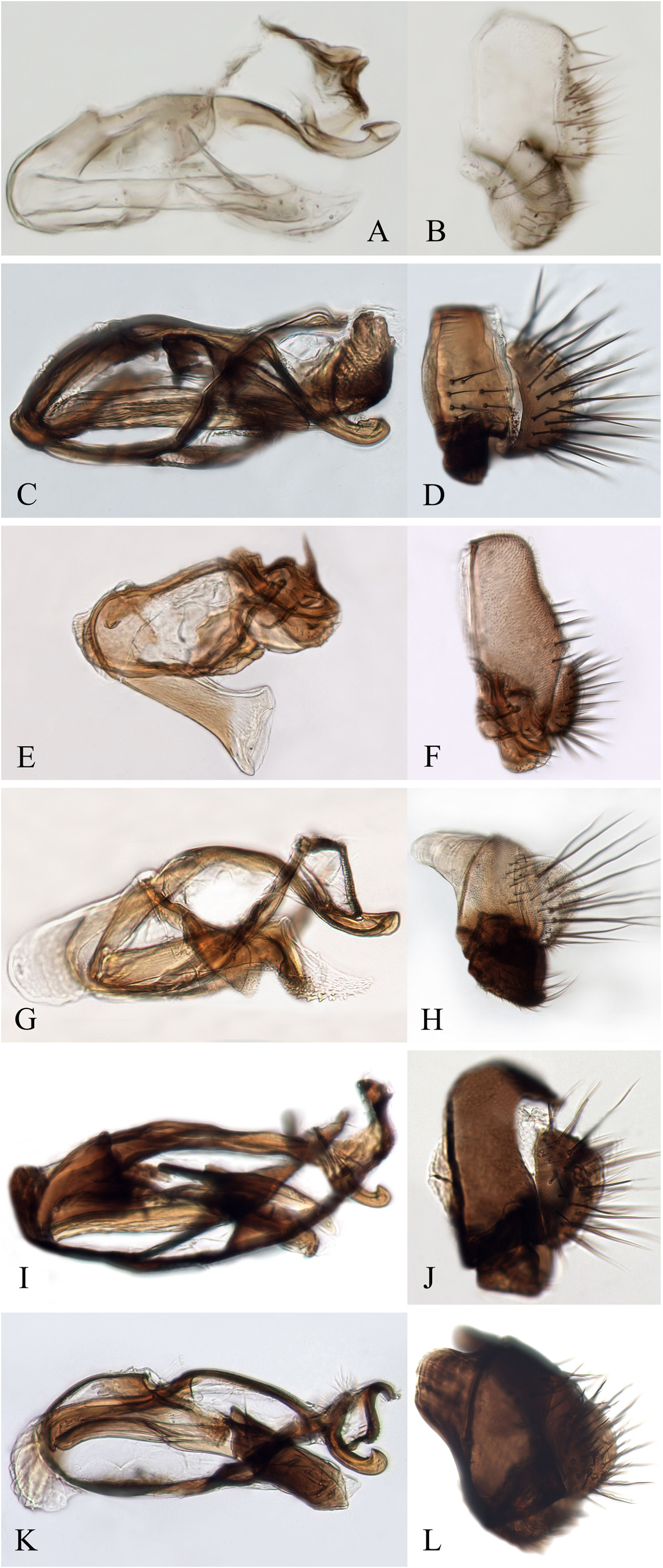
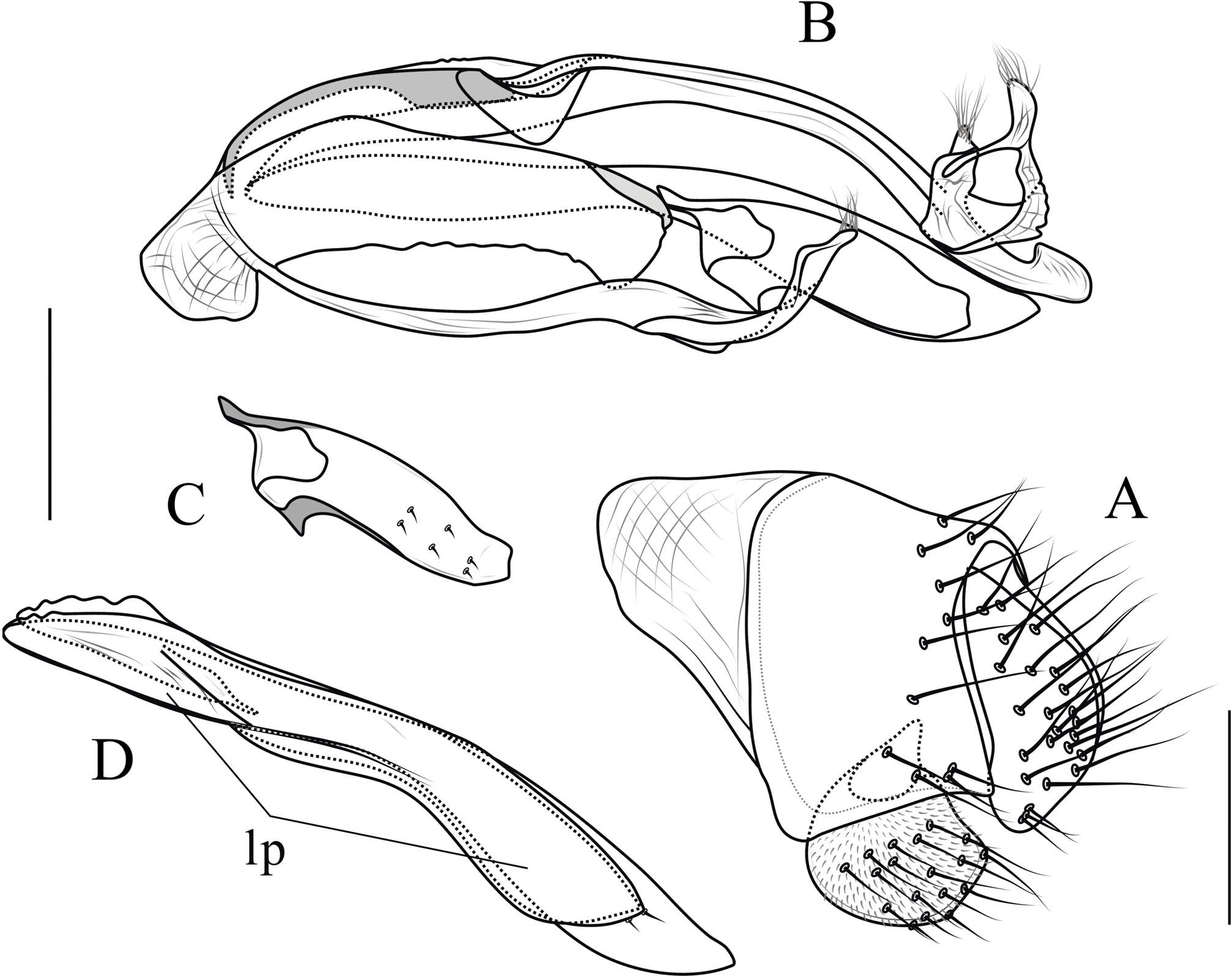
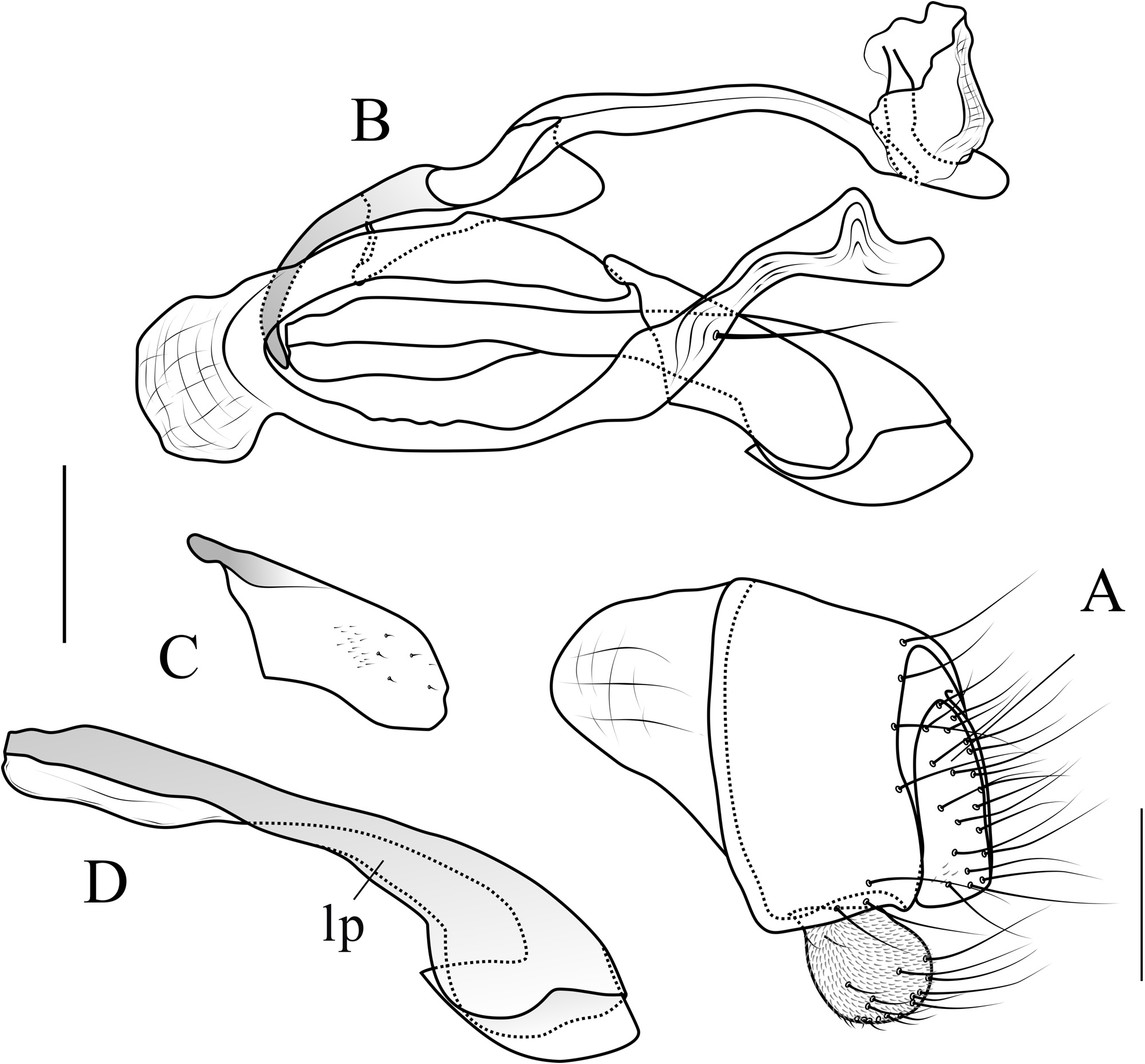
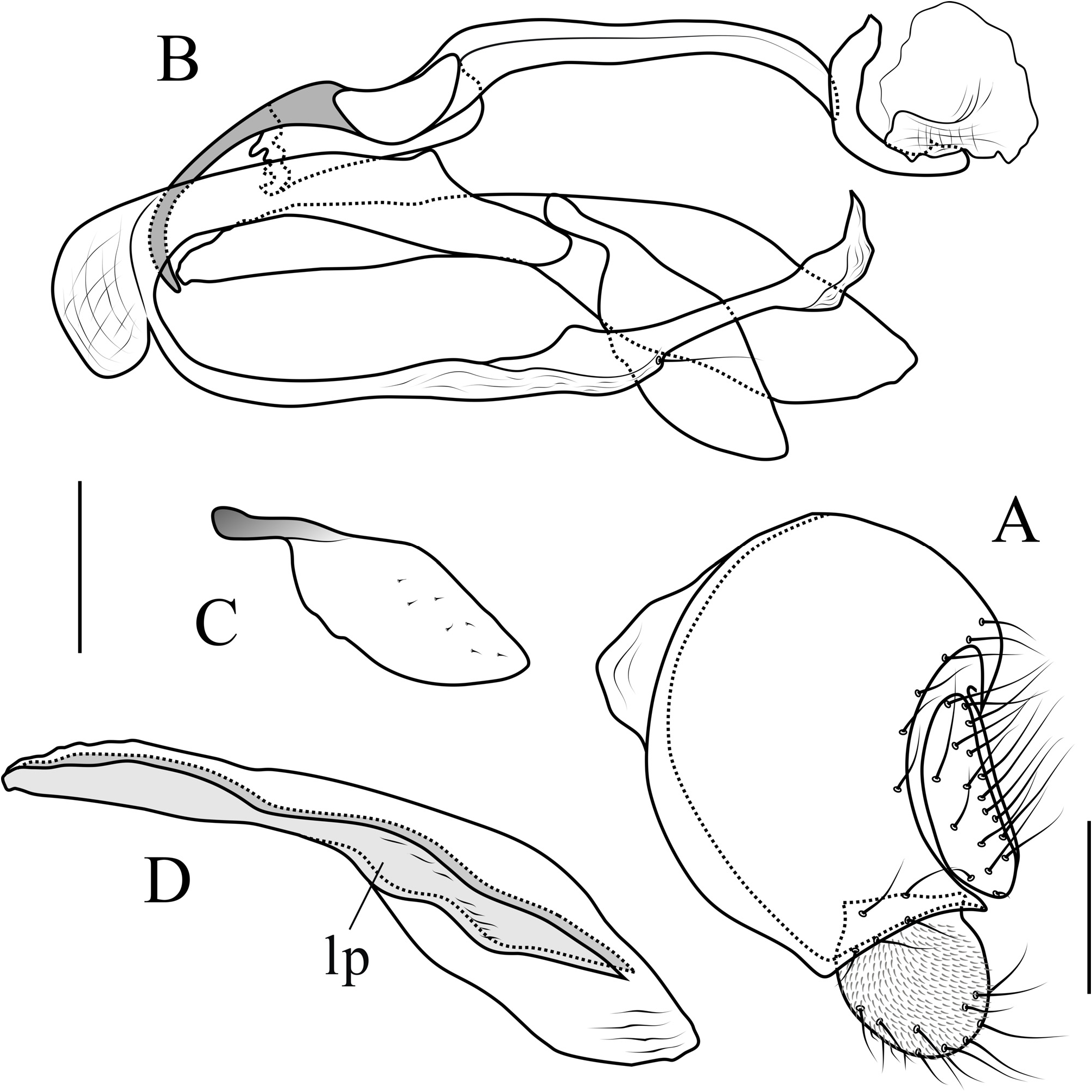
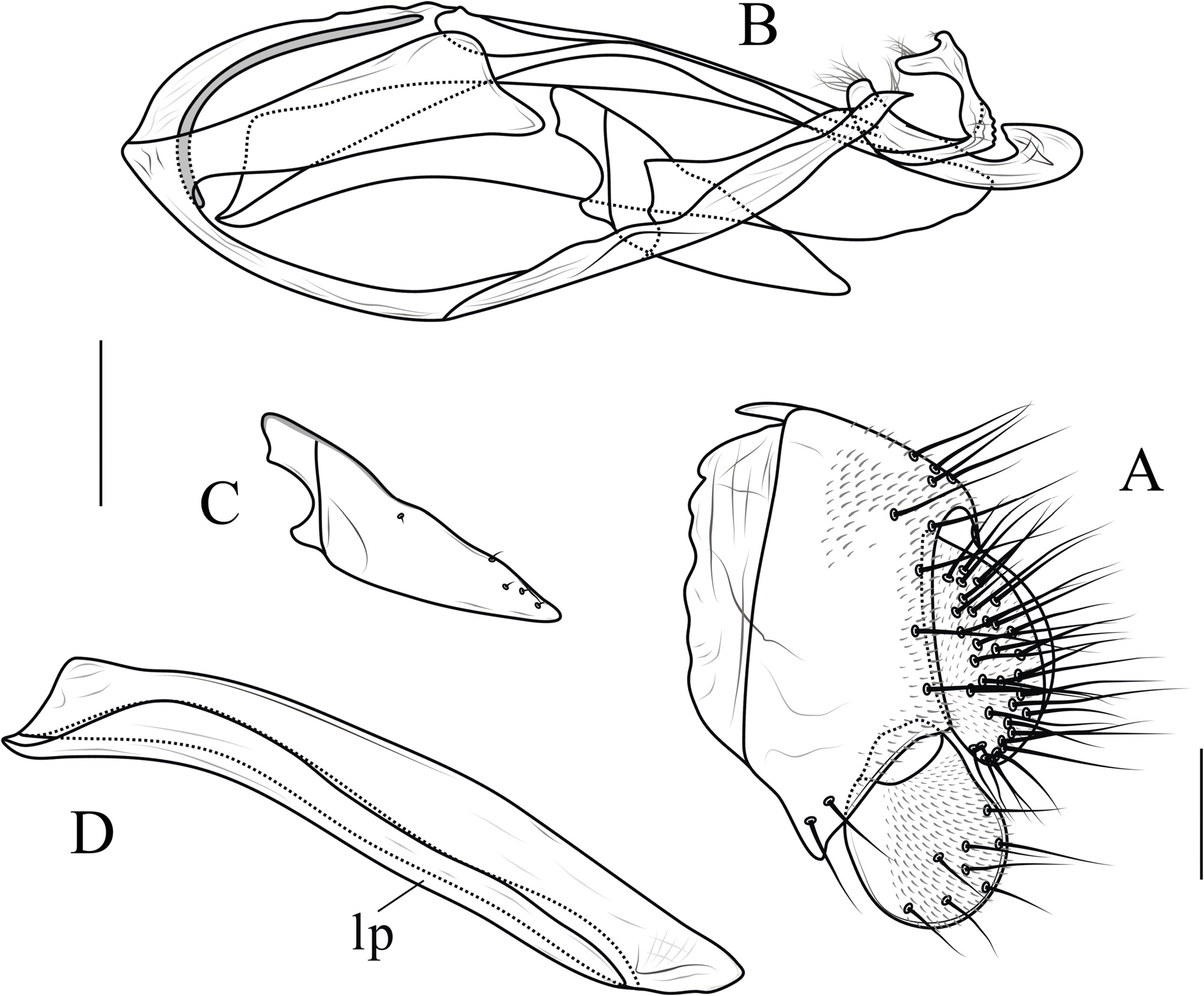
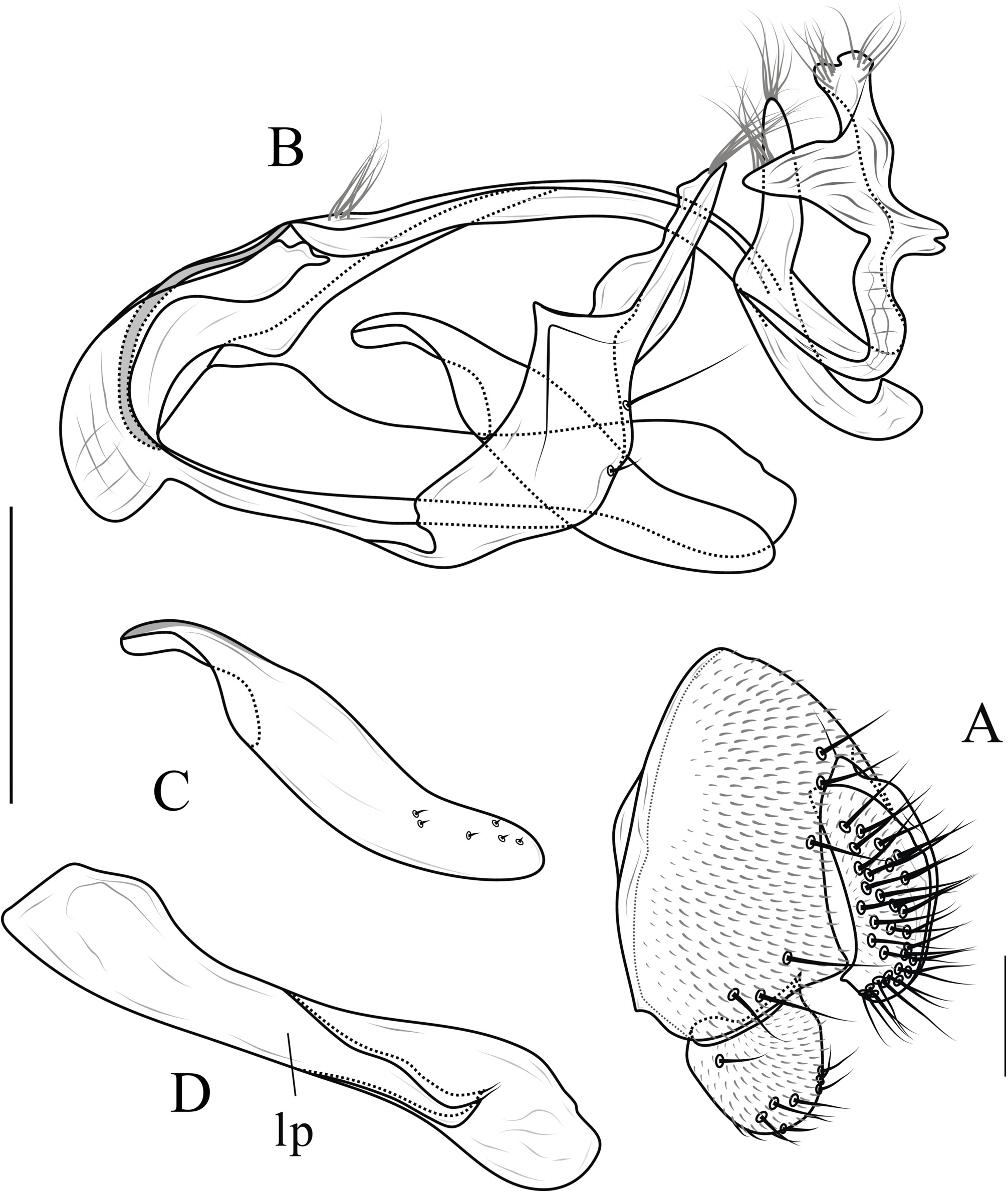
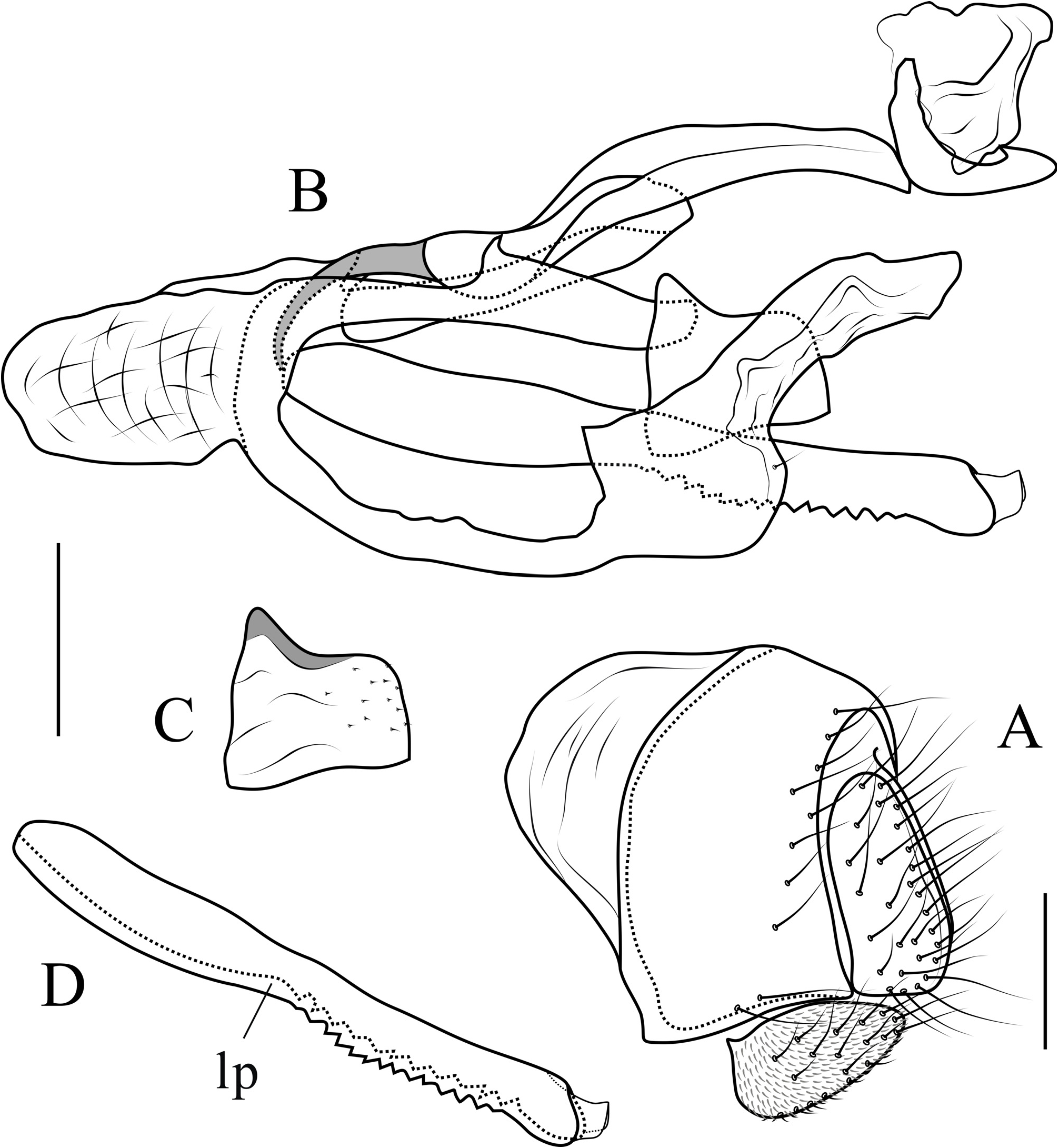
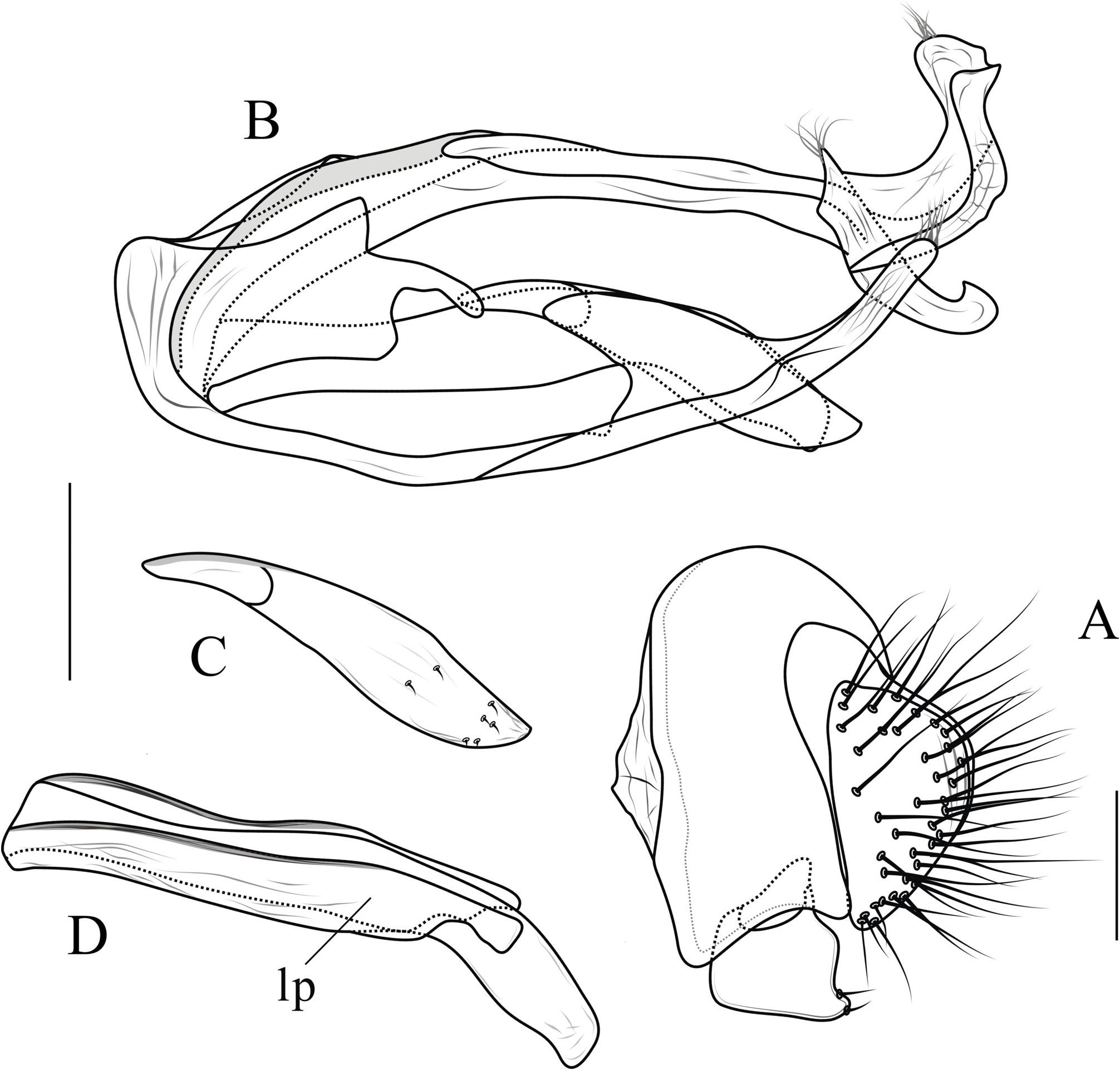
Diagnosis. This species is most similar to L. setipalpis in having the mesonotum mostly brownish yellow ( Figs. 5H View FIGURE 5 , 8Q View FIGURE 8 ), the pleura with a brown, longitudinal stripe above ( Figs. 5I View FIGURE 5 , 8R View FIGURE 8 ), the wing slightly brownish along the tip of R 2+3 and dm-cu crossvein ( Figs. 2C View FIGURE 2 , 4F View FIGURE 4 ), and the shape and pubescence of epandrium, cercus, and surstylus ( Figs. 19A View FIGURE 19 , 37A View FIGURE 37 ), but can be distinguished from the latter by the colour patterns of abdominal tergites ( Fig. 12E); paramere ventrally lacking projection ( Fig. 37C View FIGURE 37 ); aedeagus basolaterally with a small process, and laterally with a long process at half its height; the long process bearing 1 sensillum at tip ( Fig. 37D View FIGURE 37 ).
Description. Ocellar triangle dark brown, with ca. 1 or 2 seta(e) above ocellar setae. Frons brownish yellow to brownish ( Fig. 8P View FIGURE 8 ). Pedicel brownish yellow; first flagellomere yellow to dark yellow ( Fig. 8P View FIGURE 8 ). Clypeus entirely brownish yellow. Palpus brownish ( Fig. 8P View FIGURE 8 ). Postpronotal lobe yellow ( Fig. 8R View FIGURE 8 ). Acrostichal setulae in ca. 14–16 irregular rows ( Fig. 8Q View FIGURE 8 ). Scutellum brownish yellow, brownish laterally, dark yellow at tip ( Fig. 8Q View FIGURE 8 ). Katepisternum and mesopleuron mostly yellowish to yellow ( Fig. 8R View FIGURE 8 ). Wing ( Fig. 4F View FIGURE 4 ): Costal vein between R 2+3 and R 4+5 distally with ca. 5–7 peg-like spinules on ventral surface; R 4+5 and M 1 slightly divergent distally; halter mostly yellowish, with a dark yellow patch at knob ( Fig. 8R View FIGURE 8 ). Abdominal tergites dark brown, 2nd tergite yellow medially and laterally, 3rd tergite not shortened in males, 3rd and 4th tergites with yellow patches submedially and sublaterally ( Fig. 12E). Male terminalia: Epandrium lacking pubescence, with ca. 4 setae medially and near posterior margin per side ( Fig. 37A View FIGURE 37 ). Cercus lacking pubescence ( Fig. 37A View FIGURE 37 ). Surstylus pubescent ( Fig. 37A View FIGURE 37 ). Hypandrium with 1 sensillum ( Fig. 37B View FIGURE 37 ). Paramere narrow basally and apically, with ca. 6 sensilla distally ( Fig. 37C View FIGURE 37 ).
Measurements and indices. BL = 3.47 mm in holotype (range in 5♀ paratypes: 3.27–3.53), ThL = 1.73 mm (1.63–1.77), WL = 2.93 mm (2.87–3.00), WW = 1.43 mm (1.30–1.40), arb = 6–7/3–4 (7/3–4), avd = 0.78 (0.71– 0.82), adf = 2.25 (2.00–2.27), flw = 2.06 (1.88–2.20), FW/HW = 0.38 (0.34–0.39), ch/o = 0.03 (0.04–0.05), prorb = 0.069 (0.61–0.69), rcorb = 0.66 (0.53–0.77), vb = 0.39 (0.48–0.50), dcl = 0.57 (0.41–0.48), presctl = 0.60 (0.53– 0.62), sctl = damaged (1.28–1.44), sterno = 0.79 (0.69–0.77), orbito = 1.73 (1.83–2.18), dcp = 0.20 (0.19–0.25), sctlp = 1.12 (1.06–1.26), C = 2.19 (2.00–2.20), 4c = 1.02 (1.04–1.24), 4v = 1.14 (1.18–1.42), 5x = 0.68 (0.72– 0.89), ac = 1.73 (1.82–2.25), M = 0.25 (0.27–0.35), C3F = 0.77 (0.67–0.75).
Type specimens. Holotype ♂ ( SCAU, No. 128616), CHINA: Guanlei, Mengla , Yunnan, 21°38'N, 101°10'E, alt. 562m, 20.iv.2016, ex tree trunk, J Huang GoogleMaps . Paratypes: CHINA: 4♀ ( SCAU, Nos 128617–20), same data as holotype GoogleMaps ; 1♀ ( SCAU, No. 128621), Wangtianshu, Mengla , Yunnan, 21°28'N, 101°38'E, alt. 570m, 12.xi.2012, ex tussock, JJ Gao GoogleMaps .
Distribution. China ( Yunnan).
Etymology. From the Latin word: “ zebrinus ” (= stripe), referring to the pleura with a brown, longitudinal stripe above.
Key to the Leucophenga species groups in the Oriental region and the 21 species described or redescribed in this study
1. M 1 distally abbreviated, not reaching wing margin (as in Su et al. 2013, fig. 3A, D, G, J)............. the abbreviata group
- M 1 distally not abbreviated, reaching wing margin............................................................ 2
2. Palpus brown to black, sexual dimorphism conspicuously in size (as in Zhou & Chen 2015, fig. 2A, B), large in females (as in Zhou & Chen 2015, fig. 2B).............................................................. the mutabilis group
- Palpus brownish or lighter, sexual dimorphism inconspicuously in size (e.g., as in Huang & Chen 2016, fig. 4B, D), slender in female (e.g., as in Huang & Chen 2016, fig. 4B).............................................................. 3
3. Mesonotum with dense silvery pollinosity in males........................................................... 4
- Mesonotum lacking dense silvery pollinosity in males........................................................ 6
4. Body large, mostly 3–4 mm in length; pleura with brown to black patches from ketepisternum to subscutellum (as in Huang et al. in prep.); aedeagus pubescent or hairy distoventrally (as in Huang et al. in prep.).................. the maculata group
- Body small, mostly 2–3 mm in length; pleura unicolorous (e.g., as in Huang & Chen 2016, fig. 3B, J; as in Huang et al. 2017, fig. 5B, H) or with a brownish to dark brown, longitudinal stripe above (e.g., as in Huang et al. 2017, figs. 3J, 5J); aedeagus lacking pubescence or hair (e.g., as in Huang & Chen 2016, figs. 6E, 7D; as in Huang et al. 2017, figs. 10E, 11D)......... 5
5. Orb 3 and Orb 2 parallel (as in Huang & Chen 2016, fig. 6A); wing entirely hyaline but brown on R 1 medially (as in Huang & Chen 2016, fig. 2); halter with a distinct black patch at knob (as in Huang & Chen 2016, figs. 3, 4)...... the argentata group
- Orb 3 located in front of Orb 2, separated by distance less than 1/3 of that between Orb 2 and Orb 1 (as in Huang et al. 2017, fig. 10A); wing fuscous along R 1 (as in Huang et al. 2017, fig. 2); halter usually lacking distinct patch at knob (as in Huang et al. 2017, figs. 3–6)..................................................................... the subpollinosa group
6. Wing usually with distinct patch(es) (e.g., as in Huang et al. 2013a, fig. 2A, D, G, J, M; as in Huang et al. 2013b, figs. 2, 3); abdominal 3rd tergite not shortened in males (e.g., as in Huang et al. 2013a, fig. 3; as in Huang et al. 2013b, figs. 8, 9)..... 7
- Wing usually more or less clouded ( Figs. 2B, 2C, 2F, 2G View FIGURE 2 , 3A, 3C, 3D, 3F, 3G View FIGURE 3 , 4B–F View FIGURE 4 ), or entirely hyaline ( Figs. 2A, 2D, 2E View FIGURE 2 , 3B, 3E, 3H View FIGURE 3 , 4A View FIGURE 4 ); abdominal 3rd tergite shortened ( Figs. 9A, 9B, 9G, 9I, 9L View FIGURE 9 , 10A, 10D, 10G, 10I, 10K, 11D, 11F, 11H, 12B) or not ( Figs. 9D, 9E, 9F, 9K View FIGURE 9 , 10C, 10F, 11A, 11B, 11G, 11J–L, 12A) in males..................................................................................................... the 21 species described or redescribed in this study ... 8
7. Wing with broad, dark longitudinal stripe along anterodistal portion (as in Huang et al. 2013a, fig. 2A, D, G, J, M); paramere with distinct wrinkles (as in Huang et al. 2013a, figs. 4D, 5C, 6C, 7C, 8C); aedeagus basolaterally with sclerotized processes (as in Huang et al. 2013a, figs. 4E, 5D, 6D, 7D, 8D).......................................... the interrupta group
- Wing lacking longitudinal stripe along anterodistal portion (as in Huang et al. 2013b, figs. 2, 3; as in Huang et al. 2014, figs. 2–4); paramere lacking distinct wrinkles (e.g., as in Huang et al. 2013b, figs. 14D, 15C; as in Huang et al. 2014, figs. 18C, 19C); aedeagus lacking process (e.g., as in Huang et al. 2013b, figs. 14E, 15D; as in Huang et al. 2014, figs. 18D, 19D)............................................................................................ the ornata group
8. Orb 2 much shorter than Orb 3 ( Fig. 5J View FIGURE 5 ); wing lacking peg-like spinule on ventral surface of costal vein ( Fig. 2D View FIGURE 2 ); abdominal tergites (especially 3rd to 5th ones) prolonged ( Fig. 9F View FIGURE 9 )..................................... L. sorii (the sorii group)
- Orb 2 usually longer than Orb 3 ( Figs. 5A, 5D, 5G, 5M View FIGURE 5 , 6–8A, D, G, J, M, 8P View FIGURE 6 View FIGURE 7 View FIGURE 8 ); wing with several peg-like spinules on ventral surface of costal vein ( Figs. 2A–C, 2E–H View FIGURE 2 , 3 View FIGURE 3 , 4 View FIGURE 4 ); abdominal 3rd tergite shortened or normal in males, other tergites normal in both male and female ( Figs. 9A–E, 9G–L View FIGURE 9 , 10–12)....................................the 20 unplaced species in this study ..................... .. .. ......................... .. .. .......... ................................... 9
9. Abdominal 3rd tergite shortened and with fewer setae in males ( Figs. 9A, 9B, 9G, 9I, 9L View FIGURE 9 , 10A, 10D, 10G, 10I, 10K, 11D, 11F, 11H, 12B)........................................................................................... 10
- Abdominal 3rd tergite not shortened and entirely setigerous in males ( Figs. 9D, 9E, 9K View FIGURE 9 , 10C, 10F, 11A, 11B, 11G, 11J–L, 12A, 12E)............................................................................................... 22
10. Postocellar seta absent, with a long seta above ocellar setae ( Fig. 8D View FIGURE 8 ); Orb 3 located behind Orb 2 ( Fig. 8D View FIGURE 8 ); wing pointed apically ( Fig. 4B View FIGURE 4 )......................................................................... L. oxyptera sp. nov.
- Postocellar setae present, lacking long seta above ocellar setae ( Figs. 5A, 5D, 5M View FIGURE 5 , 6A, 6G, 6M View FIGURE 6 , 7D, 7G, 7J View FIGURE 7 , 8A, 8J, 8M View FIGURE 8 ); Orb 3 located in front of Orb 2 ( Figs. 5M View FIGURE 5 , 6A, 6M View FIGURE 6 , 7D, 7G, 7J View FIGURE 7 , 8A View FIGURE 8 ), or Orb 3 and Orb 2 parallel ( Figs. 5A, 5D View FIGURE 5 , 6G View FIGURE 6 , 8J, 8M View FIGURE 8 ); wing rounded apically ( Figs. 2A, 2B, 2E, 2F View FIGURE 2 , 3A, 3C, 3E, 3F, 3G View FIGURE 3 , 4A, 4D, 4E View FIGURE 4 )......................................... 11
11. Wing entirely hyaline ( Figs. 2A, 2E View FIGURE 2 , 3E View FIGURE 3 , 4A View FIGURE 4 )............................................................... 12
- Wing more or less clouded ( Figs. 2B, 2F View FIGURE 2 , 3A, 3C, 3F, 3G View FIGURE 3 , 4D, 4E View FIGURE 4 )............................................... 15
12. Mesonotum and scutellum mostly dark yellow ( Fig. 5B View FIGURE 5 ); pleura lacking stripe above ( Fig. 5C View FIGURE 5 ); surstylus curved and narrow caudally, with only a few setae along distal margin ( Fig. 17A View FIGURE 17 ).......................................... L. jacobsoni
- Mesonotum and scutellum mostly brownish yellow ( Figs. 5N View FIGURE 5 , 7E View FIGURE 7 , 8B View FIGURE 8 ); pleura with a brown to dark brown, longitudinal stripe above ( Figs. 5O View FIGURE 5 , 7F View FIGURE 7 , 8C View FIGURE 8 ); surstylus rounded caudally, with some setae on outer surface ( Figs. 21A View FIGURE 21 , 28A View FIGURE 28 , 32A View FIGURE 32 )........... 13
13. Abdominal 5th tergite entirely dark brown ( Fig. 9G, H View FIGURE 9 ); epandrium and cercus lacking pubescence ( Fig. 21A View FIGURE 21 ); aedeagus laterally mostly covered by its process ( Fig. 21D View FIGURE 21 )....................................................... L. spinifera
- Abdominal 5th tergite with yellow patches submedially and sublaterally ( Figs. 10G, 10H, 11D, 11E); epandrium and cercus mostly pubescent ( Figs. 28A View FIGURE 28 , 32A View FIGURE 32 ); aedeagus laterally less covered by its process ( Figs. 28D View FIGURE 28 , 32D View FIGURE 32 )................... 14
14. Scutellum dark brown laterally ( Fig. 7E View FIGURE 7 ); aedeagus apically rounded, laterally with a distally narrow, apically acute process, which bearing a sensillum at tip ( Fig. 28D View FIGURE 28 )................................................. L. forcipula sp. nov.
- Scutellum brownish yellow laterally ( Fig. 8B View FIGURE 8 ); aedeagus apically rectangular, ventrolaterally with a distally slightly expanded, apicodorsally acute process, which lacking sensillum at tip ( Fig. 32D View FIGURE 32 )........................... L. hyaloptera sp. nov.
15. Surstylus acute caudally ( Figs. 35A View FIGURE 35 , 36A View FIGURE 36 ).................................................................. 16
- Surstylus rounded caudally ( Figs. 18A View FIGURE 18 , 22A View FIGURE 22 , 24A View FIGURE 24 , 26A View FIGURE 26 , 29A View FIGURE 29 , 30A View FIGURE 30 )............................................. 17
16. Scutellum dark brown posteriorly and laterally, yellow at tip ( Fig. 8K View FIGURE 8 ); pleura with brown patches from ketepisternum to anatergite ( Fig. 8L View FIGURE 8 ); wing brownish along R 1, the tip of R 2+3 and dm-cu crossvein ( Fig. 4D View FIGURE 4 ); R 4+5 and M 1 nearly parallel distally ( Fig. 4D View FIGURE 4 ); abdominal 5th tergite with yellow patches submedially and sublaterally ( Fig. 11H, I); epandrium, cercus, and surstylus mostly pubescent ( Fig. 35A View FIGURE 35 ); paramere nearly triangular, lacking sensillum ( Fig. 35C View FIGURE 35 ); aedeagus distally with numerous irregular, serrated processes, laterally with a short, apically expanded process ( Fig. 35D View FIGURE 35 )........... L. serrateiceps sp. nov.
- Scutellum mostly brownish yellow ( Fig. 8N View FIGURE 8 ); pleura lacking patch or stripe above ( Fig. 8O View FIGURE 8 ); wing mostly clouded ( Fig. 4E View FIGURE 4 ); R 4+5 and M 1 slightly convergent distally ( Fig. 4E View FIGURE 4 ); abdominal 5th tergite entirely dark brown to black ( Figs. 11J–L, 12A, C, D); epandrium, cercus, and surstylus lacking pubescence ( Fig. 36A View FIGURE 36 ); paramere slender, acute basally and narrow apically, with ca. 7 sensilla distally ( Fig. 36C View FIGURE 36 ); aedeagus slightly curved ventrad, laterally with a long, apically narrow process ( Fig. 36D View FIGURE 36 )......................................................................... L. valvata sp. nov. (“normal” specimens)
17. Orb 3 and Orb 2 parallel ( Figs. 5D View FIGURE 5 , 6G View FIGURE 6 , 7J View FIGURE 7 ); pleura lacking stripe above ( Figs. 5F View FIGURE 5 , 6I View FIGURE 6 , 7L View FIGURE 7 ); epandrium and cercus mostly pubescent ( Figs. 18A View FIGURE 18 , 24A View FIGURE 24 , 30A View FIGURE 30 )............................................................................. 18
- Orb 3 located in front of Orb 2 ( Figs. 6A, 6M View FIGURE 6 , 7G View FIGURE 7 ); pleura with a brownish to dark brown, longitudinal stripe above ( Figs. 6C, 6O View FIGURE 6 , 7I View FIGURE 7 ); epandrium and cercus lacking pubescence ( Figs. 22A View FIGURE 22 , 26A View FIGURE 26 , 29A View FIGURE 29 )........................................ 20
18. Postocellar setae distinct ( Fig. 5D View FIGURE 5 ); scutellum brown to dark brown laterally, yellow at tip ( Fig. 5E View FIGURE 5 ); wing with distinct patterns ( Fig. 2B View FIGURE 2 ); paramere dorsally and distally pubescent, lacking sensillum ( Fig. 18C View FIGURE 18 ); aedeagus medioventrally with a small, pubescent projection, distoventrally with several serrated processes, and laterally lacking process ( Fig. 18D View FIGURE 18 )........................................................................................................ L. kurahashii
- Postocellar setae minute ( Figs. 6G View FIGURE 6 , 7J View FIGURE 7 ); scutellum mostly brownish yellow ( Figs. 6H View FIGURE 6 , 7K View FIGURE 7 ); wing clouded ( Fig. 3A, G View FIGURE 3 ); paramere lacking pubescence, with some sensillum distally ( Figs. 24C View FIGURE 24 , 30C View FIGURE 30 ); aedeagus medioventrally lacking projection, distoventrally lacking serrated process, laterally with at least one long process ( Figs. 24D View FIGURE 24 , 30D View FIGURE 30 )........................ 19
19. R 4+5 and M 1 slightly convergent distally ( Fig. 3A View FIGURE 3 ); abdominal tergites mostly yellow ( Figs. 9L View FIGURE 9 , 10A, B); aedeagus laterally less covered by its medially expanded process ( Fig. 24D View FIGURE 24 )........................................ L. alafumosa sp. nov.
- R 4+5 and M 1 nearly parallel distally ( Fig. 3G View FIGURE 3 ); abdominal tergites mostly dark brown ( Fig. 10K, L); aedeagus laterally mostly covered by its bifurcated processes ( Fig. 30D View FIGURE 30 )............................................ L. glabtabulata sp. nov.
20. Paramere nearly quadrate ( Fig. 29C View FIGURE 29 ); aedeagus laterally mostly covered by its distoventrally serrated process ( Fig. 29D View FIGURE 29 )....................................................................................... L. fuscipalpula sp. nov.
- Paramere nearly fusiform ( Figs. 22C View FIGURE 22 , 26C View FIGURE 26 ); aedeagus laterally less covered by its non-serrated process ( Figs. 22D View FIGURE 22 , 26D View FIGURE 26 )..... ................................................................................................... 21
21. Hypandrium with 1 sensillum ( Fig. 22B View FIGURE 22 ); aedeagus apically rounded, laterally with a wave-shaped process ( Fig. 22D View FIGURE 22 )................................................................................................ L. varinervis
- Hypandrium with 2 sensilla ( Fig. 26B View FIGURE 26 ); aedeagus apically hook-shaped, laterally with a distoventrally expanded process ( Fig. 26D View FIGURE 26 )............................................................................. L. brevitabulata sp. nov.
22. Epandrium strongly expanded dorsally ( Fig. 34A View FIGURE 34 ); aedeagus laterally lacking process ( Fig. 34D View FIGURE 34 )....... L. platypyga sp. nov.
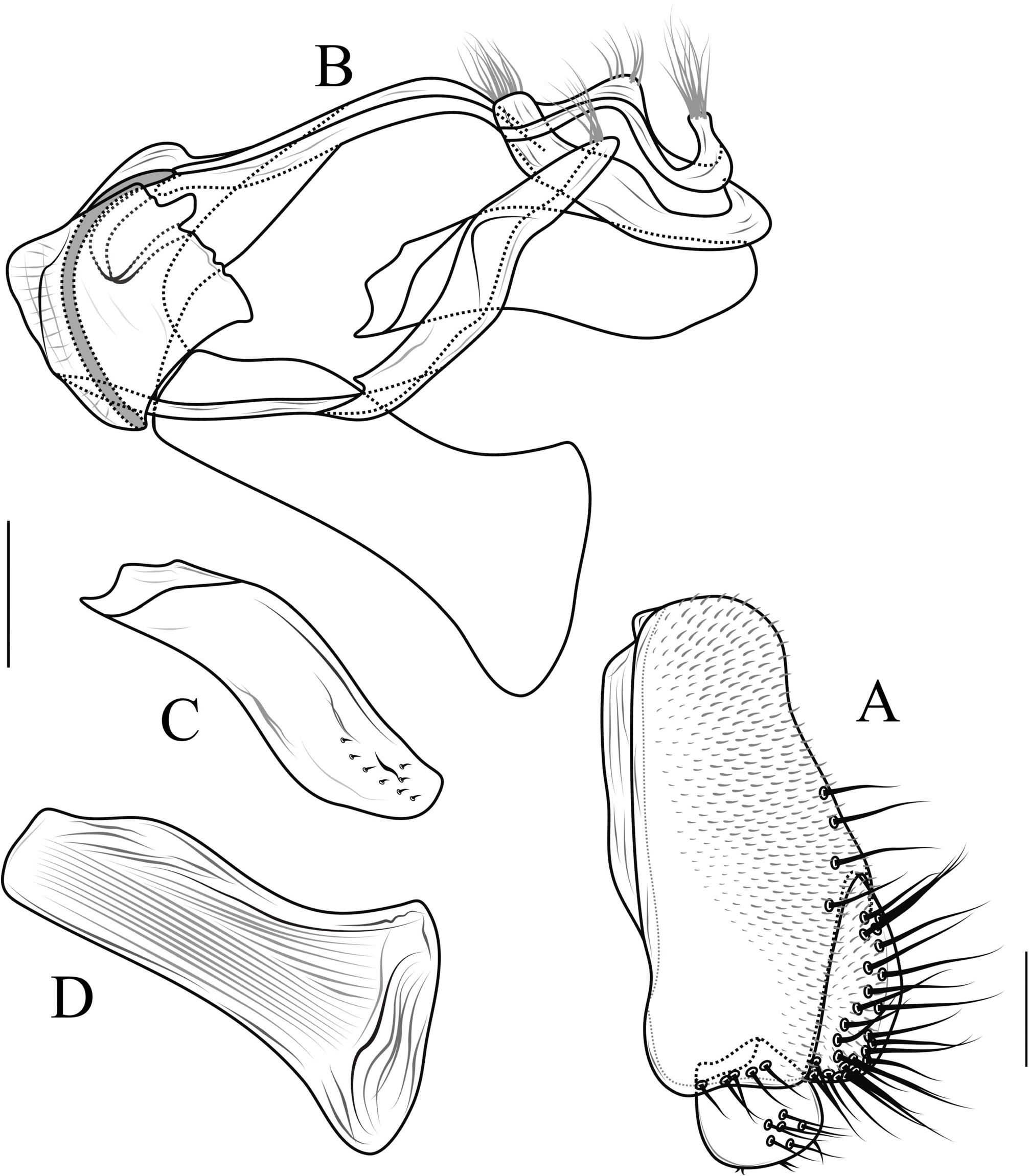
- Epandrium not expanded dorsally ( Figs. 19A View FIGURE 19 , 23A View FIGURE 23 , 25A View FIGURE 25 , 27A View FIGURE 27 , 31A View FIGURE 31 , 36A View FIGURE 36 , 37A View FIGURE 37 ); aedeagus laterally with at least one process ( Figs. 19D View FIGURE 19 , 23D View FIGURE 23 , 25D View FIGURE 25 , 27D View FIGURE 27 , 31D View FIGURE 31 , 36D View FIGURE 36 , 37D View FIGURE 37 )............................................................... 23
23. Wing mostly clouded ( Figs. 2G View FIGURE 2 , 3D View FIGURE 3 , 4E View FIGURE 4 )................................................................. 24
- Wing entirely hyaline or slightly brownish ( Figs. 2C View FIGURE 2 , 3B, 3H View FIGURE 3 , 4F View FIGURE 4 )............................................. 26
24. Orb 3 located in front of Orb 2 ( Fig. 6D View FIGURE 6 ); pleura with a brown, longitudinal stripe above ( Fig. 6F View FIGURE 6 ); paramere curved dorsad distally ( Fig. 23C View FIGURE 23 )........................................................................ L. acantha sp. nov.
- Orb 3 and Orb 2 parallel ( Figs. 7A View FIGURE 7 , 8M View FIGURE 8 ); pleura lacking stripe above ( Figs. 7C View FIGURE 7 , 8O View FIGURE 8 ); paramere not curved dorsad distally ( Figs. 27C View FIGURE 27 , 36C View FIGURE 36 )......................................................................................... 25
25. Epandrium with pubescence and setae ( Fig. 27A View FIGURE 27 ); surstylus rounded caudally, mostly pubescent, with some setae distally ( Fig. 27A View FIGURE 27 ); paramere triangular, acute apically ( Fig. 27C View FIGURE 27 ); aedeagus distally not curved ventrad, ventrolaterally with an acute process ( Fig. 27D View FIGURE 27 )........................................................................... L. delta sp. nov.
- Epandrium lacking pubescence and seta ( Fig. 36A View FIGURE 36 ); surstylus acute caudally, lacking pubescence, with setae along caudal margin only ( Fig. 36A View FIGURE 36 ); paramere slender, acute basally ( Fig. 36C View FIGURE 36 ); aedeagus distally slightly curved ventrad, laterally with an apically narrow process ( Fig. 36D View FIGURE 36 )....................................... L. valvata sp. nov. (“shortened” specimens)
26. Postocellar setae minute ( Fig. 6J View FIGURE 6 ); Orb 3 and Orb 2 parallel ( Fig. 6J View FIGURE 6 ); surstylus lacking pubescence ( Fig. 25A View FIGURE 25 ).................................................................................................. L. brevipenis sp. nov.
- Postocellar setae distinct ( Figs. 5G View FIGURE 5 , 7M View FIGURE 7 , 8P View FIGURE 8 ); Orb 3 located in front of Orb 2 ( Figs. 5G View FIGURE 5 , 7M View FIGURE 7 , 8P View FIGURE 8 ); surstylus mostly pubescent ( Figs. 19A View FIGURE 19 , 31A View FIGURE 31 , 37A View FIGURE 37 )..................................................................................... 27
27. Wing entirely hyaline ( Fig. 3H View FIGURE 3 ); pleura with a brownish yellow to brownish, indistinct longitudinal stripe above ( Fig. 7O View FIGURE 7 ); abdominal 5th tergite with yellow patches submedially and sublaterally in males ( Fig. 11A, B); epandrium and cercus mostly pubescent ( Fig. 31A View FIGURE 31 ); aedeagus laterally with one process ( Fig. 31D View FIGURE 31 )........................... L. helvipecta sp. nov.
- Wing slightly brownish along the tip of R 2+3 and dm-cu crossvein ( Figs. 2C View FIGURE 2 , 4F View FIGURE 4 ); pleura with a brown, longitudinal stripe above ( Figs. 5I View FIGURE 5 , 8R View FIGURE 8 ); abdominal 5th tergite entirely brown to dark brown ( Figs. 9D, 9E View FIGURE 9 , 12E); epandrium and cercus lacking pubescence ( Figs. 19A View FIGURE 19 , 37A View FIGURE 37 ); aedeagus laterally with two processes ( Figs. 19D View FIGURE 19 , 37D View FIGURE 37 ).................................. 28
28. R 4+5 and M 1 nearly parallel distally ( Fig. 2C View FIGURE 2 ); paramere with a projection anteroventrally ( Fig. 19C View FIGURE 19 ); aedeagus laterally with a process at same its height; the process bearing 2 sensilla at tip ( Fig. 19D View FIGURE 19 )................................. L. setipalpis
- R and M 1 slightly divergent distally ( Fig. 4F View FIGURE 4 ); paramere lacking projection ventrally ( Fig. 37C View FIGURE 37 ); aedeagus laterally with a process at half its height; the process bearing 1 sensillum at tip ( Fig. 37D View FIGURE 37 )........................... L. zebrina sp. nov.
4+5
An additional summary table ( Table 3) for the 21 Leucophenga species described or redescribed in this study is provided here on account of their various morphological differences, thus enabling someone to distinguish them from each other based on the combination of these objective, comparable morphological characters.










No known copyright restrictions apply. See Agosti, D., Egloff, W., 2009. Taxonomic information exchange and copyright: the Plazi approach. BMC Research Notes 2009, 2:53 for further explanation.
|
Kingdom |
|
|
Phylum |
|
|
Class |
|
|
Order |
|
|
Family |
|
|
Genus |