
Diospyros hongwae G.E. Schatz, Lowry & Phillipson, 2020Diospyros ranirisonii G.E. Schatz, Lowry & Phillipson, 2020Diospyros silicea G.E. Schatz, Lowry & Phillipson, 2020Diospyros suarezensis G.E. Schatz, Lowry & Phillipson, 2020
|
publication ID |
https://doi.org/10.15553/c2020v752a5 |
|
persistent identifier |
https://treatment.plazi.org/id/03CF5312-D204-FFC1-FFC2-F8DC1F34FABA |
|
treatment provided by |
Carolina |
|
scientific name |
Diospyros hongwae G.E. Schatz, Lowry & Phillipson Diospyros ranirisonii G.E. Schatz, Lowry & Phillipson Diospyros silicea G.E. Schatz, Lowry & Phillipson Diospyros suarezensis G.E. Schatz, Lowry & Phillipson |
| status |
sp. nov. |
2. Diospyros danguyana H. Perrier in Mém. Inst. Sci. Madagascar, Sér. B, Biol. Vég. 4: 117. 1952.
Lectotypus (designated by SCHATZ & LOWRY, 2011: 274): MADAGASCAR. Reg. Anosy [Prov. Toliara]: bassin
supérieur du Mandrare (SE): mont
Amboahangy
,
près d’Esira
, [ 24°15'S 46°39'E], 1000–1150 m, 25.IX.1928, buds & ♀ fl., Humbert
6826
( P [
P00573529
]!; isolecto-: BR!, G [
G00191501
]!, K!,
MO-6128543
!,
MO-6128571
!, NY!, P [
P00573530
]!, PRE!, TAN!, TEF!).
=
Maba enervis H. Perrier
in Inst. Sci. Madagascar, Sér. B, Biol. Vég. 4: 997. 1952.
Diospyros enervis (H. Perrier) G.E. Schatz & Lowry
in Adansonia ser. 3, 33: 274. 2011.
Holotypus: MADAGASCAR. Reg. Menabe [Prov. Toliara]: Ankilizato (
bassin de Morondava
), [ 20°25'S 45°03'E], VII.1917, buds, Perrier de la Bâthie
3010
( P [
P00573700
]!; iso-: P [
P00541720
]!), syn. nov.
GoogleMaps
Vernacular name. – “Hazonamalo” ( Andriamihajarivo 489).
Distribution and ecology. –
Diospyros danguyana
is known from subarid thicket and forest on sand, sandstone, and lateritic substrates from Ambatofinandrahana in the east and Ankilizato in the west, south to Tolagnaro and north of Cap Sainte Marie ( MADAGASCAR CATALOGUE, 2020), at an elevation of 20–1800 m.
Conservation status. –
Diospyros danguyana
has a geographic range in the form of an EOO of 125,261 km ² and a minimum AOO of 128 km ². It is present in the Analavelona, Andohahela, Isalo, and Makay protected areas. Outside of protected areas, it is threatened by fire and grazing. With respect to the principal threat of grazing, it exists at 29 locations. Therefore,
D. danguyana
can be assessed for its risk of extinction as “Least Concern” [LC].
Notes. –
Maba enervis H. Perrier.
(
Diospyros enervis (H. Perrier) G.E. Schatz & Lowry
) is here placed into synonymy under
D. danguyana
. Described from the northwestern portion of the overall range of
D. danguyana
, and thus from the transition from subarid to dry bioclimates,
M. enervis
exhibits leaves that are somewhat less strongly revolute upon drying, but are otherwise identical to
D. danguyana
in shape and size, with identical fruit completely enclosed within the cylindrical-tubular accrescent calyx.
Diospyros danguyana
can be distinguished from other members of the Bernieriana group by its linear leaves 4–8 times longer than wide, its elliptic to subspherical female flowers only slightly longer than wide, and its distinctly lobed accrescent calyx enclosing the fruit, the lobes 3 mm long.
Additional material examined. –
MADAGASCAR. Reg. Amoron’i Mania [Prov. Fianarantsoa]: Ambatofinandrahana, PK 2 rte de
Fenoarivo
, rocailles de cipolins, [ 20°34'48"S 45°48'38"E], IX.1956, buds, Bosser
9799
( MO, P [3 sheets], TAN)
GoogleMaps
;
ibid. loco, 1600–1800 m, [ 20°35'S 45°48'E], 21.II.1938, fr., Decary
13136
( P [2 sheets])
GoogleMaps
;
ibid. loco, à quelques km au S, rte de Fenoarivo, [ 20°35'S 45°48'E], 3.XII.1964, ♀ fl., Service Forestier
23885
( MO, P [2 sheets], TEF).
GoogleMaps
Reg. Androy [Prov. Toliara]:
Ampilira
(limite NE de l’Androy), [ 24°28'00"S 45°30'00"E], [ 450 m], 23.XI.1931, buds, Decary
9370
( MO, P [2 sheets])
GoogleMaps
;
env.
d’Ampandrandava
(entre Bekily et Tsivory), [ 24°05'S 45°42'E], 1945, buds, Seyrig
779
( P)
GoogleMaps
;
ibid. loco, 1945, buds, Seyrig
779B
( P)
GoogleMaps
;
Maroakoho, colline gneissique, rive droite de la
Menarandra
, près de
Tranoroa
, [ 24°42'S 45°04'E], 14.XI.1967, ♀ fl., Service Forestier
27966
( MO, NY, P [2 sheets], TEF, WAG)
GoogleMaps
;
Marovato, E sur la rte de
Tsihombe au Cap Sainte-Marie
, [ 25°35'S 45°09'E], 17.XII.1968, ♀ fl., Service Forestier
28532
( P [2 sheets])
GoogleMaps
;
rte from de Cap Sainte Marie to Tsihombe, c. 20 km from
Cap Sainte Marie
, 25°28'04"S 45°21'01"E, 28 m, 4.IV.2010, fr., De Block et al.
2434
( BR, MO, P)
GoogleMaps
;
village
d’Ankorakosy
, au SSE de
Tsihombe
, [ 25°18'00"S 45°29'00"E], [ 20–50 m], 17.XII.1968, buds, Service Forestier
28523
( K, MO, P [2 sheets], TEF).
GoogleMaps
Reg. Anosy [Prov. Toliara]: Analapatsy, fokontany
Ambaribe
, 25°10'23"S 46°39'19"E, 253 m, 17.II.2019, ster., Bernard et al.
2670
( DBEV, MO, P, TAN)
GoogleMaps
;
Andohahela PN
, Ambatoabo,
Imonty-Evasia
, en bas d’Apiky, 24°47'11"S 46°43'26"E, 680 m, 17.XII.2004, fr., Andriamihajarivo
489
( MO, P, TAN, TEF)
GoogleMaps
;
ibid. loco, Parcel 2, [ 24°53'S 46°35'E], [ 120–1000 m], 20.X.1990, ♀ fl., Dumetz
1338
( MO, P)
GoogleMaps
;
ibid. loco, Parcel 3, 25°01'06"S 46°38'13"E, 200–600 m, 17.XI.1990, ♀ fl., Dumetz
1418
( MO, P)
GoogleMaps
;
ibid. loco, 25°01'12"S 45°38'18"E, 100–300 m, 8.IV.1993, fr., Randriamampionona
279
( MO, P)
GoogleMaps
;
ibid. loco, au bord de la
RN 13
, 25°01'S 46°38'E, 100 m, 29.IV.1995, fr., Eboroke
1011
( MO, P)
GoogleMaps
;
Mont Apiky
au-dessus de Mahamavo, bassin de la
Mananara
, [ 24°47'S 46°44'E], 1.I.1934, fr., Humbert
13853
( K, MO, P [2 sheets], TAN)
GoogleMaps
;
Mont Morahariva
( Mahamena), vallée de la
Manambolo
, rive droite (bassin du
Mandrare
) aux env. d’Isomono (confluent de la Saka- malio), [ 24°32'06"S 45°37'48"E], 1000–1400 m 1.XII.1933, ster., Humbert
13217ter
( P)
GoogleMaps
;
Mont Vohipolaka
, au N de Betroka, [ 23°08'S 45°05'E], XI.1933, ster., Humbert
11667ter
( P)
GoogleMaps
;
Mont Vohitrosy
, vallée moyenne du Mandrare, près
d’Anadabolava
, [ 24°15'S 46°43'E], [ 800–850 m], XII.1933, fr., Humbert
12731
( MO, P [2 sheets])
GoogleMaps
;
PK 40 on RN 13
from Fort Dauphin to Ambovombe, 25°00'14"S 46°36'04"E, 28.III.2010, fr., De Block et al.
2378
( MO)
GoogleMaps
;
rte Ambovombe-Ft. Dauphin, env. de
Bevilany
, [ 25°00'30"S 46°36'00"E], 100 m, 23.IX.1953, buds, Service Forestier
8494
( P, TEF)
GoogleMaps
;
ibid. loco, S of
Bevilany village
, 25°01'S 46°36'E, 100 m, 27.III.1991, fr., Randrianasolo
203
( MO, TAN)
GoogleMaps
;
ibid. loco, c. 60 road-km W of Tolagnaro, 24°59'S 45°33'E, 70 m, 24.V.1991, fr., Zarucchi et al.
7484
( MO, P)
GoogleMaps
;
Vinanibe
, [ 25°03'33"S 46°56'28"E], [ 100 m], 17.X.1990, ♀ fl., Dumetz
1320
( MO, P).
GoogleMaps
Reg. Atsimo-Andrefana [Prov. Toliara]: Beroroha, 4 km avant
Antsoa
, sur crête, 21°15'33"S 45°09'52"E, 492 m, 4.XII.2010, buds, Andriantiana et al.
1024
( MO, P, TAN)
GoogleMaps
;
ibid. loco, forêt
d’Anosilamy
, 21°20'30"S 45°10'53"E, 448 m, 13.I.2010, fr., Razakamalala et al.
5164
( MO, P, TAN)
GoogleMaps
;
Makay Massif, plateau to the W of
Lake Anosilahy
, 21°20'17"S 45°10'42"E, 607 m, 27.XI.2010, ♀ fl., Phillipson et al.
6256
( G, K, MO, P, TAN)
GoogleMaps
;
massif
d’Analavelona
, bassin de la
Mananadabo
, [ 22°37'18"S 44°10'41"E], 1000–1300 m, 13.XII.1962, ster., Service Forestier
22196
bis ( P).
GoogleMaps
Reg. Ihorombe [Prov. Fianarantsoa]: entre Tametsoa et Sahanafo, au N de
l’Isalo
, [ 22°18'S 45°22'E], [ 700–1100 m], 30.I.1955, fr., Cours
5048
( P [2 sheets])
GoogleMaps
;
Kitranga
, entre Ambararata et Ivandrika, 20 km au NE
d’Ihosy
, [ 22°17'S 46°18'E], 22.II.1970, fr., Service Forestier
29061
( K, MO, P [2 sheets], TAN)
GoogleMaps
;
massif de Lalandrano (versant oriental), au N
d’Ihosy
, [ 22°21'00"S 45°07'30"E], 9.X.1964, ster., Service Forestier
23517
( K, MO, P [2 sheets], TEF)
GoogleMaps
;
ibid. loco, [ 22°21'00"S 45°07'30"E], 800–1000 m, 9.X.1964, ♀ fl., SF
23521
( BR, G, MO, NY, P, TAN, TEF, WAG)
GoogleMaps
;
massif de
l’Isalo
(col des
Tapia
), [ 22°33'S 45°20'E], 19.VI.1956, fr., Service Forestier
18582
( P)
GoogleMaps
;
ibid. loco, 28.XI.1946, Humbert
19504
( MO)
GoogleMaps
;
ibid. loco, [ 22°11'00"S 45°10'00"E –22°43'00"S 45°21'00"E], 514–1268 m, 24.I.1955, ster., Service Forestier
11649
( P [2 sheets])
GoogleMaps
;
ibid. loco (secteur N), montagne au S du
Village de Sahanafa
, vallée de la
Sahanafy
(affluent de la
Malio
), [ 22°20'S 45°18'E], 600–1000 m, 28.XI.1946, ♂ fl., Humbert
19501
( K, MO, P [3 sheets], TAN)
GoogleMaps
;
Mont Vohipolaka
(versant NW), au N de Betroka, [ 23°08'S 46°05'E], XI.1933, ♂ fl., Humbert
11635
( B, G, K, P [3 sheets], S)
GoogleMaps
;
Vallée d’Ihosy
, [ 22°23'58"S 45°08'10"E], VII.1911, fr., Perrier de la Bâthie
3008
( P).
GoogleMaps
Reg. Menabe [Prov. Toliara]: Ankilizato (bassin de Morondava), [ 20°25'S 45°03'E], VII.1911, fr., Perrier de la Bâthie 3010 (P).
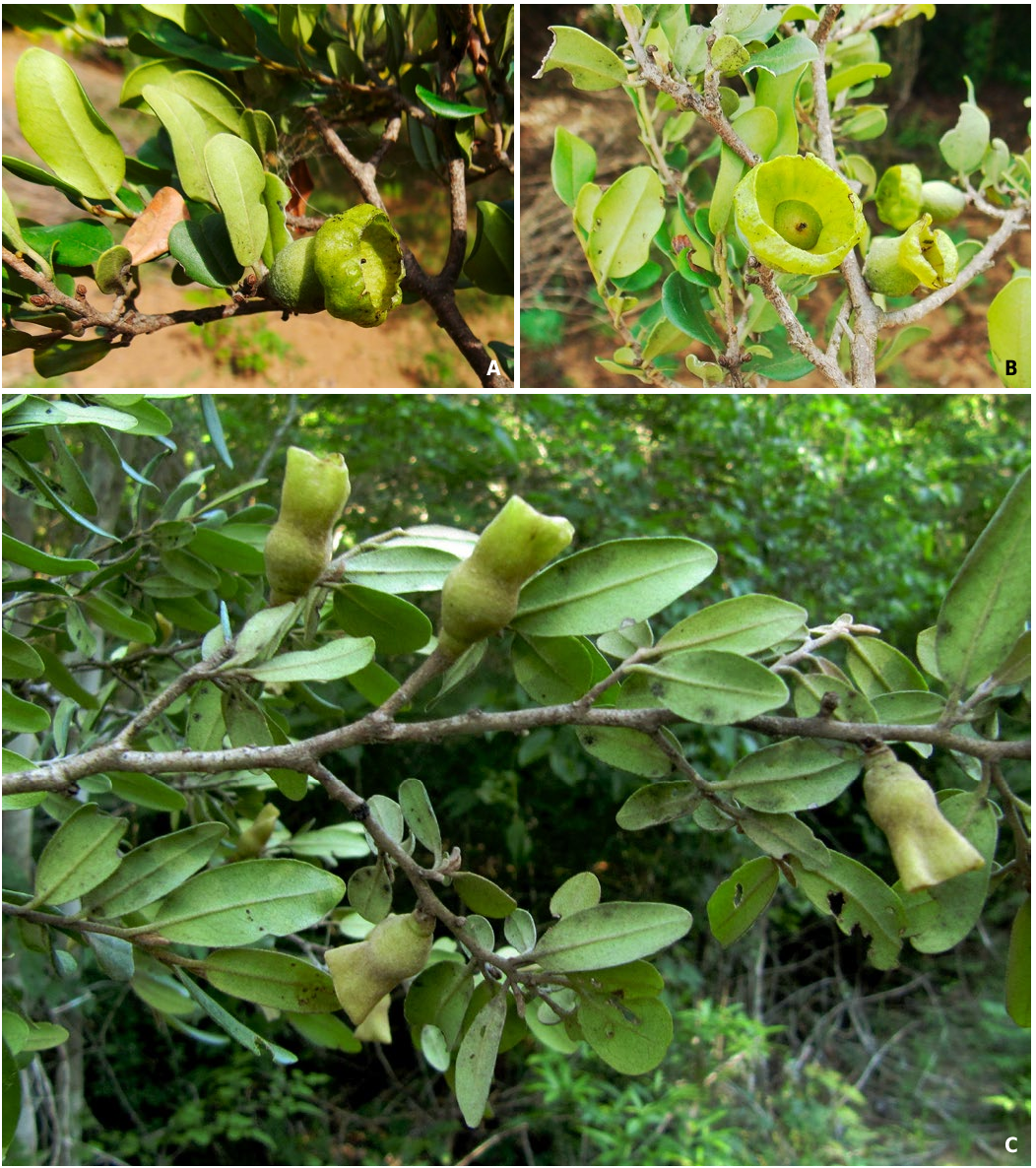
3.
Diospyros hongwae G.E. Schatz, Lowry & Phillipson
, sp. nov.
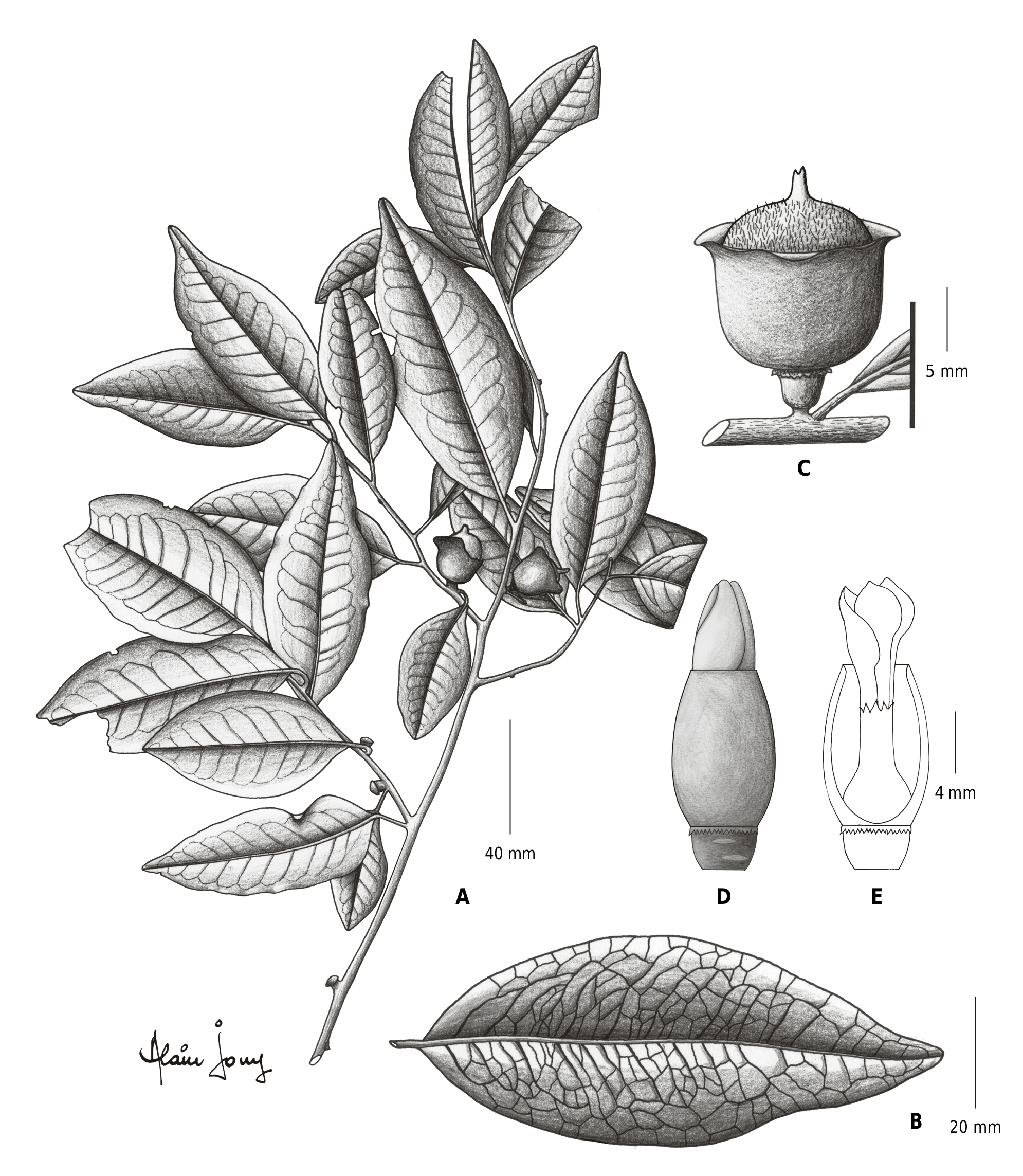
( Fig. 1B–D
View Fig
, 2
View Fig
).
Holotypus: MADAGASCAR. Reg. DIANA [Prov. Antsiranana]: env.
d’Iraro
(
vallée de l’Ifasy
), [ 13°24'S 48°55'E], 50 m, IV.1951 [ 31.III.1951], ♀ fl., fr., Service Forestier 3075 ( P [
P03975005
]!; iso-:
MO-6956006
!, G [
G00341733
]!, P [
P00722702
]!, TEF!, W!).
GoogleMaps
Diospyros hongwae G.E. Schatz, Lowry & Phillipson
can be distinguished from other members of the Bernieriana group by its large lamina (to 12 × 4.9 cm) with a flat margin and subspherical fruit slightly exserted above the cupuliform calyx, i.e., the apex of the fruit visible.
Shrub to tree 4– 15 m tall. Young stems initially sparsely to moderately densely covered with appressed, very short (< 0.1 mm) gray trichomes, glabrescent. Leaves 4–12 × 1.4–4.9 cm, elliptic, glabrous above and below, glossy above, base acute to cuneate, margin flat (weakly undulate in fresh material), apex acuminate, the acumen to 11 mm, rounded, midrib slightly impressed above, raise below, venation weakly brochidodromous with 8–10 secondary veins per side, flat to slightly raised above and below, faintly visible, tertiary venation indistinct; petiole 7–11 mm, 1 mm diam., canaliculate, initially sparsely to moderately densely covered with appressed, very short (< 0.1 mm) gray trichomes glabrescent. Male flowers not seen. Female flowers solitary in the axils of leaves and fallen leaves; pedicel 2–3 mm long, 2–3 mm diam., bearing several bracts (based upon bract scars), densely covered with very short, erect, light golden to gray trichomes; flowers ellipsoid at anthesis, calyx fully fused, adnate to the receptacle, the apex entire, 7–8 mm long, 6 mm in diam., glabrous outside, densely covered with very short, erect light golden to gray trichomes inside; calyx rapidly expanding post anthesis, extending an additional 4 mm, cupuliform; corolla tubular, 15 mm long, 4 mm in diam., lobes 4, ovate, 5 × 4 mm, apex acute, adaxially concave, densely covered with very short, appressed trichomes outside, glabrous inside; staminodia c. 18, inserted at base of corolla tube, filaments 3 mm, the distal 1 mm free, antherodes 1.5 mm, ovary subspherical, crowned by conical style, the stigma 4-lobed, lobes 1.5 mm long. Pedicel in fruit expanding to 4– 5 mm in diam., with a distinct apical rim to 6 mm in diam., the apex convex. Receptacle in fruit to 3 mm thick at base. Fruit subspherical, the apex slightly exserted above the prolonged cupuliform calyx, i.e., visible, c. 10–12 mm in diam., densely covered with short (c. 0.5 mm), appressed, light golden trichomes, crowned by the style/stigma remnant, cone-shaped, 2– 4 mm tall, 2 mm in diam. at base, densely covered with shorter (c. 0.2 mm) semi-appressed darker golden trichomes.
Etymology. – The species epithet honors our colleague and good friend Cynthia Hong-Wa, who brought order to the large and complex genus
Noronhia Stadtm. ex Thouars
(
Oleaceae
).
Vernacular name. – “Ambavy” ( Hong-Wa 317).
Distribution and ecology. –
Diospyros hongwae
is known from only three gatherings in dry forest on sandstone and alluvial soils along rivers south of Ambanja ( MADAGASCAR CATALOGUE, 2020), at an elevation of 50– 236 m.
Conservation status. –
Diospyros hongwae
has a restricted geographic range in the form of an EOO and AOO of 0.263 km ². It is not known from within any protected area, and is threatened by forest clearing for agriculture, grazing, fire, and exploitation for firewood and construction material, all of which are projected to result in continuing decline. With respect to the principal threat of forest clearing for agriculture, it exists at two locations. Therefore,
D. hongwae
can be assessed for its risk of extinction as “Endangered” [EN B1ab(i,ii,iii,iv, v)+2ab(i,ii,iii,iv,v)].
Notes. – The collections Humbert & Capuron 25932 and Service Forestier 3075 represent a single gathering divided between two separate collection series.
Diospyros hongwae
can be distinguished from other members of the Bernieriana group by its large leaves with flat margins (weakly undulate in fresh material) and its subspherical fruit, the apex of which is slightly exserted above the prolonged cupuliform calyx and thus visible.
Paratypi. – MADAGASCAR. Reg. DIANA [Prov. Antsiranana]: Ambakirano,
Behefaka
,
Anjahana
, 13°20'55"S 49°10'45"E, 236 m, 7.VI.2005, fr., Hong-Wa
317
( MO, P);
GoogleMaps
ibid. loco, 13.XII.2018, fr., Randrianaivo et al.
3298
( MO, P, TAN);
GoogleMaps
vallée de l’Ifasy
, en aval
d’Anaborano
, grès et alluvions, [ 13°24'S 48°55'E], 50–200 m, 31.III.1951, ♀ fl., fr., Humbert & Capuron
25932
( G, MO, P [2 sheets]).
GoogleMaps
4.
Diospyros ranirisonii G.E. Schatz, Lowry & Phillipson
, sp. nov.
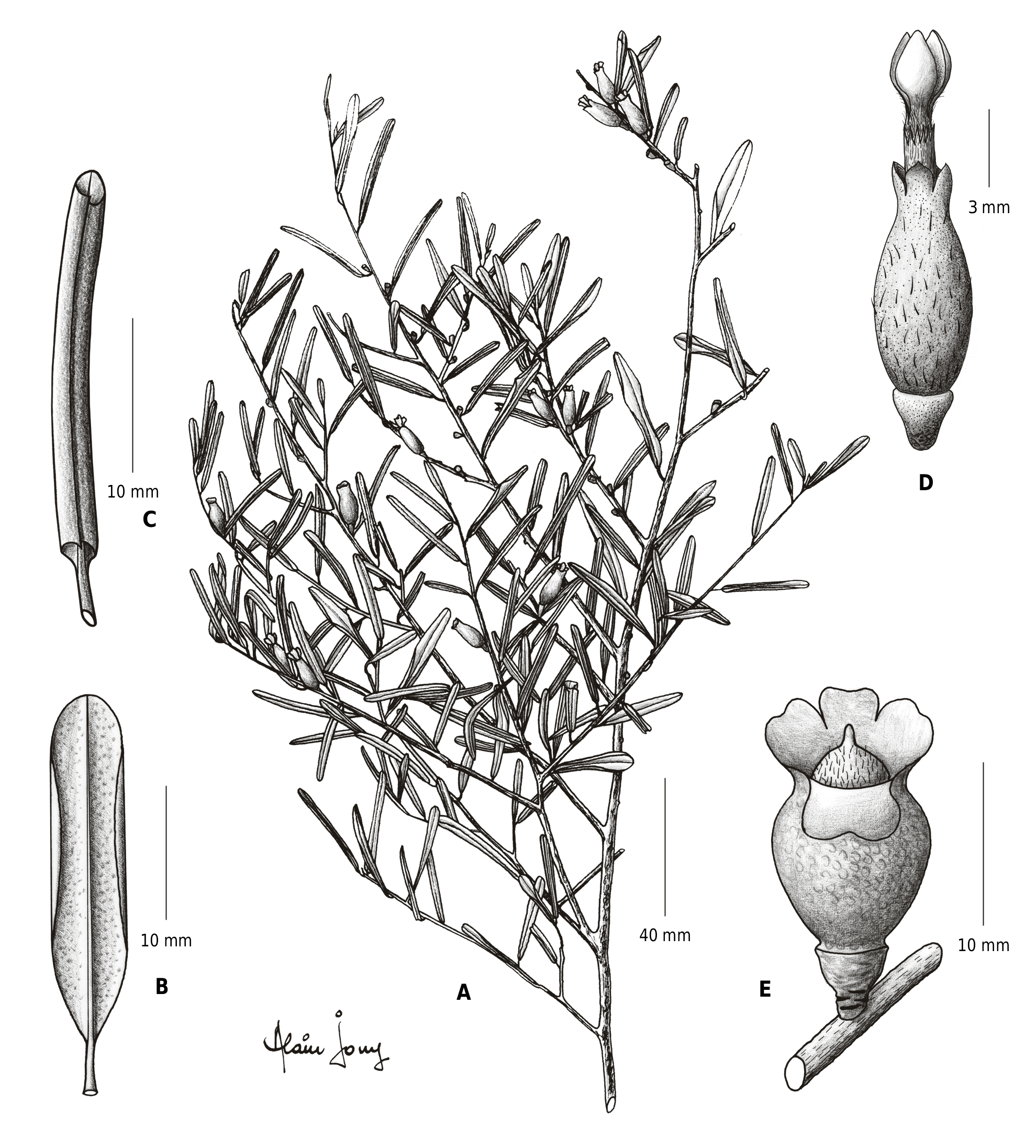
( Fig. 3
View Fig
).
Holotypus: MADAGASCAR. Reg. DIANA [Prov. Antsiranana]:
forêt de Sahafary
20.II.1962, fr., Service Forestier 20972 ( P [
P03974996
]!; iso-:
MO-6956009
!, G [
G00341734
]!, K!, P [
P00722703
]!, TEF [
TEF000892
]!, W!).
Diospyros ranirisonii G.E. Schatz, Lowry & Phillipson
can be distinguished from other members of the Bernieriana group by its linear to narrowly oblong leaves with strongly revolute margins, the abaxial surface of the lamina obscured on many leaves, its female flowers narrowly ellipsoid, 11–15 mm long, at least 2 times longer than wide, with the apex of the calyx lobed, and its mature fruit 12–16 × 7–10 mm, the lobes of the calyx 6–8 mm long.
Tree 5 – 10 m tall, to 30 cm DBH. Young stems initially densely covered with erect, very short (< 0.1 mm) gray trichomes and rufous, farinose trichomes, glabrescent. Leaves 0.9–4.4 × 0.3–0.8 cm, narrowly elliptic to linear, occasionally narrowly obovate, initially densely covered above and below with rufous farinose trichomes with a gray stellate/lepidote base, glabrescent, glossy above, base acute to cuneate, margin strongly revolute, the underside of the leaf often completely obscured, apex acute with the tip rounded, midrib slightly impressed above, raised below, covered with gray farinose trichomes, venation absent; petiole 2–4 mm, 0.8 mm diam., canaliculate, initially densely covered with rufous farinose trichomes and very short (< 0.1 mm), semi-appressed white trichomes, glabrescent. Male flowers solitary in axils of leaves, narrowly ovoid to narrowly ellipsoid; pedicels 2 mm long, 1 mm in diam., usually curved, densely covered with rufous farinose trichomes and very short (< 0.1 mm) semi-appressed, light golden trichomes; calyx tubular, 6 mm long, 2 mm in diam., densely covered with farinose trichomes and semiappressed light golden trichomes 0.2 mm long; corolla tubular, 7 mm long, 2 mm in diam., basal half glabrous, distal half densely covered with appressed trichomes < 0.1 mm, lobes 3, 3 × 2 mm, densely covered with light golden, appressed trichomes <0.1. long outside, glabrous inside; stamens 9, adnate to corolla at the base, filaments 1.5 mm, adnate for 1 mm, free for 0.5 mm, anthers 0.8 –1 × < 0.1 mm. Female flowers solitary in the axils of leaves and fallen leaves; pedicel 2–3 mm long, 2 mm diam., with 4 minute distichous bracteoles, densely covered with rufous farinose trichomes and very short (< 0.1 mm), erect, light golden to gray trichomes; flowers narrowly ellipsoid at anthesis, 10– 11 mm long, 4– 5 mm in diam., calyx adnate to receptacle, 8–10 mm tall, the apex with (3–)4 lobes, 2 × 2–3 mm, slightly reflexed, densely covered outside with rufous farinose trichomes and sparse semiappressed light golden trichomes 0.5 mm long; calyx lobes rapidly expanding post anthesis, to 6–8 × 5–6 mm, succulent; corolla tubular, 10 mm long, tube 8 mm long, lobes 4, 2 × 2 mm, broadly triangular, densely covered with semi-appressed light golden trichomes; staminodia 9, filaments 1.2 mm, antherode 0.8 mm; ovary 3 mm long, 2 mm in diam., ellipsoid, basal third glabrous, upper 2/3 densely covered with short appressed light golden trichomes, stylar column narrowly conical, 3 mm. Pedicel in fruit expanding to 4–5 mm in diam. Fruit 12–16 mm long, 7–10 mm in diam., ellipsoid, initially enclosed within the prolonged calyx until it breaks off, glabrous to densely covered toward the apex with short (< 0.1 mm), appressed, light golden trichomes, crowned by the style/stigma remnant, cone-shaped, 2 mm tall, 1 mm in diam. at base.
Etymology. – The species epithet honors Patrick Ranirison, who made many important collections from the Loky Manambato protected area while pursuing his doctoral studies and played a leading role in the establishment of the new Ampasindava and Galoko-Kalobinono protected areas.
Vernacular name and uses. – “Mapingo” ( Andriambolonera & Bernard 275). Wood is used for the manufacture of furniture ( Andriambolonera & Bernard 275).
Distribution and ecology. –
Diospyros ranirisonii
is known from dry forest on sand in the far north in DIANA and SAVA regions from the Sahafary forest south to the Bobankora forest ( MADAGASCAR CATALOGUE, 2020), at an elevation of 50– 230 m.
Conservation status. –
Diospyros ranirisonii
has a geographic range in the form of an EOO of 760 km ² and a minimum AOO of 32 km ². It is present in the Loky-Manambato protected area. At other localities, it is threatened by fire, forest clearing for agriculture, grazing, and exploitation for firewood and construction material, all of which are projected to result in continuing decline. With respect to the principal threat of forest clearing for agriculture, it exists at seven locations.
Diospyros ranirisonii
can therefore be assessed for its risk of extinction as “Vulnerable” [VU B1ab(i,ii,iii,iv,v)+2ab(i,ii,iii,iv,v)].
Notes. –
Diospyros ranirisonii
can be distinguished from other members of the Bernieriana group by its narrowly elliptic to linear leaves with strongly revolute margins, initially densely covered with rufous farinose indumentum, narrowly ellipsoid female flowers at least 2 times longer than wide, and lobed calyx enclosing the fruit, the lobes 6–8 mm long in fruit.
Paratypi. –
MADAGASCAR. Reg. DIANA [Prov. Antsiranana]:
forêt d’Analafondro
, 26.II.1964, fr., Service Forestier
23322
( FHO, G, K, MO, P [2 sheets], TAN, TEF, US, W)
;
ibid. loco, 7.II.1966, ♂ fl., Service Forestier
24522
( G, MO, P, TAN, TEF),
ibid.loco, 7.II.1966, ♀ fl., Service Forestier
24523
( G, MO, P [2 sheets], TAN, TEF, W).
Reg. SAVA [Prov. Antsiranana]: Ampondra, 3.X.2013, fr., Rabarijaona et al.
326
( K, MO, P, TAN)
;
Loky Manambato AP, 27.IX.2013, ster., Andriambololonera & Bernard
275
( MO, TAN)
;
ibid. loco, 16.IV.2004, fr., Ranirison
668
( G, MO, P)
;
ibid. loco, 14.IX.2013, fr., Onjalalaina et al.
21
( BR, K, MO, P, TAN)
;
ibid. loco, 11.II.2004, fr., Ranirison & Nusbaumer
417
( G, MO)
;
ibid. loco, 6.III.2003, fr., Gautier et al.
4241
( G, MO, P)
;
ibid. loco, 9.III.2004, fr., Gautier et al.
4506
( G, MO, P).
5.
Diospyros silicea G.E. Schatz, Lowry & Phillipson
, sp. nov.
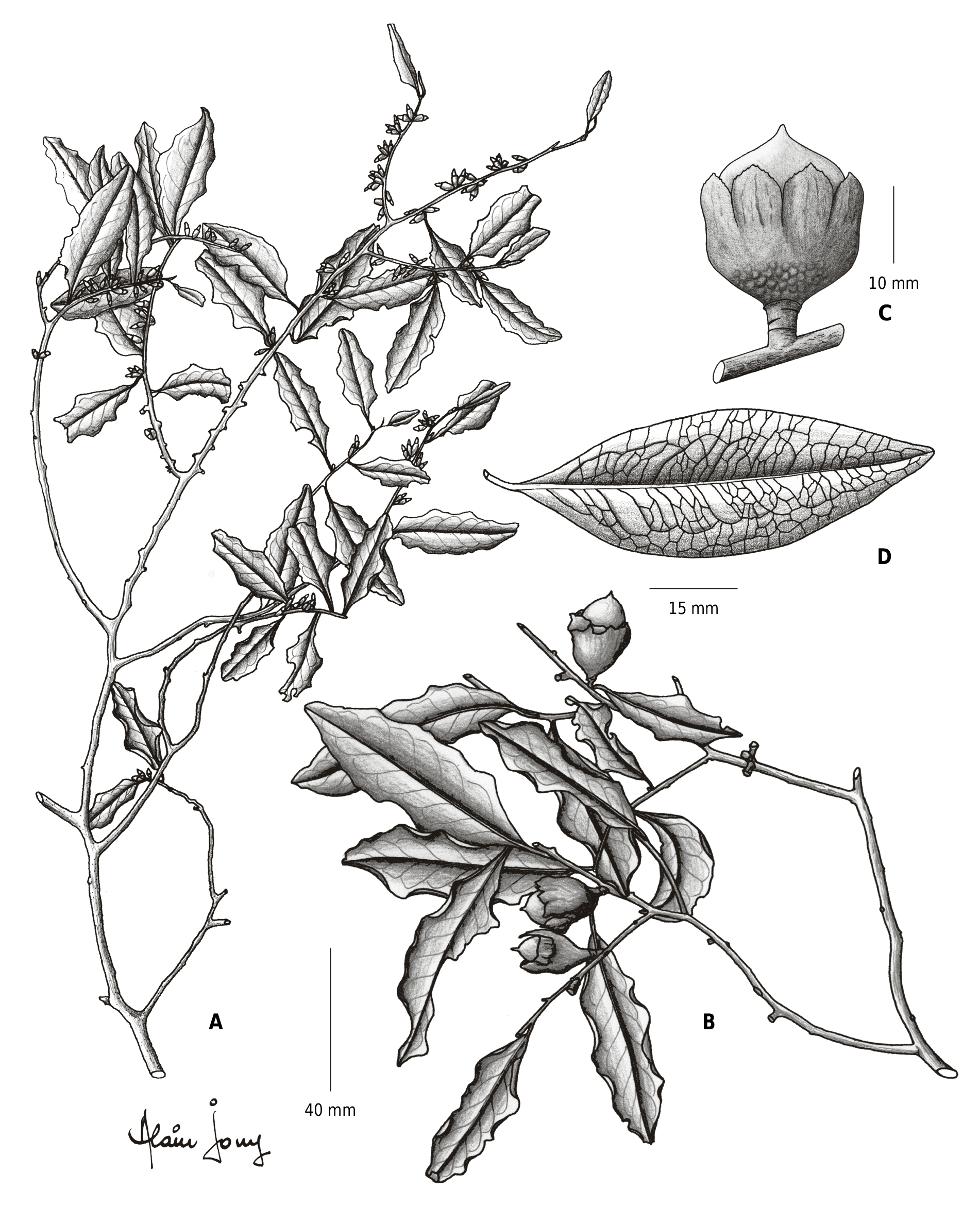
( Fig. 4
View Fig
).
Holotypus: MADAGASCAR. Region Atsimo-Andrefana [Prov. Toliara]:
forêt de Zombitsy
(= Zombitse-Vohibasia) (
Sakaraha
), [ 22°52'52"S 44°41'22"E], 600 – 850 m, 26 – 29.III.1955, fr., Humbert, Bégué & Capuron
29598
( P [
P03974999
]!; iso-: G [
G00341735
]!,
MO-6956010
!, P [
P00722704
]!, TAN!, W!).
GoogleMaps
Diospyros silicea G.E. Schatz, Lowry & Phillipson
can be distinguished from other members of the Bernieriana group by its leaves with distinctly undulate margins and its ellipsoid fruit with the apex exserted above the calyx.
Tree 5–10 m tall. Young stems initially covered with erect, very short (< 0.1 mm) gray trichomes, glabrescent. Leaves 2.4–7.8 × 1.2–2.7 cm, elliptic, glabrous above and below, base cuneate, margin distinctly undulate and somewhat revolute, apex acute to acuminate with the tip rounded, midrib slightly impressed above, raised below, venation weakly brochidodromous with 6 secondary veins per side, slightly raised and faintly visible above, completely obscure below; petiole 3–7 mm, 0.7 mm diam., canaliculate, initially covered with very short (< 0.1 mm), semi-erect white trichomes, glabrescent. Male flowers in fascicles of 3 or 4 in axils of leaves, ellipsoid, 4 – 5 mm long, 2.5– 3 mm in diam. in bud; pedicels 1 mm long, 0.5 mm in diam, covered with very short (< 0.1 mm) erect, white trichomes, bearing several caducous bracts; calyx tubular, 4–5 mm long, 2–3 mm in diam., the apex with irregular shallow lobes, densely covered very short (< 0.1 mm) semi-appressed, white trichomes and the surface papillate outside, glabrous inside; corolla tubular, 7.5 mm long, 2.2 mm in diam., basal half glabrous, distal half densely covered with very short ( 0.1 mm) appressed trichomes, lobes 5, 3 × 1.5 mm, narrowly ovate, imbricate, adaxially concave, densely covered with white, appressed trichomes c. 0.1 long outside, glabrous inside; stamens 10, adnate to corolla at the base, filaments 0.5– 0.8 mm, anthers 2– 2.2 mm. Female flowers not seen. Pedicel in fruit 2–3 mm long, to 4–5 mm in diam., covered with very short (< 0.1 mm) semi-appressed white trichomes; calyx extending 5–6 mm above fruit, apex with shallow irregular lobes, not completely enclosing the fruit, i.e., the apex of the fruit visible before the calyx lobes break off, glabrous outside, densely covered with very short (< 0.1 mm) erect, white trichomes inside. Fruit 15–18 mm long, 9–14 mm in diam., ellipsoid, the apex exserted above the calyx, glabrous to densely covered toward the apex with short (< 0.1 mm), appressed, light golden trichomes, crowned by the style/stigma remnant, cone-shaped, 2 mm tall, 1 mm in diam. at base.
Etymology. – The species epithet refers to the weathered siliceous sand substrate where the new species occurs.
Distribution and ecology. –
Diospyros silicea
is known from only two gatherings in subarid forest and thicket on siliceous sand from Zombitse-Vohibasia National Park south to Tsiombe ( MADAGASCAR CATALOGUE, 2020), at an elevation of 250– 850 m.
Conservation status. –
Diospyros silicea
has a restricted geographic range in the form of an AOO of 8 km ². It is present from the Zombitse-Vohibasia National Park. At its other known locality, east of Tsiombe, it is threatened by grazing, fire, and exploitation for firewood and construction material, all of which are projected to result in continuing decline. With respect to the principal threat of grazing, it exists at two locations. Therefore,
D. silicea
can be assessed for its risk of extinction as “Endangered” [EN B2ab(iii)].
Notes. – The two collections Humbert et al. 29598 and Service Forestier 11918 represent a single gathering divided between two separate collection series.
Diospyros silicea
can be distinguished from other members of the Bernieriana group by its leaves with distinctly undulate margins, and its ellipsoid fruit exserted above the calyx with shallow irregular lobes.
Paratypi. – MADAGASCAR. Reg. Androy [Prov. Toliara]: env. E de Tsiombe, [ 25°18'45"S 45°30'15"E], 70 m, 14.XI.1967, buds, Service Forestier
27981
( MO, P, TEF).
GoogleMaps
Reg. Atsimo-Andrefana [Prov. Toliara]:
forêt de Zombitsy
, à l’Est de
Sakaraha
, [ 22°52'52"S 44°41'22"E], [ 600–850 m], III.1955, fr., Service Forestier
11918
( G, MO, NY, P [2 sheets], TEF, US).
GoogleMaps
6.
Diospyros suarezensis G.E. Schatz, Lowry & Phillipson
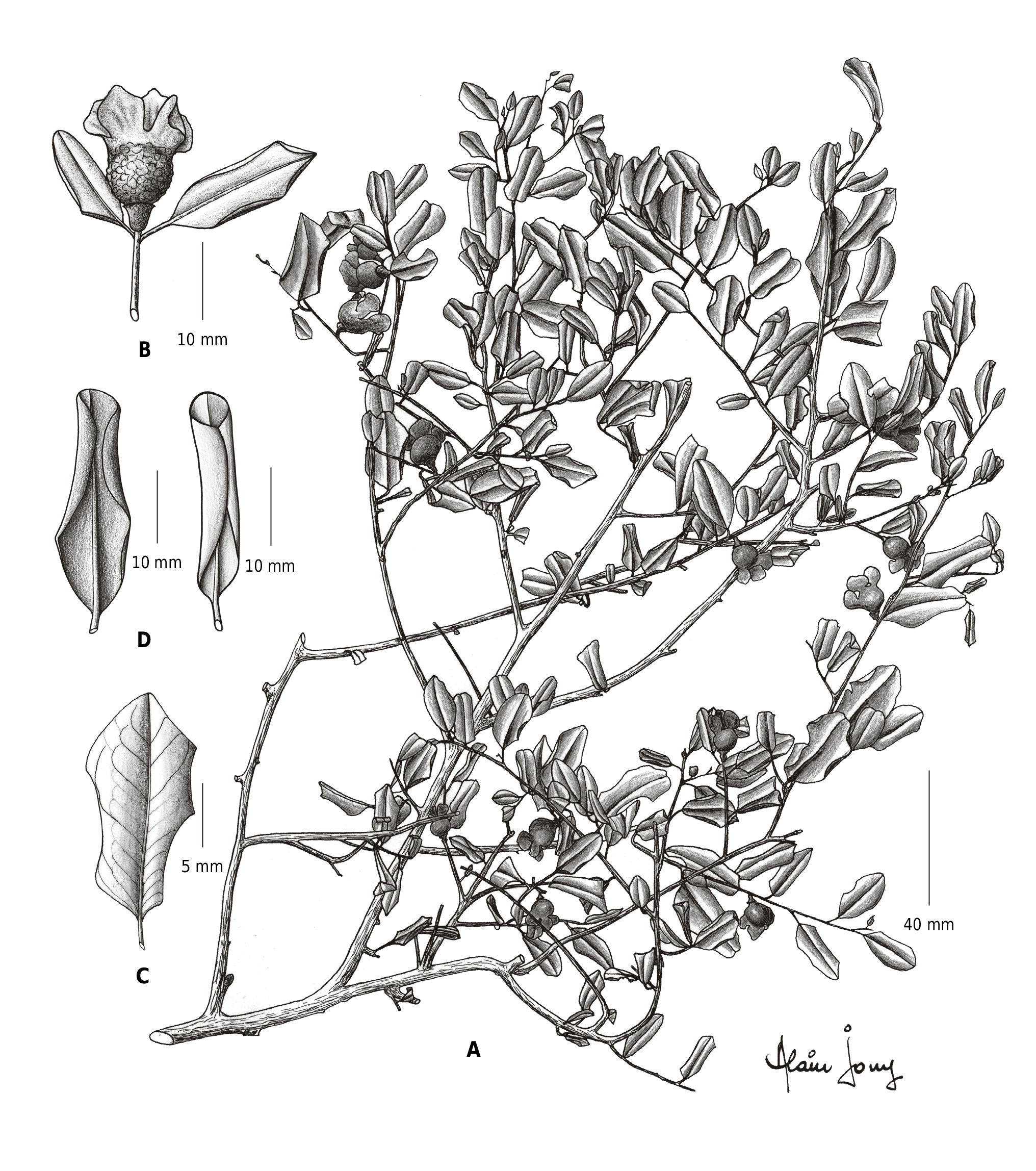
, sp. nov. ( Fig. 5
View Fig
, 6A–B
View Fig
).
Holotypus: MADAGASCAR. Reg. DIANA [Prov. Antsiranana]:
forêt d’Orangea
[ Oronjia], along the dirt track near the remains of the French fort on hill above
Ramena
, 12°15'01"S 49°21'39"E, 50 m, 20.I.2003, fr., Miller et al.
10724
(
MO-6883922
!; iso-: P [
P01031025
]!, G [
G00341891
]!, TAN!, W!).
GoogleMaps
Diospyros suarezensis G.E. Schatz, Lowry & Phillipson
can be distinguished from other members of the Bernieriana group by its small (0.8–2.7 × 0.3–1.6 cm) elliptic to obovate leaves with revolute margins, the broadest blade less than 3 times longer than wide, the adaxial surface of the lamina glossy, the abaxial surface glabrous or initially with white farinose indument and then glabrescent, its female flowers obconical, with the apex of the calyx entire, the calyx strongly accrescent in fruit to 8–9 mm long.
Shrub to tree 1.5– 5 m tall. Young stems densely covered with erect, very short (< 0.1 mm) gray trichomes. Leaves 0.8–2.7 × 0.3–1.6 cm, elliptic to obovate, glabrous and glossy above, glabrous or initially with white farinose indumentum and then glabrescent below, base acute to obtuse, margin revolute to strongly revolute and then obscuring much of the abaxial lamina surface, apex obtuse to rounded, the very tip rounded, midrib flat to slightly impressed above, slightly raised below, venation weakly brochidodromous with 3–4 secondary veins per side, flat to slightly raised above, only faintly visible above and below, tertiary venation indistinct; petiole 1–3 mm, 0.8 mm diam., canaliculate, densely covered with erect, very short (< 0.1 mm) gray trichomes. Male flowers not seen. Female flowers solitary in the axils of leaves and fallen leaves; pedicel 0.5–1 mm long, 0.7 mm diam., bearing several bracts densely covered with very short, appressed, light golden to gray trichomes; flowers obconical at anthesis, calyx fully fused, obconical, 4–5 mm long, 2 mm diam. at base to 3–3.5 mm in diam. at apex, the apex entire, densely covered with rufous farinose trichomes and very short, appressed light golden to gray trichomes outside, very densely covered with very short semi-appressed light golden trichomes inside, glabrescent outside; calyx rapidly expanding post anthesis, extending an additional 4– 9 mm, with visible venation, the apex entire; corolla tubular to slightly obconical, 5 mm long, 2 mm in diam. at base to 2.5 mm diam. at apex, glabrous for basal 2/3, densely covered with very short appressed trichomes for apical 1/3, lobes 3 or 4, broadly ovate, 2.5 × 2 mm, apex obtuse, densely covered with very short, appressed trichomes outside, glabrous inside; staminodia 4, inserted toward the apex of corolla tube, filaments adnate to corolla, 3 mm, the, antherodes 1 mm, ovary obovoid to subspherical, 2 mm tall, 2 mm in diam., densely covered with short appressed trichomes, crowned by the cylindrical style, 2 mm tall, 0.5 mm diam., densely covered with short appressed trichomes. Pedicel in fruit expanding to 2 mm long, 3–5 mm in diam. Fruit 9–12 mm in diam., subspherical, initially enclosed within the prolonged calyx until it breaks off, densely covered with short (c. 0.5 mm), appressed, light golden trichomes toward the apex, crowned by the style/stigma remnant, narrowly cone-shaped, 2 mm tall, 0.8 mm in diam. at base.
Vernacular names. – “Beando beravina” ( Christian et al. 67); “Jaobiampototra” ( Razafitsalama 593); “Kirandrambiavy madiniky” ( Be et al. 126); “Sarimina” ( Ratovoson 2105).
Distribution and ecology. –
Diospyros suarezensis
is known from dry forest on sand in the DIANA region from Oronjia south to Irodo ( MADAGASCAR CATALOGUE, 2020), at an elevation of 0– 280 m.
Conservation status. –
Diospyros suarezensis
has a restricted geographic range in the form of an EOO of 439 km ² and a minimum AOO of 68 km ². It is present in the Ambodivahibe Marine Reserve and Oronjia protected areas. Outside of protected areas, it is threatened by grazing, fire, and exploitation for firewood and construction material, all of which are projected to result in continuing decline. With respect to the principal threat of fire, it exists at 16 locations. Therefore,
D. suarezensis
can be assessed for its risk of extinction as “Near Threatened” [NT], as it nearly qualifies as “Vulnerable” under Criteria B1 and B2 ( IUCN, 2012).
Notes. –
Diospyros suarezensis
can be distinguished from other members of the Bernierana group by its small elliptic to obovate leaves with revolute margins, and its subspherical fruit enclosed within the accrescent calyx lacking lobes.
Paratypi. – MADAGASCAR. Reg. DIANA [Prov. Antsiranana]: Ambararata, 12°16'47"S 49°22'37"E, 72 m, 12.XII.2015, buds, Ratovoson
2105
( MO, P, TAN [+ 2 sheets])
GoogleMaps
;
ibid. loco, 12°16'36"S 49°22'07"E, 60 m, 13.II.2005, fl., Schatz
4234
( CNARP, MO, P, TAN)
GoogleMaps
;
Ambodivahibe, forêt littorale
d’Ampio
, 12°23'4"S 49°26'23"E, 10 m, 19.V.2005, fr., Ramananjanahary et al.
309
( MO, P, TAN)
GoogleMaps
;
Andrafiabe, 3 km au NW
d’Ambolobozokely
, 12°25'59"S 49°30'07"E, 34 m, 16.VI.2005, fr., Be et al.
126
( MO, P, TAN)
GoogleMaps
;
ibid. loco, 12°26'00"S 49°30'08"E, 16 m, 28.XII.2008, fr., Christian et al.
67
( CNARP, MO, TAN)
GoogleMaps
;
ibid. loco, 4 km au N
d’Ambolobozobe
, 12°29'00"S 49°31'25"E, 10 m, 8.II.2005, fr., Ratovoson et al.
929
( G, MO, P, TAN)
GoogleMaps
;
ibid. loco, 2 km au NW du village, 12°26'15"S 49°29'15"E, 11.XII.2007, fl., Rakotoarisoa
767
( K, TAN)
GoogleMaps
;
Andrafiakely,
Ambolobozokely
,
Ampasimena
, à 2 km au NW du village, 12°26'15"S 49°29'39"E, 11.XII.2007, fr., Rakotonandrasana
1264
( MO, P, TAN)
GoogleMaps
;
Ankarongana (
Korangana
),
Irodo
,
Analafondro forest
, 12°37'47"S 49°31'15"E, 55 m, 24.II.2006, ster., Birkinshaw et al.
1593
( MO, P, TAN)
GoogleMaps
;
Ankorikakely, rte
Ramena
, PK 10.5, 12°17'59"S 49°21'21"E, 5 m, 11.V.2005, fr., Ratovoson et al.
978
( G, MO, P, TAN)
GoogleMaps
;
ibid. loco, 12°17'18"S 49°21'27"E, 0 m, 16.II.2005, fr. Schatz et al.
4337
( CNARP, MO, P, TAN)
GoogleMaps
;
à l’E
d’Antsiranana
, [ 12°16'S 49°22'E], 22.II.1962, fr., Service Forestier
20941
( MO, P, TEF)
GoogleMaps
;
ibid. loco, [ 12°16'00"S 49°22'00"E], 25.II.1964, fr., Service Forestier 23259 ( MO, P [2 sheets], TEF)
GoogleMaps
;
Baie des Dunes
, 12°14'27"S 49°22'26"E, 10 m, 17.V.2004, fr., Razafitsalama et al.
593
( MO, P, TAN)
GoogleMaps
;
forêt
d’Analafondro
, à la base du plateau de Sahafary (sur la rive gauche du Rodo inf.), [ 12°37'S 49°29'E], 1.V.1966, fr., Service Forestier
24710
( MO, P [2 sheets], TEF)
GoogleMaps
;
forêt de Matsaborimaiky, 12°15'31"S 49°22'05"E, 22.I.2014, ♀ fl., Randrianaivo et al.
2437
( BR, G, MO, TEF)
GoogleMaps
;
forêt E de Diego-Suarez, 12°22'S 49°21'23"E, X.1975, Rakotozafy
1517
( TAN)
GoogleMaps
;
Irodo, 12°38'03"S 49°31'48"E, 53 m, 27.V.2005, fr., Hong-Wa et al.
227
( MO, P, TAN)
GoogleMaps
;
Oronjia, 12°14'11"S 49°21'51"E, 41 m, 27.I.2014, fr, Rabarijaona et al.
526
( BR, K, MO, P, TAN)
GoogleMaps
;
ibid. loco, [ 12°15'S 49°23'E], 27.IV.1963, fr., Service Forestier
22727
( G, MO, P [2 sheets], TEF)
GoogleMaps
;
ibid. loco (au S),
prés d’Ivovona
, [ 12°19'S 49°23'E], 15.XII.1963, ster., Service Forestier
22965
( MO, P, TEF)
GoogleMaps
;
ibid. loco, 15.XII.1963, ♂ fl., Service Forestier
22966
( G, MO, P, TEF, W)
GoogleMaps
;
Ramena ( 2 km à l’E du village), 12°15'05"S 49°22'01"E, 12.I.2005, fr., Randrianaivo et al.
1144
( G, MO, P, TAN)
GoogleMaps
;
Sahafary,
Sadjoavato
,
Saharenana
ambany, 12°35'05"S 49°27'22"E, 205 m, 5.XII.2006, fr., Andriamihajarivo et al.
1036
( CNARP, MO, P, TAN)
GoogleMaps
;
ibid. loco, 12°36'26"S 49°26'43"E, 280 m, 8.I.2007, ♂ fl., Ratovoson et al.
1170
( MO, P, TAN)
GoogleMaps
;
Tanneverse
, PK 10, rte de Ramena, 12°17'58"S 49°21'20"E, 18.X.2013, fr., Rakotoarisoa & Andriamahay
3258
( K, MO, P, TAN, TEF).
GoogleMaps
7.
Diospyros torquata H. Perrier
in Mém. Inst. Sci. Madagascar, Sér. B, Biol. Vég. 4: 112. 1952.
Lectotypus (designated by SCHATZ & LOWRY, 2011: 280):
MADAGASCAR. Reg. Boeny [Prov. Mahajanga]:
baie d’Amboanio
, près de Majunga, II.1911, fr., Perrier de la Bâthie 1823 ( P [
P00573702
]!)
.
=
Diospyros torquata var. mabaoides H. Perrier
in Mém. Inst. Sci Madag., sér. B, 4: 112 (1952).
Lectotypus (designated by SCHATZ & LOWRY, 2011: 280):
MADAGASCAR. Reg. Boeny [Prov. Mahajanga]: près de la mer, Majunga, I.1929, ♀ fl., fr., Perrier de la Bâthie 13468 ( P [
P00573703
]!; isolecto-: P [
P00573704
,
P00573705
]!).
Distribution and ecology. –
Diospyros torquata
is distributed in dry deciduous forest on sand from Boriziny south to the Kirindy forest north of Morondava ( MADAGASCAR CATALOGUE, 2020), at an elevation of 0– 242 m.
Vernacular names. – “Hazomalandy” ( Ramananjanahary 52); “Hazomintina” ( Service Forestier 34798); “Kehazalahy” ( Service Forestier 19040).
Conservation status. –
Diospyros torquata
has a geographic range in the form of an EOO of 74,659 km ² and a minimum AOO of 60 km ². It is present in the Ankarafantsika National Park. At other localities, it is threatened by fire, forest clearing for agriculture, grazing, and exploitation for firewood and construction material, all of which are projected to result in continuing decline. With respect to the principal threat of forest clearing for agriculture, it exists at fourteen locations.
Diospyros torquata
can therefore be assessed for its risk of extinction as “Near Threatened” [NT], as it nearly qualifies for “Vulnerable” under criterion B2 ( IUCN, 2012).
Notes. –
Diospyros torquata
can be distinguished from other members of the Bernieriana group by its flat lamina and fruit completely enclosed within the accrescent calyx ( Fig. 6C
View Fig
), the portion extending above the fruit tubular to narrowly conical and unlobed. The
var. mabaoides
was described to accommodate 6-locular fruit, which nevertheless exhibited a 4-merous corolla, variation that PERRIER DE LA BÂTHIE (1952b) had observed within the population at the baie d’Amboanio, the type locality of
D. torquata
.
The type collection of
Diospyros torquata
was incorrectly cited in the protologue as Perrier de la Bâthie 1923 ( PERRIER DE LA BÂTHIE, 1952a).
Additional material examined. –
MADAGASCAR. Reg. Betsiboka [Prov. Mahajanga]: Tsinainaondry, près
Antaliha
, 12.II.1958, fr., Service Forestier
19040
( P [2 sheets]).
Reg. Boeny [Prov. Mahajanga]: Ambatoboeny,
Tsaramandroso
, 18.IV.2007, fr., Miandrimanana et al.
100
( MO, P, TAN)
;
Ankarafantsika AP, 25.II.2019, ster., Randrianaivo & Rakotovao
3347
( DBEV, MO, P, TAN, ZT)
;
ibid. loco, 4.IV.1933, fr., Service Forestier
55
( P)
;
ibid. loco, 30.III.1952, fr., Service Forestier
5485
( P, TEF)
;
Antsanitia, 7.I.2000, fr., Rakotonasolo
130
( K, P, TAN)
;
Benetsy
, 1965, ster., Service Forestier
24274
( G, MO, P, TEF)
;
Mahajanga, 24.XI.1965, fr., Service Forestier
24303
( P [3 sheets], TEF)
;
ibid. loco, 24.XI.1965, ♂ fl., Service Forestier
24298
( MO, P [2 sheets])
;
ibid. loco, 25.II.2019, ster., Randrianaivo & Rakotovao
3348
( DBEV, MO, P, TAN, ZT)
;
Tsimaloto,
Marovoay
, 18.II.1997, Service Forestier
34798
( TEF)
;
Vallée du Menavava, XII.1905, fr., Perrier de la Bâthie
8777
( P [2 sheets]).
Reg. Melaky [Prov. Mahajanga]:
Ankiloty
, 22.II.1957, fr., Service Forestier
16713
( MO, P, TEF)
;
Beanka, 17.III.2012, fr., Hanitrarivo et al.
356
( G, MO, P).
Reg. Menabe [Prov. Toliara]:
Kirindy Forest
, 13.II.2010, fr., Phillipson et al.
6146
( G, K, MO, P, TAN).
Reg. Sofia [Prov. Mahajanga]: S de Boriziny, 16.XI.2004, fr., Ramananjanahary
52
( MO, P, TEF).
3. Diospyros hongwae G.E. Schatz, Lowry & Phillipson , sp. nov.
( Fig. 1B–D View Fig , 2 View Fig ).
Holotypus: MADAGASCAR. Reg. DIANA [Prov. Antsiranana]: env. d’Iraro ( vallée de l’Ifasy ), [ 13°24'S 48°55'E], 50 m, IV.1951 [ 31.III.1951], ♀ fl., fr., Service Forestier 3075 ( P [ P03975005 ]!; iso-: MO-6956006 !, G [ G00341733 ]!, P [ P00722702 ]!, TEF!, W!). GoogleMaps
Diospyros hongwae G.E. Schatz, Lowry & Phillipson can be distinguished from other members of the Bernieriana group by its large lamina (to 12 × 4.9 cm) with a flat margin and subspherical fruit slightly exserted above the cupuliform calyx, i.e., the apex of the fruit visible.
Shrub to tree 4– 15 m tall. Young stems initially sparsely to moderately densely covered with appressed, very short (< 0.1 mm) gray trichomes, glabrescent. Leaves 4–12 × 1.4–4.9 cm, elliptic, glabrous above and below, glossy above, base acute to cuneate, margin flat (weakly undulate in fresh material), apex acuminate, the acumen to 11 mm, rounded, midrib slightly impressed above, raise below, venation weakly brochidodromous with 8–10 secondary veins per side, flat to slightly raised above and below, faintly visible, tertiary venation indistinct; petiole 7–11 mm, 1 mm diam., canaliculate, initially sparsely to moderately densely covered with appressed, very short (< 0.1 mm) gray trichomes glabrescent. Male flowers not seen. Female flowers solitary in the axils of leaves and fallen leaves; pedicel 2–3 mm long, 2–3 mm diam., bearing several bracts (based upon bract scars), densely covered with very short, erect, light golden to gray trichomes; flowers ellipsoid at anthesis, calyx fully fused, adnate to the receptacle, the apex entire, 7–8 mm long, 6 mm in diam., glabrous outside, densely covered with very short, erect light golden to gray trichomes inside; calyx rapidly expanding post anthesis, extending an additional 4 mm, cupuliform; corolla tubular, 15 mm long, 4 mm in diam., lobes 4, ovate, 5 × 4 mm, apex acute, adaxially concave, densely covered with very short, appressed trichomes outside, glabrous inside; staminodia c. 18, inserted at base of corolla tube, filaments 3 mm, the distal 1 mm free, antherodes 1.5 mm, ovary subspherical, crowned by conical style, the stigma 4-lobed, lobes 1.5 mm long. Pedicel in fruit expanding to 4– 5 mm in diam., with a distinct apical rim to 6 mm in diam., the apex convex. Receptacle in fruit to 3 mm thick at base. Fruit subspherical, the apex slightly exserted above the prolonged cupuliform calyx, i.e., visible, c. 10–12 mm in diam., densely covered with short (c. 0.5 mm), appressed, light golden trichomes, crowned by the style/stigma remnant, cone-shaped, 2– 4 mm tall, 2 mm in diam. at base, densely covered with shorter (c. 0.2 mm) semi-appressed darker golden trichomes.
Etymology. – The species epithet honors our colleague and good friend Cynthia Hong-Wa, who brought order to the large and complex genus Noronhia Stadtm. ex Thouars ( Oleaceae ).
Vernacular name. – “Ambavy” ( Hong-Wa 317).
Distribution and ecology. – Diospyros hongwae is known from only three gatherings in dry forest on sandstone and alluvial soils along rivers south of Ambanja ( MADAGASCAR CATALOGUE, 2020), at an elevation of 50– 236 m.
Conservation status. – Diospyros hongwae has a restricted geographic range in the form of an EOO and AOO of 0.263 km ². It is not known from within any protected area, and is threatened by forest clearing for agriculture, grazing, fire, and exploitation for firewood and construction material, all of which are projected to result in continuing decline. With respect to the principal threat of forest clearing for agriculture, it exists at two locations. Therefore, D. hongwae can be assessed for its risk of extinction as “Endangered” [EN B1ab(i,ii,iii,iv, v)+2ab(i,ii,iii,iv,v)].
View FigureNotes. – The collections Humbert & Capuron 25932 and Service Forestier 3075 represent a single gathering divided between two separate collection series. Diospyros hongwae can be distinguished from other members of the Bernieriana group by its large leaves with flat margins (weakly undulate in fresh material) and its subspherical fruit, the apex of which is slightly exserted above the prolonged cupuliform calyx and thus visible.
Paratypi. – MADAGASCAR. Reg. DIANA [Prov. Antsiranana]: Ambakirano, Behefaka , Anjahana , 13°20'55"S 49°10'45"E, 236 m, 7.VI.2005, fr., Hong-Wa 317 ( MO, P); GoogleMaps ibid. loco, 13.XII.2018, fr., Randrianaivo et al. 3298 ( MO, P, TAN); GoogleMaps vallée de l’Ifasy , en aval d’Anaborano , grès et alluvions, [ 13°24'S 48°55'E], 50–200 m, 31.III.1951, ♀ fl., fr., Humbert & Capuron 25932 ( G, MO, P [2 sheets]). GoogleMaps
4. Diospyros ranirisonii G.E. Schatz, Lowry & Phillipson , sp. nov.
( Fig. 3 View Fig ).
Holotypus: MADAGASCAR. Reg. DIANA [Prov. Antsiranana]: forêt de Sahafary 20.II.1962, fr., Service Forestier 20972 ( P [ P03974996 ]!; iso-: MO-6956009 !, G [ G00341734 ]!, K!, P [ P00722703 ]!, TEF [ TEF000892 ]!, W!).
Diospyros ranirisonii G.E. Schatz, Lowry & Phillipson can be distinguished from other members of the Bernieriana group by its linear to narrowly oblong leaves with strongly revolute margins, the abaxial surface of the lamina obscured on many leaves, its female flowers narrowly ellipsoid, 11–15 mm long, at least 2 times longer than wide, with the apex of the calyx lobed, and its mature fruit 12–16 × 7–10 mm, the lobes of the calyx 6–8 mm long.
Tree 5 – 10 m tall, to 30 cm DBH. Young stems initially densely covered with erect, very short (< 0.1 mm) gray trichomes and rufous, farinose trichomes, glabrescent. Leaves 0.9–4.4 × 0.3–0.8 cm, narrowly elliptic to linear, occasionally narrowly obovate, initially densely covered above and below with rufous farinose trichomes with a gray stellate/lepidote base, glabrescent, glossy above, base acute to cuneate, margin strongly revolute, the underside of the leaf often completely obscured, apex acute with the tip rounded, midrib slightly impressed above, raised below, covered with gray farinose trichomes, venation absent; petiole 2–4 mm, 0.8 mm diam., canaliculate, initially densely covered with rufous farinose trichomes and very short (< 0.1 mm), semi-appressed white trichomes, glabrescent. Male flowers solitary in axils of leaves, narrowly ovoid to narrowly ellipsoid; pedicels 2 mm long, 1 mm in diam., usually curved, densely covered with rufous farinose trichomes and very short (< 0.1 mm) semi-appressed, light golden trichomes; calyx tubular, 6 mm long, 2 mm in diam., densely covered with farinose trichomes and semiappressed light golden trichomes 0.2 mm long; corolla tubular, 7 mm long, 2 mm in diam., basal half glabrous, distal half densely covered with appressed trichomes < 0.1 mm, lobes 3, 3 × 2 mm, densely covered with light golden, appressed trichomes <0.1. long outside, glabrous inside; stamens 9, adnate to corolla at the base, filaments 1.5 mm, adnate for 1 mm, free for 0.5 mm, anthers 0.8 –1 × < 0.1 mm. Female flowers solitary in the axils of leaves and fallen leaves; pedicel 2–3 mm long, 2 mm diam., with 4 minute distichous bracteoles, densely covered with rufous farinose trichomes and very short (< 0.1 mm), erect, light golden to gray trichomes; flowers narrowly ellipsoid at anthesis, 10– 11 mm long, 4– 5 mm in diam., calyx adnate to receptacle, 8–10 mm tall, the apex with (3–)4 lobes, 2 × 2–3 mm, slightly reflexed, densely covered outside with rufous farinose trichomes and sparse semiappressed light golden trichomes 0.5 mm long; calyx lobes rapidly expanding post anthesis, to 6–8 × 5–6 mm, succulent; corolla tubular, 10 mm long, tube 8 mm long, lobes 4, 2 × 2 mm, broadly triangular, densely covered with semi-appressed light golden trichomes; staminodia 9, filaments 1.2 mm, antherode 0.8 mm; ovary 3 mm long, 2 mm in diam., ellipsoid, basal third glabrous, upper 2/3 densely covered with short appressed light golden trichomes, stylar column narrowly conical, 3 mm. Pedicel in fruit expanding to 4–5 mm in diam. Fruit 12–16 mm long, 7–10 mm in diam., ellipsoid, initially enclosed within the prolonged calyx until it breaks off, glabrous to densely covered toward the apex with short (< 0.1 mm), appressed, light golden trichomes, crowned by the style/stigma remnant, cone-shaped, 2 mm tall, 1 mm in diam. at base.
Etymology. – The species epithet honors Patrick Ranirison, who made many important collections from the Loky Manambato protected area while pursuing his doctoral studies and played a leading role in the establishment of the new Ampasindava and Galoko-Kalobinono protected areas.
Vernacular name and uses. – “Mapingo” ( Andriambolonera & Bernard 275). Wood is used for the manufacture of furniture ( Andriambolonera & Bernard 275).
Distribution and ecology. – Diospyros ranirisonii is known from dry forest on sand in the far north in DIANA and SAVA regions from the Sahafary forest south to the Bobankora forest ( MADAGASCAR CATALOGUE, 2020), at an elevation of 50– 230 m.
Conservation status. – Diospyros ranirisonii has a geographic range in the form of an EOO of 760 km ² and a minimum AOO of 32 km ². It is present in the Loky-Manambato protected area. At other localities, it is threatened by fire, forest clearing for agriculture, grazing, and exploitation for firewood and construction material, all of which are projected to result in continuing decline. With respect to the principal threat of forest clearing for agriculture, it exists at seven locations.
View FigureDiospyros ranirisonii can therefore be assessed for its risk of extinction as “Vulnerable” [VU B1ab(i,ii,iii,iv,v)+2ab(i,ii,iii,iv,v)].
Notes. – Diospyros ranirisonii can be distinguished from other members of the Bernieriana group by its narrowly elliptic to linear leaves with strongly revolute margins, initially densely covered with rufous farinose indumentum, narrowly ellipsoid female flowers at least 2 times longer than wide, and lobed calyx enclosing the fruit, the lobes 6–8 mm long in fruit.
Paratypi. – MADAGASCAR. Reg. DIANA [Prov. Antsiranana]: forêt d’Analafondro , 26.II.1964, fr., Service Forestier 23322 ( FHO, G, K, MO, P [2 sheets], TAN, TEF, US, W) ; ibid. loco, 7.II.1966, ♂ fl., Service Forestier 24522 ( G, MO, P, TAN, TEF), ibid.loco, 7.II.1966, ♀ fl., Service Forestier 24523 ( G, MO, P [2 sheets], TAN, TEF, W). Reg. SAVA [Prov. Antsiranana]: Ampondra, 3.X.2013, fr., Rabarijaona et al. 326 ( K, MO, P, TAN) ; Loky Manambato AP, 27.IX.2013, ster., Andriambololonera & Bernard 275 ( MO, TAN) ; ibid. loco, 16.IV.2004, fr., Ranirison 668 ( G, MO, P) ; ibid. loco, 14.IX.2013, fr., Onjalalaina et al. 21 ( BR, K, MO, P, TAN) ; ibid. loco, 11.II.2004, fr., Ranirison & Nusbaumer 417 ( G, MO) ; ibid. loco, 6.III.2003, fr., Gautier et al. 4241 ( G, MO, P) ; ibid. loco, 9.III.2004, fr., Gautier et al. 4506 ( G, MO, P).
5. Diospyros silicea G.E. Schatz, Lowry & Phillipson , sp. nov.
( Fig. 4 View Fig ).
Holotypus: MADAGASCAR. Region Atsimo-Andrefana [Prov. Toliara]: forêt de Zombitsy (= Zombitse-Vohibasia) ( Sakaraha ), [ 22°52'52"S 44°41'22"E], 600 – 850 m, 26 – 29.III.1955, fr., Humbert, Bégué & Capuron 29598 ( P [ P03974999 ]!; iso-: G [ G00341735 ]!, MO-6956010 !, P [ P00722704 ]!, TAN!, W!). GoogleMaps
Diospyros silicea G.E. Schatz, Lowry & Phillipson can be distinguished from other members of the Bernieriana group by its leaves with distinctly undulate margins and its ellipsoid fruit with the apex exserted above the calyx.
Tree 5–10 m tall. Young stems initially covered with erect, very short (< 0.1 mm) gray trichomes, glabrescent. Leaves 2.4–7.8 × 1.2–2.7 cm, elliptic, glabrous above and below, base cuneate, margin distinctly undulate and somewhat revolute, apex acute to acuminate with the tip rounded, midrib slightly impressed above, raised below, venation weakly brochidodromous with 6 secondary veins per side, slightly raised and faintly visible above, completely obscure below; petiole 3–7 mm, 0.7 mm diam., canaliculate, initially covered with very short (< 0.1 mm), semi-erect white trichomes, glabrescent. Male flowers in fascicles of 3 or 4 in axils of leaves, ellipsoid, 4 – 5 mm long, 2.5– 3 mm in diam. in bud; pedicels 1 mm long, 0.5 mm in diam, covered with very short (< 0.1 mm) erect, white trichomes, bearing several caducous bracts; calyx tubular, 4–5 mm long, 2–3 mm in diam., the apex with irregular shallow lobes, densely covered very short (< 0.1 mm) semi-appressed, white trichomes and the surface papillate outside, glabrous inside; corolla tubular, 7.5 mm long, 2.2 mm in diam., basal half glabrous, distal half densely covered with very short ( 0.1 mm) appressed trichomes, lobes 5, 3 × 1.5 mm, narrowly ovate, imbricate, adaxially concave, densely covered with white, appressed trichomes c. 0.1 long outside, glabrous inside; stamens 10, adnate to corolla at the base, filaments 0.5– 0.8 mm, anthers 2– 2.2 mm. Female flowers not seen. Pedicel in fruit 2–3 mm long, to 4–5 mm in diam., covered with very short (< 0.1 mm) semi-appressed white trichomes; calyx extending 5–6 mm above fruit, apex with shallow irregular lobes, not completely enclosing the fruit, i.e., the apex of the fruit visible before the calyx lobes break off, glabrous outside, densely covered with very short (< 0.1 mm) erect, white trichomes inside. Fruit 15–18 mm long, 9–14 mm in diam., ellipsoid, the apex exserted above the calyx, glabrous to densely covered toward the apex with short (< 0.1 mm), appressed, light golden trichomes, crowned by the style/stigma remnant, cone-shaped, 2 mm tall, 1 mm in diam. at base.
Etymology. – The species epithet refers to the weathered siliceous sand substrate where the new species occurs.
Distribution and ecology. – Diospyros silicea is known from only two gatherings in subarid forest and thicket on siliceous sand from Zombitse-Vohibasia National Park south to Tsiombe ( MADAGASCAR CATALOGUE, 2020), at an elevation of 250– 850 m.
Conservation status. – Diospyros silicea has a restricted geographic range in the form of an AOO of 8 km ². It is present from the Zombitse-Vohibasia National Park. At its other known locality, east of Tsiombe, it is threatened by grazing, fire, and exploitation for firewood and construction material, all of which are projected to result in continuing decline. With respect to the principal threat of grazing, it exists at two locations. Therefore, D. silicea can be assessed for its risk of extinction as “Endangered” [EN B2ab(iii)].
Notes. – The two collections Humbert et al. 29598 and Service Forestier 11918 represent a single gathering divided between two separate collection series. Diospyros silicea can be distinguished from other members of the Bernieriana group by its leaves with distinctly undulate margins, and its ellipsoid fruit exserted above the calyx with shallow irregular lobes.
Paratypi. – MADAGASCAR. Reg. Androy [Prov. Toliara]: env. E de Tsiombe, [ 25°18'45"S 45°30'15"E], 70 m, 14.XI.1967, buds, Service Forestier 27981 ( MO, P, TEF). GoogleMaps Reg. Atsimo-Andrefana [Prov. Toliara]: forêt de Zombitsy , à l’Est de Sakaraha , [ 22°52'52"S 44°41'22"E], [ 600–850 m], III.1955, fr., Service Forestier 11918 ( G, MO, NY, P [2 sheets], TEF, US). GoogleMaps
6. Diospyros suarezensis G.E. Schatz, Lowry & Phillipson , sp. nov. ( Fig. 5 View Fig , 6A–B View Fig ).
Holotypus: MADAGASCAR. Reg. DIANA [Prov. Antsiranana]: forêt d’Orangea [ Oronjia], along the dirt track near the remains of the French fort on hill above Ramena , 12°15'01"S 49°21'39"E, 50 m, 20.I.2003, fr., Miller et al. 10724 ( MO-6883922 !; iso-: P [ P01031025 ]!, G [ G00341891 ]!, TAN!, W!). GoogleMaps
Diospyros suarezensis G.E. Schatz, Lowry & Phillipson can be distinguished from other members of the Bernieriana group by its small (0.8–2.7 × 0.3–1.6 cm) elliptic to obovate leaves with revolute margins, the broadest blade less than 3 times longer than wide, the adaxial surface of the lamina glossy, the abaxial surface glabrous or initially with white farinose indument and then glabrescent, its female flowers obconical, with the apex of the calyx entire, the calyx strongly accrescent in fruit to 8–9 mm long.
Shrub to tree 1.5– 5 m tall. Young stems densely covered with erect, very short (< 0.1 mm) gray trichomes. Leaves 0.8–2.7 × 0.3–1.6 cm, elliptic to obovate, glabrous and glossy above, glabrous or initially with white farinose indumentum and then glabrescent below, base acute to obtuse, margin revolute to strongly revolute and then obscuring much of the abaxial lamina surface, apex obtuse to rounded, the very tip rounded, midrib flat to slightly impressed above, slightly raised below, venation weakly brochidodromous with 3–4 secondary veins per side, flat to slightly raised above, only faintly visible above and below, tertiary venation indistinct; petiole 1–3 mm, 0.8 mm diam., canaliculate, densely covered with erect, very short (< 0.1 mm) gray trichomes. Male flowers not seen. Female flowers solitary in the axils of leaves and fallen leaves; pedicel 0.5–1 mm long, 0.7 mm diam., bearing several bracts densely covered with very short, appressed, light golden to gray trichomes; flowers obconical at anthesis, calyx fully fused, obconical, 4–5 mm long, 2 mm diam. at base to 3–3.5 mm in diam. at apex, the apex entire, densely covered with rufous farinose trichomes and very short, appressed light golden to gray trichomes outside, very densely covered with very short semi-appressed light golden trichomes inside, glabrescent outside; calyx rapidly expanding post anthesis, extending an additional 4– 9 mm, with visible venation, the apex entire; corolla tubular to slightly obconical, 5 mm long, 2 mm in diam. at base to 2.5 mm diam. at apex, glabrous for basal 2/3, densely covered with very short appressed trichomes for apical 1/3, lobes 3 or 4, broadly ovate, 2.5 × 2 mm, apex obtuse, densely covered with very short, appressed trichomes outside, glabrous inside; staminodia 4, inserted toward the apex of corolla tube, filaments adnate to corolla, 3 mm, the, antherodes 1 mm, ovary obovoid to subspherical, 2 mm tall, 2 mm in diam., densely covered with short appressed trichomes, crowned by the cylindrical style, 2 mm tall, 0.5 mm diam., densely covered with short appressed trichomes. Pedicel in fruit expanding to 2 mm long, 3–5 mm in diam. Fruit 9–12 mm in diam., subspherical, initially enclosed within the prolonged calyx until it breaks off, densely covered with short (c. 0.5 mm), appressed, light golden trichomes toward the apex, crowned by the style/stigma remnant, narrowly cone-shaped, 2 mm tall, 0.8 mm in diam. at base.
Vernacular names. – “Beando beravina” ( Christian et al. 67); “Jaobiampototra” ( Razafitsalama 593); “Kirandrambiavy madiniky” ( Be et al. 126); “Sarimina” ( Ratovoson 2105).
Distribution and ecology. – Diospyros suarezensis is known from dry forest on sand in the DIANA region from Oronjia south to Irodo ( MADAGASCAR CATALOGUE, 2020), at an elevation of 0– 280 m.
Conservation status. – Diospyros suarezensis has a restricted geographic range in the form of an EOO of 439 km ² and a minimum AOO of 68 km ². It is present in the Ambodivahibe Marine Reserve and Oronjia protected areas. Outside of protected areas, it is threatened by grazing, fire, and exploitation for firewood and construction material, all of which are projected to result in continuing decline. With respect to the principal threat of fire, it exists at 16 locations. Therefore, D. suarezensis can be assessed for its risk of extinction as “Near Threatened” [NT], as it nearly qualifies as “Vulnerable” under Criteria B1 and B2 ( IUCN, 2012).
Notes. – Diospyros suarezensis can be distinguished from other members of the Bernierana group by its small elliptic to obovate leaves with revolute margins, and its subspherical fruit enclosed within the accrescent calyx lacking lobes.
Paratypi. – MADAGASCAR. Reg. DIANA [Prov. Antsiranana]: Ambararata, 12°16'47"S 49°22'37"E, 72 m, 12.XII.2015, buds, Ratovoson 2105 ( MO, P, TAN [+ 2 sheets]) GoogleMaps ; ibid. loco, 12°16'36"S 49°22'07"E, 60 m, 13.II.2005, fl., Schatz 4234 ( CNARP, MO, P, TAN) GoogleMaps ; Ambodivahibe, forêt littorale d’Ampio , 12°23'4"S 49°26'23"E, 10 m, 19.V.2005, fr., Ramananjanahary et al. 309 ( MO, P, TAN) GoogleMaps ; Andrafiabe, 3 km au NW d’Ambolobozokely , 12°25'59"S 49°30'07"E, 34 m, 16.VI.2005, fr., Be et al. 126 ( MO, P, TAN) GoogleMaps ; ibid. loco, 12°26'00"S 49°30'08"E, 16 m, 28.XII.2008, fr., Christian et al. 67 ( CNARP, MO, TAN) GoogleMaps ; ibid. loco, 4 km au N d’Ambolobozobe , 12°29'00"S 49°31'25"E, 10 m, 8.II.2005, fr., Ratovoson et al. 929 ( G, MO, P, TAN) GoogleMaps ; ibid. loco, 2 km au NW du village, 12°26'15"S 49°29'15"E, 11.XII.2007, fl., Rakotoarisoa 767 ( K, TAN) GoogleMaps ; Andrafiakely, Ambolobozokely , Ampasimena , à 2 km au NW du village, 12°26'15"S 49°29'39"E, 11.XII.2007, fr., Rakotonandrasana 1264 ( MO, P, TAN) GoogleMaps ; Ankarongana ( Korangana ), Irodo , Analafondro forest , 12°37'47"S 49°31'15"E, 55 m, 24.II.2006, ster., Birkinshaw et al. 1593 ( MO, P, TAN) GoogleMaps ; Ankorikakely, rte Ramena , PK 10.5, 12°17'59"S 49°21'21"E, 5 m, 11.V.2005, fr., Ratovoson et al. 978 ( G, MO, P, TAN) GoogleMaps ; ibid. loco, 12°17'18"S 49°21'27"E, 0 m, 16.II.2005, fr. Schatz et al. 4337 ( CNARP, MO, P, TAN) GoogleMaps ; à l’E d’Antsiranana , [ 12°16'S 49°22'E], 22.II.1962, fr., Service Forestier 20941 ( MO, P, TEF) GoogleMaps ; ibid. loco, [ 12°16'00"S 49°22'00"E], 25.II.1964, fr., Service Forestier 23259 ( MO, P [2 sheets], TEF) GoogleMaps ; Baie des Dunes , 12°14'27"S 49°22'26"E, 10 m, 17.V.2004, fr., Razafitsalama et al. 593 ( MO, P, TAN) GoogleMaps ; forêt d’Analafondro , à la base du plateau de Sahafary (sur la rive gauche du Rodo inf.), [ 12°37'S 49°29'E], 1.V.1966, fr., Service Forestier 24710 ( MO, P [2 sheets], TEF) GoogleMaps ; forêt de Matsaborimaiky, 12°15'31"S 49°22'05"E, 22.I.2014, ♀ fl., Randrianaivo et al. 2437 ( BR, G, MO, TEF) GoogleMaps ; forêt E de Diego-Suarez, 12°22'S 49°21'23"E, X.1975, Rakotozafy 1517 ( TAN) GoogleMaps ; Irodo, 12°38'03"S 49°31'48"E, 53 m, 27.V.2005, fr., Hong-Wa et al. 227 ( MO, P, TAN) GoogleMaps ; Oronjia, 12°14'11"S 49°21'51"E, 41 m, 27.I.2014, fr, Rabarijaona et al. 526 ( BR, K, MO, P, TAN) GoogleMaps ; ibid. loco, [ 12°15'S 49°23'E], 27.IV.1963, fr., Service Forestier 22727 ( G, MO, P [2 sheets], TEF) GoogleMaps ; ibid. loco (au S), prés d’Ivovona , [ 12°19'S 49°23'E], 15.XII.1963, ster., Service Forestier 22965 ( MO, P, TEF) GoogleMaps ; ibid. loco, 15.XII.1963, ♂ fl., Service Forestier 22966 ( G, MO, P, TEF, W) GoogleMaps ; Ramena ( 2 km à l’E du village), 12°15'05"S 49°22'01"E, 12.I.2005, fr., Randrianaivo et al. 1144 ( G, MO, P, TAN) GoogleMaps ; Sahafary, Sadjoavato , Saharenana ambany, 12°35'05"S 49°27'22"E, 205 m, 5.XII.2006, fr., Andriamihajarivo et al. 1036 ( CNARP, MO, P, TAN) GoogleMaps ; ibid. loco, 12°36'26"S 49°26'43"E, 280 m, 8.I.2007, ♂ fl., Ratovoson et al. 1170 ( MO, P, TAN) GoogleMaps ; Tanneverse , PK 10, rte de Ramena, 12°17'58"S 49°21'20"E, 18.X.2013, fr., Rakotoarisoa & Andriamahay 3258 ( K, MO, P, TAN, TEF). GoogleMaps
7. Diospyros torquata H. Perrier in Mém. Inst. Sci. Madagascar, Sér. B, Biol. Vég. 4: 112. 1952.
Lectotypus (designated by SCHATZ & LOWRY, 2011: 280): MADAGASCAR. Reg. Boeny [Prov. Mahajanga]: baie d’Amboanio , près de Majunga, II.1911, fr., Perrier de la Bâthie 1823 ( P [ P00573702 ]!) .
= Diospyros torquata var. mabaoides H. Perrier in Mém. Inst. Sci Madag., sér. B, 4: 112 (1952).
Lectotypus (designated by SCHATZ & LOWRY, 2011: 280): MADAGASCAR. Reg. Boeny [Prov. Mahajanga]: près de la mer, Majunga, I.1929, ♀ fl., fr., Perrier de la Bâthie 13468 ( P [ P00573703 ]!; isolecto-: P [ P00573704 , P00573705 ]!).
Distribution and ecology. – Diospyros torquata is distributed in dry deciduous forest on sand from Boriziny south to the Kirindy forest north of Morondava ( MADAGASCAR CATALOGUE, 2020), at an elevation of 0– 242 m.
Vernacular names. – “Hazomalandy” ( Ramananjanahary 52); “Hazomintina” ( Service Forestier 34798); “Kehazalahy” ( Service Forestier 19040).
Conservation status. – Diospyros torquata has a geographic range in the form of an EOO of 74,659 km ² and a minimum AOO of 60 km ². It is present in the Ankarafantsika National Park. At other localities, it is threatened by fire, forest clearing for agriculture, grazing, and exploitation for firewood and construction material, all of which are projected to result in continuing decline. With respect to the principal threat of forest clearing for agriculture, it exists at fourteen locations. Diospyros torquata can therefore be assessed for its risk of extinction as “Near Threatened” [NT], as it nearly qualifies for “Vulnerable” under criterion B2 ( IUCN, 2012).
Notes. – Diospyros torquata can be distinguished from other members of the Bernieriana group by its flat lamina and fruit completely enclosed within the accrescent calyx ( Fig. 6C View Fig ), the portion extending above the fruit tubular to narrowly conical and unlobed. The var. mabaoides was described to accommodate 6-locular fruit, which nevertheless exhibited a 4-merous corolla, variation that PERRIER DE LA BÂTHIE (1952b) had observed within the population at the baie d’Amboanio, the type locality of D. torquata .
The type collection of Diospyros torquata was incorrectly cited in the protologue as Perrier de la Bâthie 1923 ( PERRIER DE LA BÂTHIE, 1952a).
Additional material examined. – MADAGASCAR. Reg. Betsiboka [Prov. Mahajanga]: Tsinainaondry, près Antaliha , 12.II.1958, fr., Service Forestier 19040 ( P [2 sheets]). Reg. Boeny [Prov. Mahajanga]: Ambatoboeny, Tsaramandroso , 18.IV.2007, fr., Miandrimanana et al. 100 ( MO, P, TAN) ; Ankarafantsika AP, 25.II.2019, ster., Randrianaivo & Rakotovao 3347 ( DBEV, MO, P, TAN, ZT) ; ibid. loco, 4.IV.1933, fr., Service Forestier 55 ( P) ; ibid. loco, 30.III.1952, fr., Service Forestier 5485 ( P, TEF) ; Antsanitia, 7.I.2000, fr., Rakotonasolo 130 ( K, P, TAN) ; Benetsy , 1965, ster., Service Forestier 24274 ( G, MO, P, TEF) ; Mahajanga, 24.XI.1965, fr., Service Forestier 24303 ( P [3 sheets], TEF) ; ibid. loco, 24.XI.1965, ♂ fl., Service Forestier 24298 ( MO, P [2 sheets]) ; ibid. loco, 25.II.2019, ster., Randrianaivo & Rakotovao 3348 ( DBEV, MO, P, TAN, ZT) ; Tsimaloto, Marovoay , 18.II.1997, Service Forestier 34798 ( TEF) ; Vallée du Menavava, XII.1905, fr., Perrier de la Bâthie 8777 ( P [2 sheets]). Reg. Melaky [Prov. Mahajanga]: Ankiloty , 22.II.1957, fr., Service Forestier 16713 ( MO, P, TEF) ; Beanka, 17.III.2012, fr., Hanitrarivo et al. 356 ( G, MO, P). Reg. Menabe [Prov. Toliara]: Kirindy Forest , 13.II.2010, fr., Phillipson et al. 6146 ( G, K, MO, P, TAN). Reg. Sofia [Prov. Mahajanga]: S de Boriziny, 16.XI.2004, fr., Ramananjanahary 52 ( MO, P, TEF).

| N |
Nanjing University |
| S |
Department of Botany, Swedish Museum of Natural History |
No known copyright restrictions apply. See Agosti, D., Egloff, W., 2009. Taxonomic information exchange and copyright: the Plazi approach. BMC Research Notes 2009, 2:53 for further explanation.
|
Kingdom |
|
|
Phylum |
|
|
Class |
|
|
Order |
|
|
Family |
|
|
Genus |