
Braunus prionotus, 2016
|
publication ID |
https://doi.org/10.11646/zootaxa.4078.1.16 |
|
publication LSID |
lsid:zoobank.org:pub:0102DC85-29D8-4B7A-BD24-984C115189AA |
|
persistent identifier |
https://treatment.plazi.org/id/03BF87AB-1B2A-FFCA-9AC4-99CB33F3FE5D |
|
treatment provided by |
Plazi |
|
scientific name |
Braunus prionotus |
| status |
|
Braunus Distant, 1899
Braunus Distant, 1899: 422–423; Kirkaldy, 1909: 220. Lojus McDonald, 1982: 327. syn. nov.
Type species. Braunus: Coriplatus sciocorinus Walker, 1867, by monotypy. Lojus : Lojus asperus McDonald, 1982, by original designation.
Diagnosis. Mandibular plates widely triangular apically, at least as long as clypeus. Costal margin of each forewing with a basal process. Peritreme of the metathoracic gland obsolete; mesial margin of each ostiole bordered by a globoid tubercle. Abdominal sternite III projected over abdominal sternite IV ventro-medially. Male genitalia: dorsal rim of pygophore concave with 1 + 1 trapezoidal expansions laterad to segment X; segment X rectangular. Female genitalia: sutural margin of each gonocoxite 8 parallel basally, usually juxtaposed, and divergent apically.
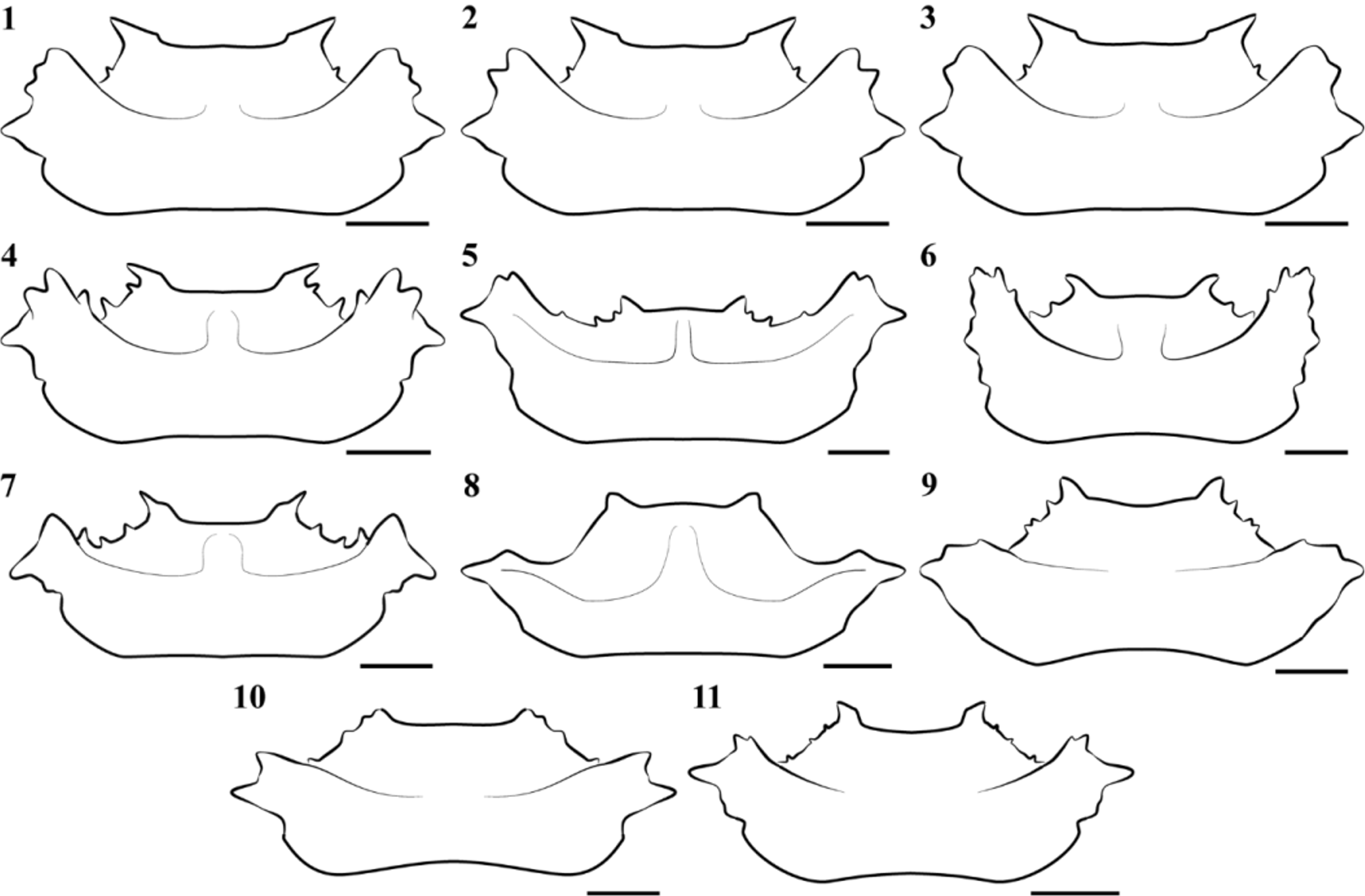
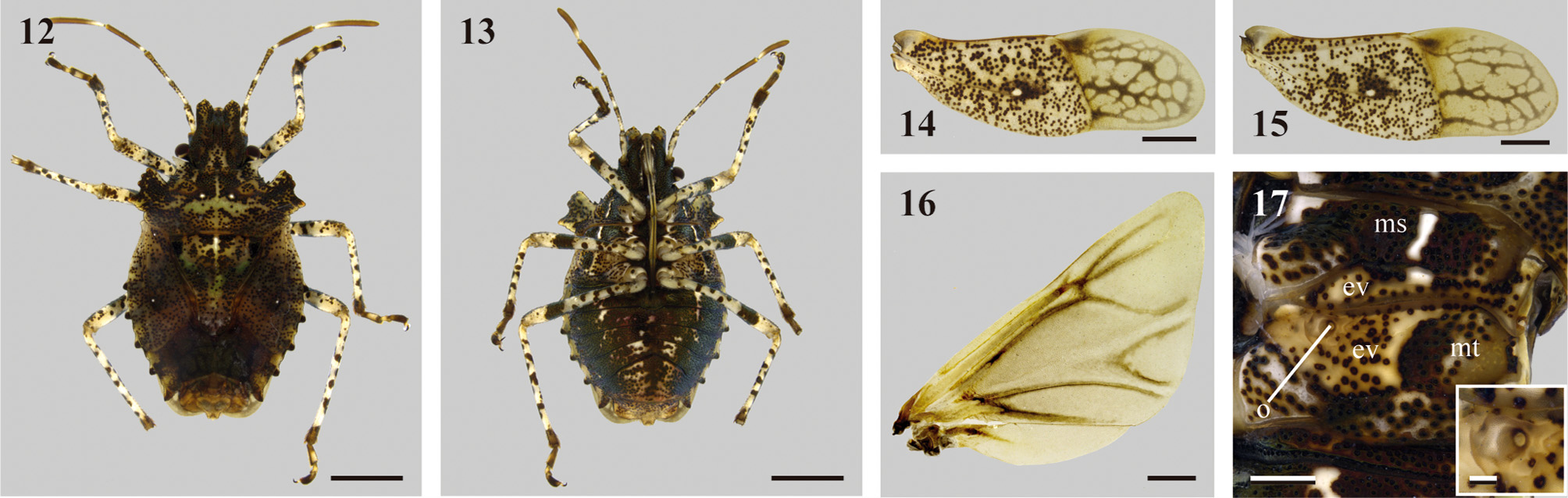
Description. Brown to dark-brown or mottled brown and ivory; legs dark-brown or yellowish with brown, circular spots; dorsal and ventral surfaces of connexivum light brown medially. Integument strongly corrugated dorsally. Head longer than wide; mandibular plates equal to or longer than clypeus, but usually not meeting anterior to clypeus, widely triangular apically; anterior margin of each bucculae triangular, each posterior margin tapering towards base of head; ocelli from rudimentary to well-developed; antennae five-segmented; labium arising before anterior margin of eyes, attaining from hind coxae to abdominal sternite III. Anterior angles of pronotum obtuse or acutely projected; anterolateral margins smooth or with spine-like tubercles; humeral angles strongly projected laterad or anteriad, each with a single process or quadrate with two or more processes marginally; posterolateral margin each with or without a median tubercle and indentation; posterior margin straight to strongly concave; cicatrices swollen ( Figs 1–11 View FIGURES 1 – 11 ). Scutellum foveate in basal angles. Costal margin of each forewing with an obtuse process basally; radial vein calloused or not apically; membranal veins coarse and reticulated; length of corium and membrane variable ( Figs 14 –15 View FIGURES 12 – 17 , 56– 57 View FIGURES 54 – 59 ). Peritreme of metasternal gland obsolete; mesial margin of ostiole bordered by a rounded process; evaporatorium concolorous with pleural color pattern, reaching halfway to lateral metapleural margin and to the posterior margin of mesopleura ( Figs 17 View FIGURES 12 – 17 , 51 View FIGURES 48 – 53 , 59 View FIGURES 54 – 59 ). Posterolateral angles of abdominal sternites each projected posterolaterally, obtuse apically. Median portion of abdominal sternite III projected onto base of abdominal sternite IV.
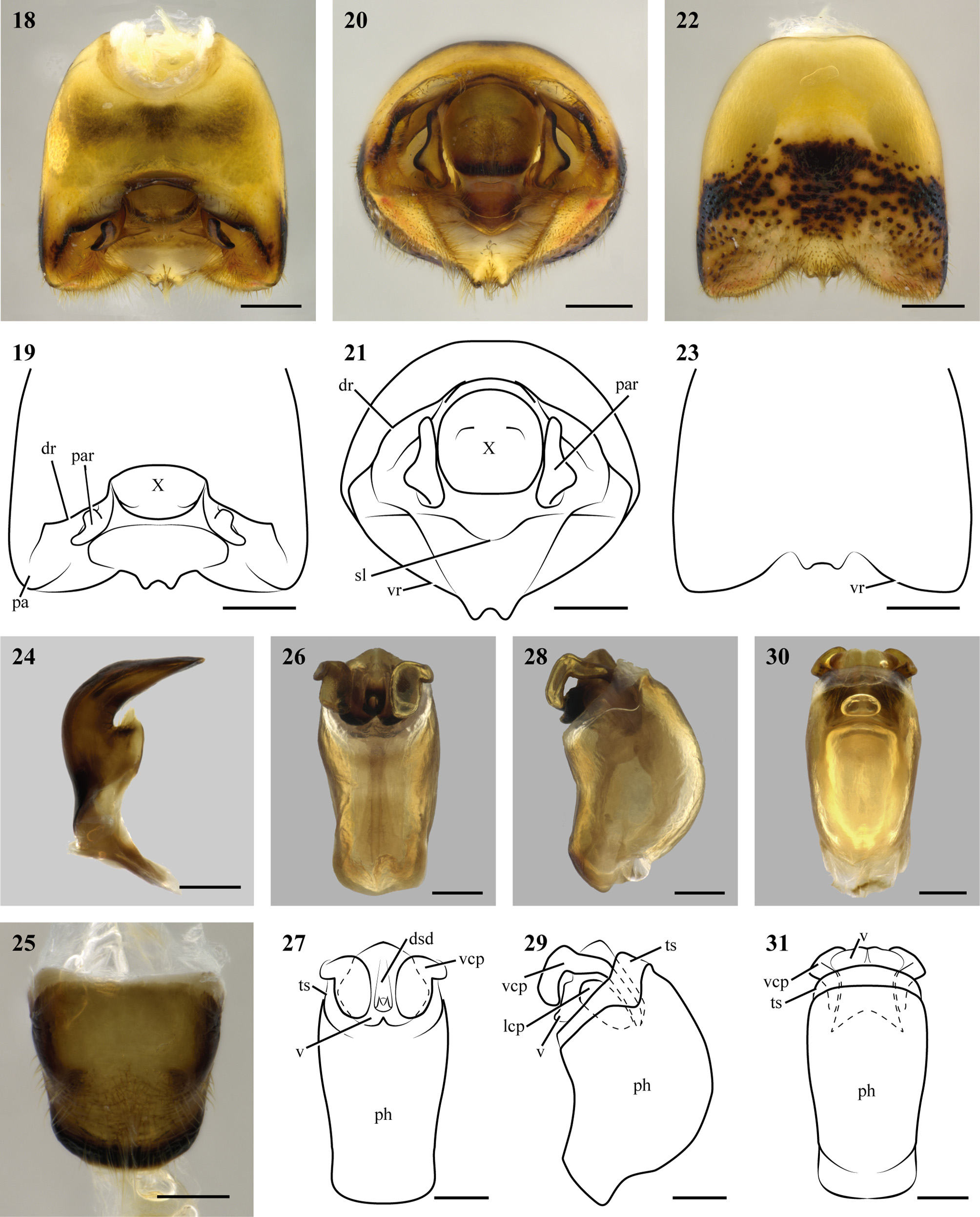
Male genitalia. Pygophore sub-quadrate ( Figs 18 –23 View FIGURES 18 – 31 , 38–43 View FIGURES 36 – 43 , 60– 65 View FIGURES 60 – 73 ). Dorsal rim concave with 1 + 1 trapezoidal projections laterally to segment X. Segment X rectangular ( Figs 25 View FIGURES 18 – 31 , 67 View FIGURES 60 – 73 ). Parameres F-shaped ( Figs 24 View FIGURES 18 – 31 , 66 View FIGURES 60 – 73 ), placed laterad to segment X. Inferior layer of ventral rim uniformly excavated or emarginated; superior layer of ventral rim depressed medially. Apical margin of phallotheca with a membranous thecal shield ( Figs 26 –31 View FIGURES 18 – 31 , 68– 73 View FIGURES 60 – 73 ; ts). Ventral and laterodorsal conjunctival processes present, ventral hatchet-like.
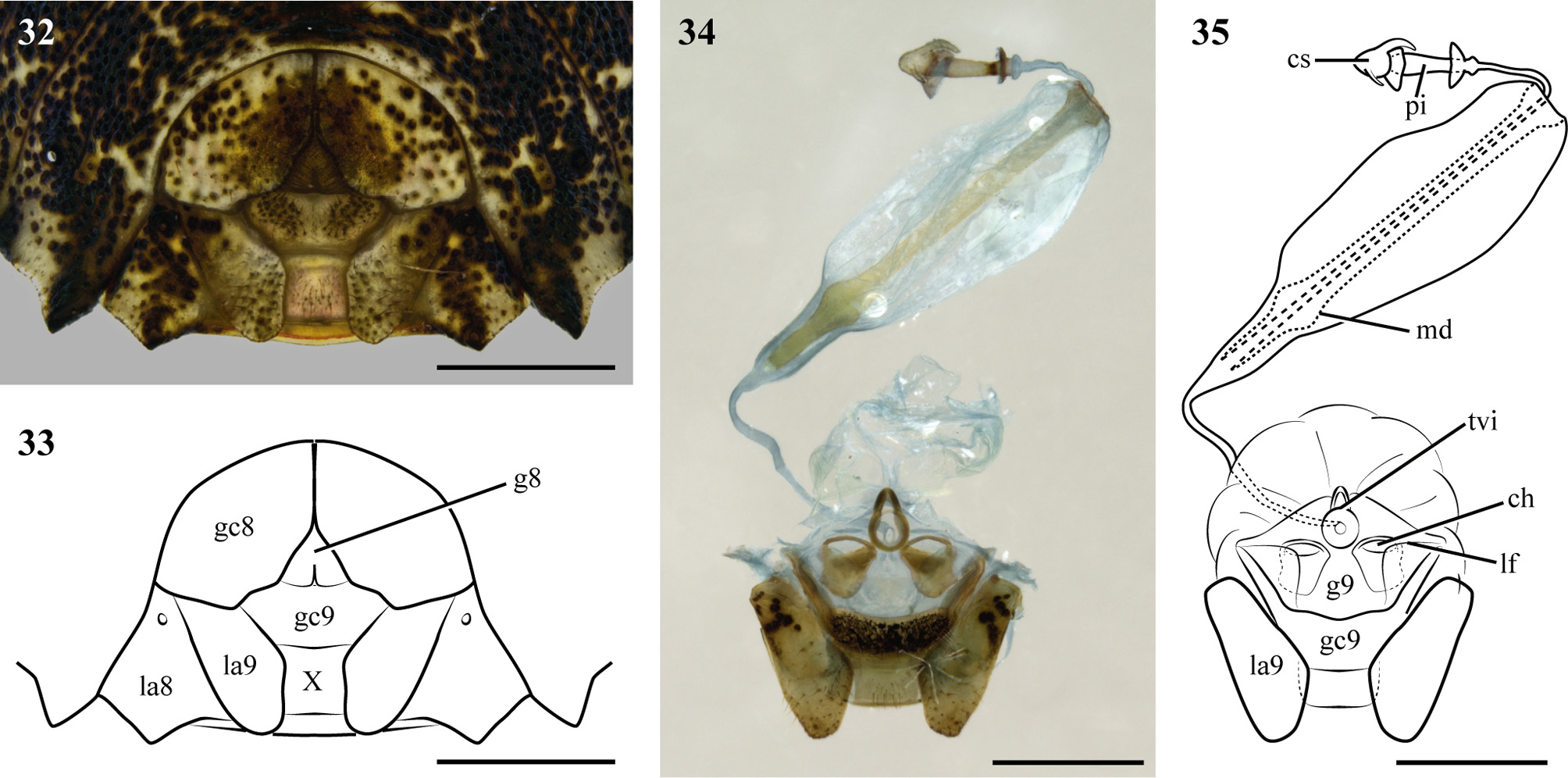
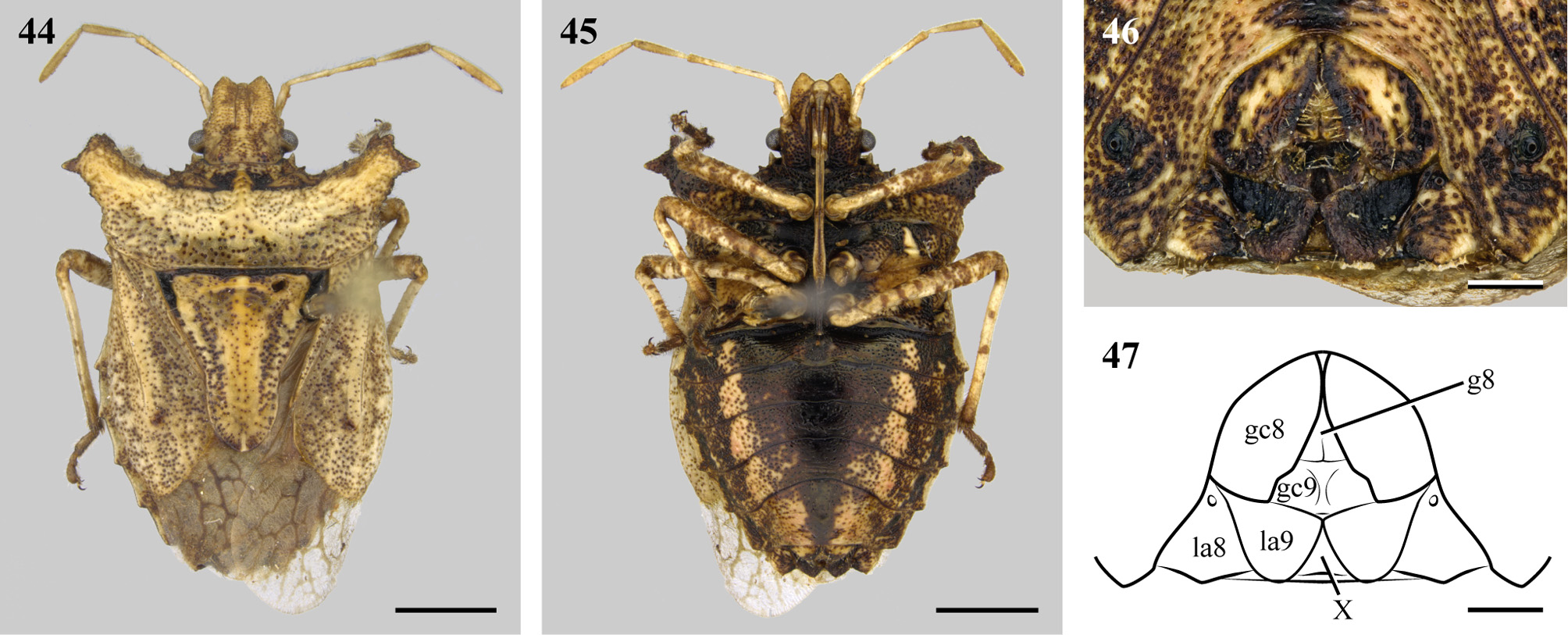
Female genitalia ( Figs 32 –33 View FIGURES 32 – 35 , 46–47 View FIGURES 44 – 47 , 52–53 View FIGURES 48 – 53 , 74– 75 View FIGURES 74 – 77 ). S utural margins of gonocoxites 8 each parallel basally, usually juxtaposed, and divergent apically. Gonapophyses 8 visible, usually carinated medially. Spiracle of laterotergites 8 visible, placed posterior to lateral angle of each gonocoxite 8. Gonocoxites 9 rectangular or trapezoidal. Laterotergites 9 basally depressed, rounded apically. Segment X rectangular.
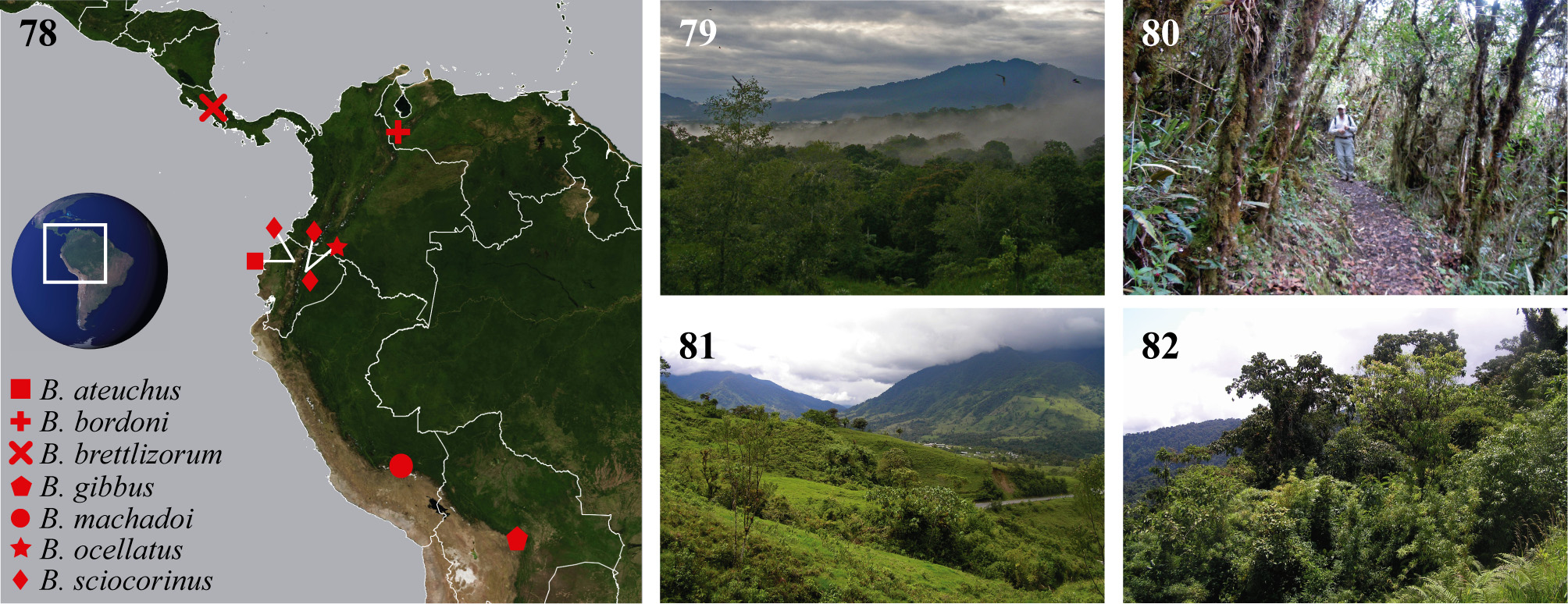
Distribution. Central America: Costa Rica. South America: Venezuela, Colombia, Ecuador, Peru and Bolivia ( Figs 78–82 View FIGURES 78 – 82 ).
Remarks. McDonald ( 1982) related Braunus [sic Lojus ] to Berecynthus Stål, 1862 , Padaeus Stål, 1862 , and Proxys Spinola, 1837 based on the shape of metasternal gland ( MG) peritreme and projections on the anterolateral margins of pronotum. However, while the MG peritreme is obsolete in Braunus, it is fully developed, spout-shaped on Berecynthus , Padaeus and Proxys . Similarly, the anterolateral margins of the pronotum are armed with fingerlike process in Braunus and Berecynthus , whereas smooth in Padaeus and Proxys . The corrugate dorsal appearance, brachyptery, obsolete MG peritreme, and genitalia structure of Braunus is similar to Pentatomiana Grazia & Barcellos, 2004 , as noted by Grazia & Barcellos ( 2004).
Key to species of Braunus Distant, 1899
1. Lateral margin of each mandibular plate denticulate ( Fig. 50 View FIGURES 48 – 53 ); humeral angles of pronotum projected anteriad, each with multiple processes ( Figs 6 View FIGURES 1 – 11 , 48 View FIGURES 48 – 53 ); apex of scutellum explanate ( Fig. 48 View FIGURES 48 – 53 )................ B. prionotus Barão & Garbelotto sp. nov.
1 ’. Lateral margin of each mandibular plate smooth; humeral angles of pronotum projected laterad, each with 1–4 processes ( Figs 1 –5, 7– 11 View FIGURES 1 – 11 ); apex of scutellum smooth..................................................................... 2
2 ( 1). Anterolateral margins of pronotum smooth, except for a weak tubercle at each anterior angle; humeral angles of pronotum each with single digitoid process at apex ( Fig. 8 View FIGURES 1 – 11 )....................................... B. ateuchus (Thomas) comb. nov.
2 ’. Anterolateral margins of pronotum each with spine-like tubercles; humeral angles of pronotum each with two or more processes apically ( Figs 1 –5, 7, 9–11 View FIGURES 1 – 11 )........................................................................ 3
3 ( 2 ’). Anterior angles of pronotum each with a spine-like tubercle surpassing the lateral margin of each compound eye in dorsal view ( Figs 1 –4, 7 View FIGURES 1 – 11 )......................................................................................... 4
3 ’. Anterior angles of pronotum each with a spine-like tubercle not surpassing the lateral margin of each compound eye in dorsal view ( Figs 5, 9– 11 View FIGURES 1 – 11 ).................................................................................... 6
4 ( 3). Head uniformly dark brown dorsally; posterolateral margins of pronotum sinuated, each with median indentation ( Figs 1–3 View FIGURES 1 – 11 ); internal margin of each pronotal cicatrix with white spot.......................... B. sciocorinus (Walker) ( Figs 12–13 View FIGURES 12 – 17 )
4 ’. Head uniformly castaneous dorsally; posterolateral margins of pronotum sinuated, each with tubercle and indentation medially ( Figs 4, 7 View FIGURES 1 – 11 ); internal margin of each pronotal cicatrix concolorous with remainder of pronotum......................... 5
5 ( 4 ’). Outline of each mandibular plate black dorsally; anterolateral margins of pronotum each with stout tubercles; each humeral angle trilobed apically; posterior margin of pronotum slightly concave ( Fig. 4 View FIGURES 1 – 11 ); abdomen dark brown ventrally with 1 + 1 yellowish bands mediolaterally.................................. B. machadoi Barão & Garbelotto sp. nov. ( Figs 36–37 View FIGURES 36 – 43 )
5 ’. Outline of each mandibular plate concolorous with remainder of head; anterolateral margins of pronotum each with small tubercles; each humeral angle singled lobed apically; posterior margin of pronotum straight ( Fig. 7 View FIGURES 1 – 11 ); abdomen uniformly reddish-brown ventrally....................................................... B. asperus (McDonald) comb. nov.
6 ( 3 ’). Tubercles on each anterolateral margin of pronotum obtuse; humeral angles of pronotum each with two processes apically, one anteriorly and one posteriorly ( Fig. 10 View FIGURES 1 – 11 )....................................... B. brettlizorum (Thomas) comb. nov.
6 ’. Tubercles on each anterolateral margin of pronotum acute; humeral angles of pronotum each with three processes apically, two anterior and one posterior ( Figs 5, 9, 11 View FIGURES 1 – 11 )................................................................... 7
7 ( 6 ’). Ocelli absent; apex of each hemelytral radial vein not calloused; inferior layer of ventral rim of pygophore smooth........................................................................ B. bordoni (Brailovsky & Rolston) comb. nov.
7 ’. Ocelli present; apex of each hemelytral radial vein calloused; inferior layer of ventral rim of pygophore projected medially (except B. gibbus Garbelotto & Barão sp. nov., male unknown)................................................. 8
8 ( 7 ’). Dark brown dorsally; abdomen uniformly dark brown ventrally; anterior lobe of pronotum as long as posterior lobe of pronotum ( Fig. 11 View FIGURES 1 – 11 ).................................................... B. ocellatus (Thomas) comb. nov. ( Figs 54–55 View FIGURES 54 – 59 )
8 ’. Light brown to yellowish dorsally; abdomen dark brown ventrally with 1 + 1 yellowish bands mediolaterally; anterior lobe of pronotum shorter than posterior lobe of pronotum ( Fig. 5 View FIGURES 1 – 11 )............ B. gibbus Garbelotto & Barão sp. nov. ( Figs 44–45 View FIGURES 44 – 47 )





No known copyright restrictions apply. See Agosti, D., Egloff, W., 2009. Taxonomic information exchange and copyright: the Plazi approach. BMC Research Notes 2009, 2:53 for further explanation.
|
Kingdom |
|
|
Phylum |
|
|
Class |
|
|
Order |
|
|
Family |
|
|
Genus |

Braunus prionotus
| Barão, Kim Ribeiro, Garbelotto, Thereza De Almeida, Campos, Luiz Alexandre & Grazia, Jocelia 2016 |
| Braunus Distant, 1899 : 422–423 |
| Kirkaldy, 1909 : 220 |
Lojus
| Lojus McDonald, 1982 : 327 |