
Dodomeira adrianae
|
publication ID |
https://doi.org/10.11646/zootaxa.4334.1.1 |
|
publication LSID |
lsid:zoobank.org:pub:29D71097-AD81-41F0-9AC4-F1D4982B9743 |
|
persistent identifier |
https://treatment.plazi.org/id/C0079262-FFEF-FFA1-1FBB-FDEFFA60FAD1 |
|
treatment provided by |
Plazi |
|
scientific name |
Dodomeira adrianae |
| status |
|
Key to species (13) of D. adrianae group
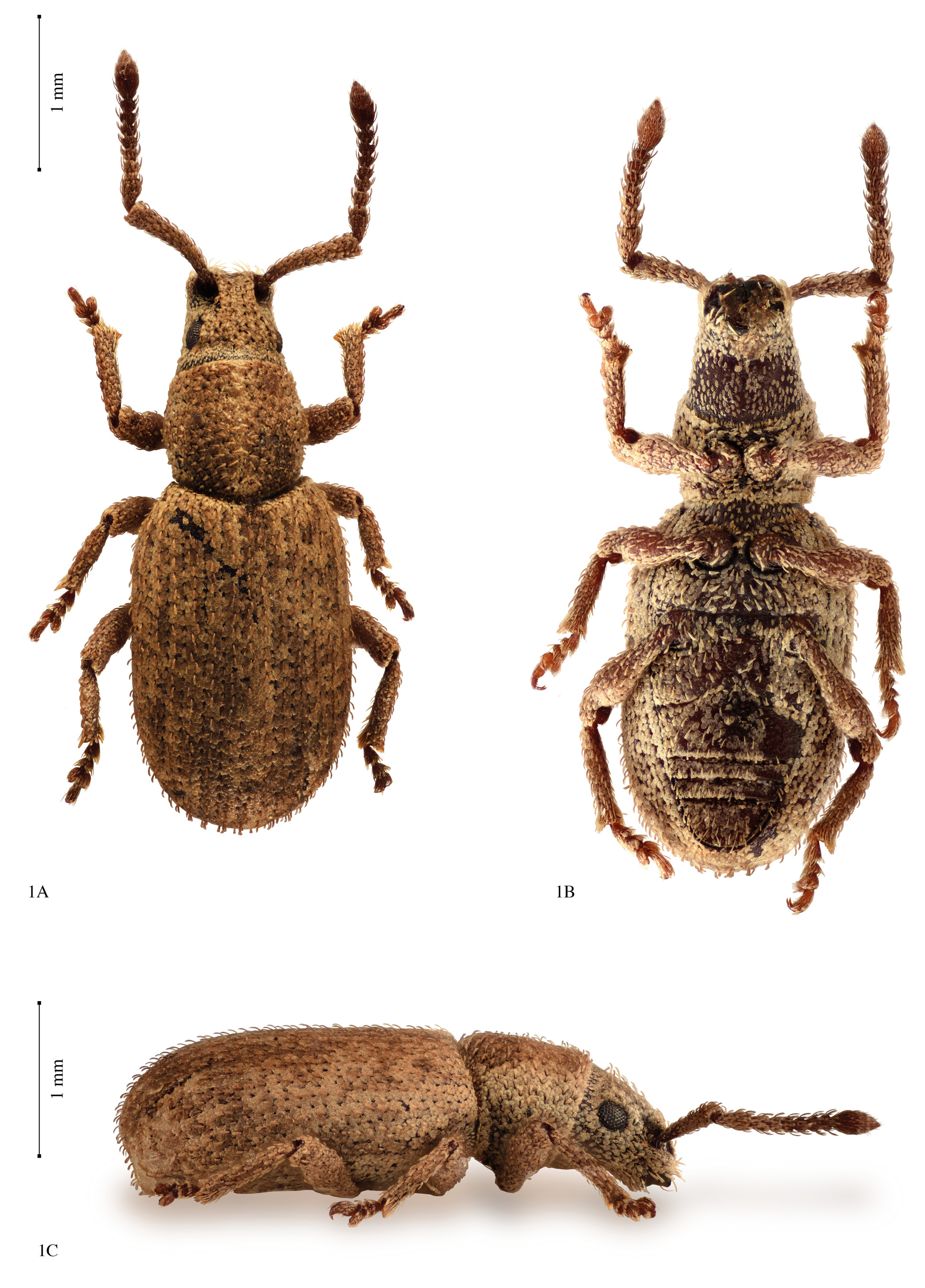
1. Elytra with spatulate setae ( Fig. 1 View FIGURES 1 Ga)...................................................................... 2
1’ Elytra with clavate setae ( Fig. 1 View FIGURES 1 Gb)....................................................................... 7
2. Pronotum sub-square (length/width ratio 1.00)..................................................... D. alta sp. n.
2’ Pronotum transverse (length/width ratio 0.83–0.95)........................................................... 3
3. Rostrum subparallel to sides................................................................ D. calatina sp. n.
3’ Rostrum subconical to sides.............................................................................4
4. Antenna short with scape/funicle ratio 0.60–0.70.................................................. D. juliae sp. n.
4’ Antenna elongate with scape/funicle ratio 0.74–0.83.......................................................... 5
5. Elytra with catenulate setae flattened (0–15°).................................................... D. siderea sp. n.
5’ Elytra with setae recumbent (15°–30°), raised (30°–45°), semi-erect (45°–75°)..................................... 6
6. Elytral declivity with setae recumbent/raised (10°–40°) less spatulate................................ D. sicana sp. n.
6’ Elytral declivity with setae more spatulate raised/semi-erect (40°–75°)............................. D. adrianae sp. n.
7. Pronotum more transverse with ratio length/width 0.83......................................... D. forbicionii sp. n.
7’ Pronotum less transverse with ratio length/width 0.90–0.96.................................................... 8
8. Protibia with two acute spines on inner edge................................................... D. sicelidis sp. n.
8’ Protibia with three acute spines on inner edge............................................................... 9
9. Elytral declivity with setae very widened at apex and recumbent (15°–30°).......................... D. belicensis sp. n.
9’ Elytral declivity with setae widened at apex and raised (30°–45°)............................................... 10
10. Head with vertex/mesorostrum apex ratio 1.75–1.80............................................ D. hiemalis sp. n.
10’ Head with vertex/mesorostrum ratio 1.95–2.00............................................................. 11
11. Elytral declivity with setae quite raised (30°–35°).............................................. D. ibleiensis sp. n.
11’ Elytral declivity with setae raised (35°–45°)................................................................ 12
12. Elytra more elongate (ratio: 1.63–1.65). Pronotum sub-square....................................... D. enzoi sp. n.
12’ Elytra less elongate (ratio: 1.57–1.60). Pronotum transverse...................................... D. laliaensis sp. n.
No known copyright restrictions apply. See Agosti, D., Egloff, W., 2009. Taxonomic information exchange and copyright: the Plazi approach. BMC Research Notes 2009, 2:53 for further explanation.
|
Kingdom |
|
|
Phylum |
|
|
Class |
|
|
Order |
|
|
Family |
|
|
Genus |