
Centruroides bani Armas & Marcano Fondeur, 1987 Centruroides griseus (C. L. Koch, 1844) Centruroides jorgeorum Santiago-Blay, 2009 Centruroides sasae Santiago-Blay, 2009 Isometrus maculatus (De Geer, 1778) Microtityus borincanus Teruel, Rivera & Sánchez, 2014 Microtityus santosi Teruel, Rivera & Sánchez, 2014 Microtityus vieques Teruel, Rivera & Santos, 2015 Heteroctenus abudi (Armas & Marcano Fondeur, 1987) Tityus alejandroi Teruel, Rivera & Santos, 2015 Tityus angelesae Santiago-Blay, 2009 Tityus estherae Santiago-Blay, 2009 Tityus juliorum Santiago-Blay, 2009
|
publication ID |
https://doi.org/10.5281/zenodo.4648508 |
|
publication LSID |
lsid:zoobank.org:pub:0343EFAE-9A2A-4FC8-A84B-579B22D741B3 |
|
DOI |
https://doi.org/10.5281/zenodo.4770692 |
|
persistent identifier |
https://treatment.plazi.org/id/A97A87F3-FFEC-FF88-FFEB-FA97FE255803 |
|
treatment provided by |
Carolina |
|
scientific name |
Centruroides bani Armas & Marcano Fondeur, 1987 Centruroides griseus (C. L. Koch, 1844) Centruroides jorgeorum Santiago-Blay, 2009 Centruroides sasae Santiago-Blay, 2009 Isometrus maculatus (De Geer, 1778) Microtityus borincanus Teruel, Rivera & Sánchez, 2014 Microtityus santosi Teruel, Rivera & Sánchez, 2014 Microtityus vieques Teruel, Rivera & Santos, 2015 Heteroctenus abudi (Armas & Marcano Fondeur, 1987) Tityus alejandroi Teruel, Rivera & Santos, 2015 Tityus angelesae Santiago-Blay, 2009 Tityus estherae Santiago-Blay, 2009 Tityus juliorum Santiago-Blay, 2009 |
| status |
|
Centruroides bani Armas & Marcano Fondeur, 1987 .
DISTRIBUTION. Hispaniola and Mona Island ( Puerto Rico). This species was recorded from Mona Island by Esposito et al. (2017: 27), but without mentioning the material examined. Teruel et al. (2017) synonymizes Centruroides mariaorum Santiago-Blay, 2009 , described from Mona Island, to C. bani , and added new localities from this small insular territory, as well as notes on its habitat.
Centruroides griseus (C. L. Koch, 1844) .
DISTRIBUTION. Virgin Islands and Puerto Rico, including some satellite islands of the last ( Vieques, Culebra, Caja de Muertos, Magueyes). The presence of C. griseus in Desecheo Island (Torres-González, 1965, cited by Santiago-Blay, 2009: 112) was considered by Teruel et al. (2015: 13) as needed of verification and probably erroneous. The Puerto Rican population was described by Armas (1982) as Centruroides griseus borinquensis , but later downgraded by him to subspecies ( Armas, 1988: 50). Nevertheless, Santiago-Blay (2009: 112) mentioned it as a subspecies of C. griseus (C. L. Koch, 1844) , whereas Esposito & Prendini (2019) removed it from the synonymy with C. griseus , and raised it to the species level, a nomenclatural action overlooked by Crew & Esposito (2020: fig. 11), who again mentioned it as a subspecies of C. griseus . If C. griseus borinquensis is a good species, then it would be most strongly demonstrated. Consequently, at this moment caution seems preferable.This is the most common scorpion in Puerto Rico and Virgin Islands, also being synanthropic (Santiago-Blay, 2009).
Centruroides jorgeorum Santiago-Blay, 2009 .
DISTRIBUTION. Only known from the type locality: Puerto Rico: Patillas: Barrio Guardarraya, close to Barrio Pollo. This species was barely described on the basis of a single adult female, which is the only known specimen. On July 28, 2010, personal effort for rediscovering it in the type locality was fruitless. It remains as a species pendant of confirmation (Teruel et al., 2015: 12) .
Centruroides sasae Santiago-Blay, 2009 .
DISTRIBUTION. Only known from the type locality: Caja de Muertos Island. This species was described on the basis of a single adult male, which is the only known specimen. Its description is very inadequate and efforts for rediscovering it have been unproductive, because all the collected specimens were C. griseus ( Armas, 2010; Teruel et al., 2015). In a very recent paper on Caribbean arthropod biogeography, Crew & Esposito (2020: fig. 11) included this dubious species in their analyses, but likely they were in error. Its taxonomical status is pendant of confirmation (Teruel et al., 2015: 12; but also see Armas, 2010: 62).
Isometrus maculatus (De Geer, 1778) .
DISTRIBUTION. Cosmotropical. This synanthropic species was recorded by Banks (1906) from San Juan, Puerto Rico; Santiago-Blay (2009) mentioned 60 specimens that he alleged were examined, but data on their localities were lacking .
Microtityus borincanus Teruel, Rivera & Sánchez, 2014 .
DISTRIBUTION. Only known from the type locality: Puerto Rico: Sabana Grande Municipality: Barrio Susúa, Susúa State Forest ( 18°05'34"N 66°54'32"W). This species was described on the basis of a single adult female, which is the only known specimen GoogleMaps .
Microtityus santosi Teruel, Rivera & Sánchez, 2014 .
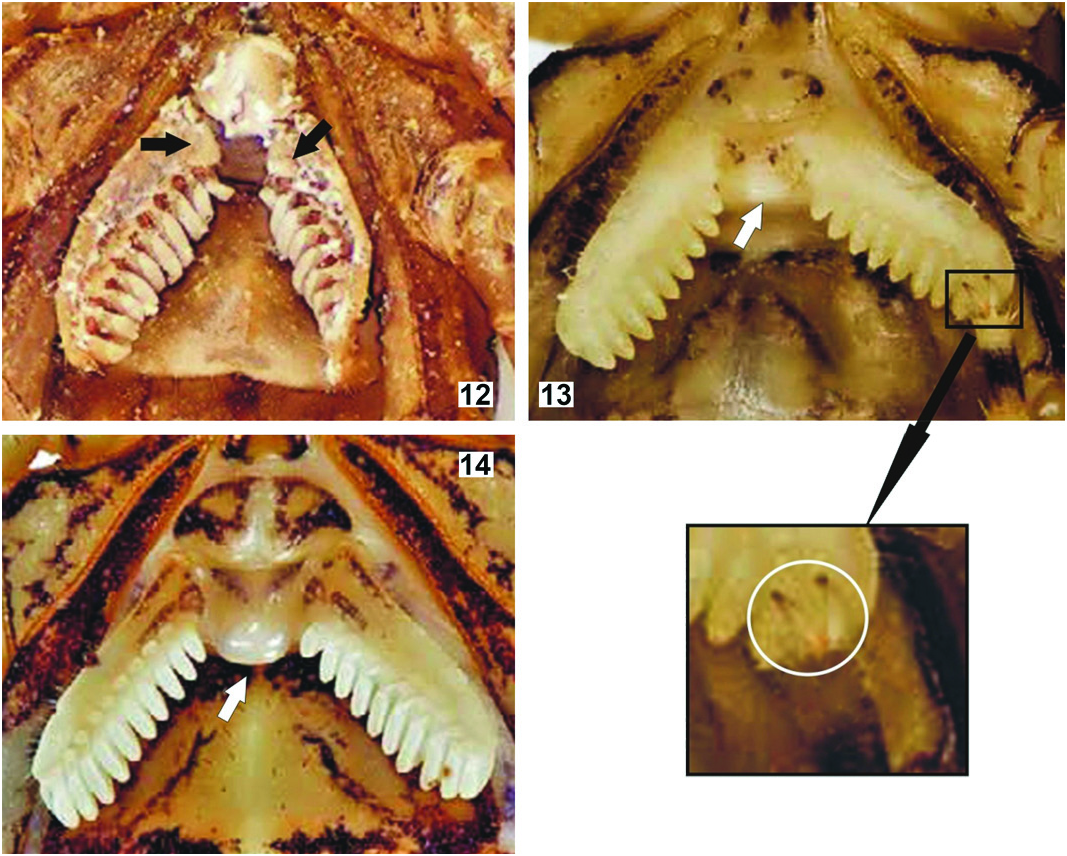
DISTRIBUTION. Only known from the type locality: Culebrita Island ( 18°05'34"N 66°54'32"W). This species was described on the basis of a single adult female, which is the only known specimen. On the apical area of the left comb of the holotype ( Fig. 13 View Figures 12−14 ) there are two egg-like organisms solidly attached, similar to those found on some scorpions and a Colombian schizomid ( Armas, 2003: fig. 2; Delgado-Santa & Armas, 2013: fig. 3B), which were overlooked by Teruel et al. (2014). This enigmatic organism resembles an insect or mite egg, but its real origin is yet unknown. It also has been observed on an Oiclus sp. ( Diplocentridae ) from St. Kitts, Lesser Antilles (pers. obs.).
Microtityus vieques Teruel, Rivera & Santos, 2015 .
DISTRIBUTION. Only known from the type locality: Vieques Island (probably from Monte Pirata, western part of the island). The female holotype and a male paratype are the only known specimens .
Heteroctenus abudi (Armas & Marcano Fondeur, 1987) .
DISTRIBUTION. Dominican Republic (Hispaniola Island) and Mona Island ( Puerto Rico). This species was described from Mona Island as Rhopalurus virkkii Santiago-Blay, 2009 , but Esposito et al. (2017) transferred it to Heteroctenus and synonymized it with H. abudi , as previously suggested by Teruel & Armas (2012: 216-217).
Tityus alejandroi Teruel, Rivera & Santos, 2015 .
DISTRIBUTION. Only known from the type locality: Vieques Island, probably from Monte Pirata (eastern part of the island). The only known specimens are the adult male holotype and two juvenile male paratypes.
Tityus angelesae Santiago-Blay, 2009 .
DISTRIBUTION. Southwestern Puerto Rico. Of this species only two specimens are known: the female holotype from Susúa State Forest, Sabana Grande Municipality , and other female from Juana Diaz, approximately 40 km E of the type locality (Teruel et al., 2015: 10) .
Tityus estherae Santiago-Blay, 2009 .
DISTRIBUTION. Most parts of Puerto Rico. A redescription of this species and data on its natural history were provided by Teruel et al. (2020).
Tityus juliorum Santiago-Blay, 2009 .
DISTRIBUTION. Mainly northeastern Puerto Rico. According with Teruel et al. (2015: 10-11), an adult female and two immatures collected on south of Sierra de Guardarraya, Patilla, southeastern Puerto Rico, recorded by Armas (2010) as this species, might be T. alejandroi .
Centruroides griseus (C. L. Koch, 1844) .
DISTRIBUTION. Virgin Islands and Puerto Rico, including some satellite islands of the last ( Vieques, Culebra, Caja de Muertos, Magueyes). The presence of C. griseus in Desecheo Island (Torres-González, 1965, cited by Santiago-Blay, 2009: 112) was considered by Teruel et al. (2015: 13) as needed of verification and probably erroneous. The Puerto Rican population was described by Armas (1982) as Centruroides griseus borinquensis , but later downgraded by him to subspecies ( Armas, 1988: 50). Nevertheless, Santiago-Blay (2009: 112) mentioned it as a subspecies of C. griseus (C. L. Koch, 1844) , whereas Esposito & Prendini (2019) removed it from the synonymy with C. griseus , and raised it to the species level, a nomenclatural action overlooked by Crew & Esposito (2020: fig. 11), who again mentioned it as a subspecies of C. griseus . If C. griseus borinquensis is a good species, then it would be most strongly demonstrated. Consequently, at this moment caution seems preferable.This is the most common scorpion in Puerto Rico and Virgin Islands, also being synanthropic (Santiago-Blay, 2009).
Centruroides jorgeorum Santiago-Blay, 2009 .
DISTRIBUTION. Only known from the type locality: Puerto Rico: Patillas: Barrio Guardarraya, close to Barrio Pollo. This species was barely described on the basis of a single adult female, which is the only known specimen. On July 28, 2010, personal effort for rediscovering it in the type locality was fruitless. It remains as a species pendant of confirmation (Teruel et al., 2015: 12) .
Centruroides sasae Santiago-Blay, 2009 .
DISTRIBUTION. Only known from the type locality: Caja de Muertos Island. This species was described on the basis of a single adult male, which is the only known specimen. Its description is very inadequate and efforts for rediscovering it have been unproductive, because all the collected specimens were C. griseus ( Armas, 2010; Teruel et al., 2015). In a very recent paper on Caribbean arthropod biogeography, Crew & Esposito (2020: fig. 11) included this dubious species in their analyses, but likely they were in error. Its taxonomical status is pendant of confirmation (Teruel et al., 2015: 12; but also see Armas, 2010: 62).
Isometrus maculatus (De Geer, 1778) .
DISTRIBUTION. Cosmotropical. This synanthropic species was recorded by Banks (1906) from San Juan, Puerto Rico; Santiago-Blay (2009) mentioned 60 specimens that he alleged were examined, but data on their localities were lacking .
Microtityus borincanus Teruel, Rivera & Sánchez, 2014 .
DISTRIBUTION. Only known from the type locality: Puerto Rico: Sabana Grande Municipality: Barrio Susúa, Susúa State Forest ( 18°05'34"N 66°54'32"W). This species was described on the basis of a single adult female, which is the only known specimen GoogleMaps .
Microtityus santosi Teruel, Rivera & Sánchez, 2014 .
DISTRIBUTION. Only known from the type locality: Culebrita Island ( 18°05'34"N 66°54'32"W). This species was described on the basis of a single adult female, which is the only known specimen. On the apical area of the left comb of the holotype ( Fig. 13 View Figures 12−14 ) there are two egg-like organisms solidly attached, similar to those found on some scorpions and a Colombian schizomid ( Armas, 2003: fig. 2; Delgado-Santa & Armas, 2013: fig. 3B), which were overlooked by Teruel et al. (2014). This enigmatic organism resembles an insect or mite egg, but its real origin is yet unknown. It also has been observed on an Oiclus sp. ( Diplocentridae ) from St. Kitts, Lesser Antilles (pers. obs.).
Microtityus vieques Teruel, Rivera & Santos, 2015 .
DISTRIBUTION. Only known from the type locality: Vieques Island (probably from Monte Pirata, western part of the island). The female holotype and a male paratype are the only known specimens .
Heteroctenus abudi (Armas & Marcano Fondeur, 1987) .
DISTRIBUTION. Dominican Republic (Hispaniola Island) and Mona Island ( Puerto Rico). This species was described from Mona Island as Rhopalurus virkkii Santiago-Blay, 2009 , but Esposito et al. (2017) transferred it to Heteroctenus and synonymized it with H. abudi , as previously suggested by Teruel & Armas (2012: 216-217).
Tityus alejandroi Teruel, Rivera & Santos, 2015 .
DISTRIBUTION. Only known from the type locality: Vieques Island, probably from Monte Pirata (eastern part of the island). The only known specimens are the adult male holotype and two juvenile male paratypes.
Tityus angelesae Santiago-Blay, 2009 .
DISTRIBUTION. Southwestern Puerto Rico. Of this species only two specimens are known: the female holotype from Susúa State Forest, Sabana Grande Municipality , and other female from Juana Diaz, approximately 40 km E of the type locality (Teruel et al., 2015: 10) .
Tityus estherae Santiago-Blay, 2009 .
DISTRIBUTION. Most parts of Puerto Rico. A redescription of this species and data on its natural history were provided by Teruel et al. (2020).
Tityus juliorum Santiago-Blay, 2009 .
DISTRIBUTION. Mainly northeastern Puerto Rico. According with Teruel et al. (2015: 10-11), an adult female and two immatures collected on south of Sierra de Guardarraya, Patilla, southeastern Puerto Rico, recorded by Armas (2010) as this species, might be T. alejandroi .
No known copyright restrictions apply. See Agosti, D., Egloff, W., 2009. Taxonomic information exchange and copyright: the Plazi approach. BMC Research Notes 2009, 2:53 for further explanation.
|
Kingdom |
|
|
Phylum |
|
|
Class |
|
|
Order |
|
|
Family |
|
|
Genus |