
Vestinautilus inflexus, Korn & Bockwinkel, 2022
|
publication ID |
https://doi.org/10.5852/ejt.2022.831.1871 |
|
publication LSID |
lsid:zoobank.org:pub:EAA2EAE2-DA8B-4516-B332-CB8423B8EEAA |
|
persistent identifier |
https://treatment.plazi.org/id/9327592F-F43C-194A-FD6C-1BD8FDDF55E6 |
|
treatment provided by |
Felipe |
|
scientific name |
Vestinautilus inflexus |
| status |
sp. nov. |
Vestinautilus inflexus sp. nov.
urn:lsid:zoobank.org:act:
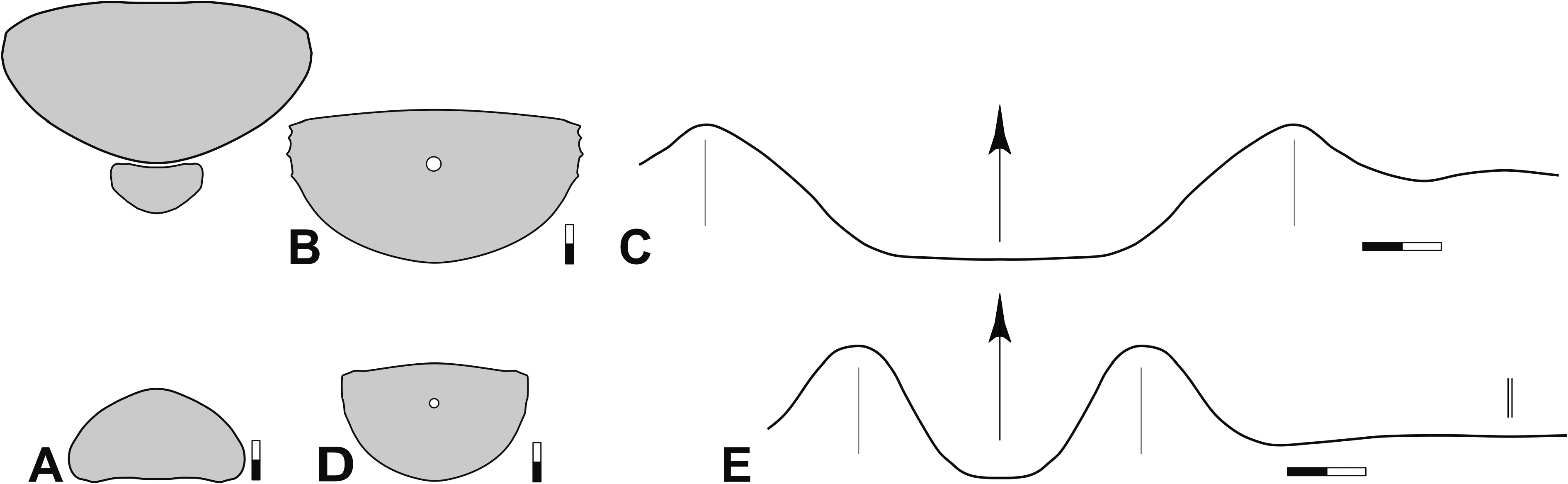
Figs 18–19 View Fig View Fig , Table 10
Diagnosis
Species of Vestinautilus with moderately depressed, rounded-triangular whorl profile (ww/wh ~ 1.95), venter weakly flattened, smooth, ventrolateral shoulder angular. Whorls not embracing. Ornament with three weak but sharp ridges on the flank. Septa inflexed to produce a deep external lobe.
Etymology
From the Latin ‘ inflexus ’, referring to the incurved septum.
Type material
Holotype ALGERIA • Mouydir , south of Oued Temertasset (locality MOU-D1); Argiles de Teguentour ( Upper Pericyclus-Progoniatites Assemblage; early late Tournaisian); Korn et al. 2002 Coll.; illustrated in Fig. 18B View Fig ; MB.C.30472.1 .
Paratypes ALGERIA • 2 specimens; Mouydir , south of Oued Temertasset (locality MOU-D1); Argiles de Teguentour ( Upper Pericyclus-Progoniatites Assemblage; early late Tournaisian); Korn et al. 2002 Coll.; illustrated in Fig. 18A, C View Fig ; MB.C.30472.2 – MB.C.30472.3 .
Description
Holotype MB.C.30472.1 is a phragmocone fragment from a quarter whorl with 15 mm whorl height ( Fig. 18B View Fig ). It has a moderately depressed whorl profile (ww/wh = 1.94) with a flattened venter and broadly rounded lateral and dorsal zones. The ventrolateral shoulder is subangular and reinforced by two sharp longitudinal ridges; there are two more, weaker ridges on the outer flank ( Fig. 19B View Fig ). The suture line shows a broad external lobe, flattened at the base. This particular shape is caused by an inflexion of the septum on the middle of the venter. There is a narrowly rounded saddle on the ventrolateral shoulder and a shallow, broadly rounded lobe on the flank ( Fig. 19C View Fig ).
Paratype MB.C.30472.2 is a desert-polished specimen with half a whorl preserved; it has a diameter of 24.5 mm ( Fig. 18A View Fig ). It was sectioned and shows one and a half whorls, which possess a similar profile. The last preserved whorl does, at 24 mm conch diameter, not touch the preceding, but this may be caused by the lack of the original shell wall ( Fig. 19A View Fig ). The longitudinal ridges are only barely visible and rather weak when compared with the holotype. The suture line shows a deeper external lobe, which is less flattened at the base.
The smaller paratype MB.C.30472.3 ( Fig. 18C View Fig ) with 6 mm whorl height has a less depressed whorl profile, but shows very clearly the ventral inflexion of the septum and the resulting very deep external lobe ( Fig. 19E View Fig ).
Remarks
Vestinautilus inflexus sp. nov. belongs to the species of the genus with a moderately depressed whorl profile (ww/wh ~1.95) and thus ranges between the more slender species V. angulatus sp. nov. (ww/wh ~1.50) as well as V. papilio sp. nov. (ww/wh ~ 1.70) and the stouter species V. bicristatus sp. nov. (ww/ wh ~2.15). The new species differs from those species of the genus with a similar whorl profile in the very weak longitudinal ridges.

No known copyright restrictions apply. See Agosti, D., Egloff, W., 2009. Taxonomic information exchange and copyright: the Plazi approach. BMC Research Notes 2009, 2:53 for further explanation.