
Glemparon rotoiti, Jaschhof & Jaschhof, 2018
|
publication ID |
https://doi.org/10.5852/ejt.2018.450 |
|
publication LSID |
lsid:zoobank.org:pub:A0B2B62B-557E-48F6-A1BC-46D670D6ADB1 |
|
DOI |
https://doi.org/10.5281/zenodo.3815628 |
|
persistent identifier |
https://treatment.plazi.org/id/030EDECD-B4EF-4500-A2B7-73615D7EEB1B |
|
taxon LSID |
lsid:zoobank.org:act:030EDECD-B4EF-4500-A2B7-73615D7EEB1B |
|
treatment provided by |
Valdenar |
|
scientific name |
Glemparon rotoiti |
| status |
sp. nov. |
Glemparon rotoiti View in CoL sp. nov.
urn:lsid:zoobank.org:act:
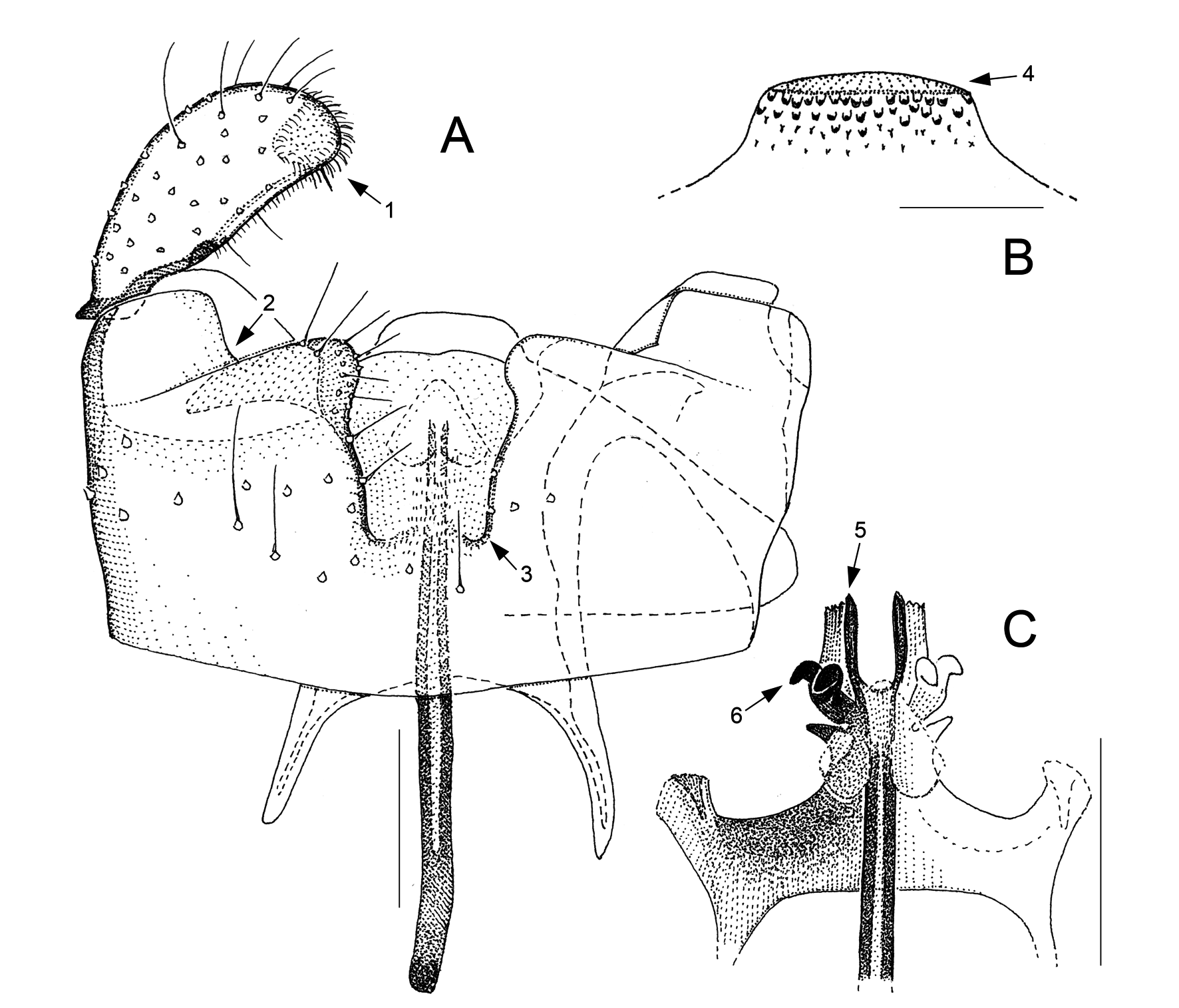
Fig. 14 View Fig A–C
Diagnosis
The elongate gonostylus of simple shape is not compressed at the apex, which is rounded and covered with dense microtrichia (↓ 1, Fig. 14A View Fig ). The gonocoxites are peculiar for both the membranous portions ventroposteriorly, whose outline resembles a stair (↓ 2, Fig. 14A View Fig ), and the ventral emargination, which is large, somewhat rectangular and vaguely delineated at the base (↓ 3, Fig. 14A View Fig ). The ninth tergite has an almost truncate, strongly sclerotized posterior edge (↓ 4, Fig. 14B View Fig ), which is a unique feature in Glemparon , and on the inside numerous small tubercles in indistinct rows. The tegmen is provided with a pair of sclerotized, serrate points (↓ 5, Fig. 14C View Fig ) and, at the points’ bases, sclerotized processes each consisting of two curved teeth (↓ 6, Fig. 14C View Fig ).
Etymology
The specific epithet refers to Lake Rotoiti in the north of New Zealand’s South Island, where the holotype was collected.
Material examined
Holotype
NEW ZEALAND: ♂, South Island, Tasman, Nelson Lakes National Park, Lake Rotoiti , 640 m a.s.l., 20 Dec. 2000, southern beech forest, Malaise trap, Department of Conservation St. Arnaud leg. ( NZAC, no. CEC1425).
Other characters
BODY SIZE. 1.6 mm.
HEAD. Eye bridge 1–2 ommatidia long dorsally. Flagellomeres 12; apical flagellomere merged of two bodies; neck of fourth flagellomere 0.7 times the node. Palpus clearly shorter than head height, 4 setaebearing segments, apical segment longest of all.
THORAX. Pronotal setae absent.
WING. Length /width ratio 2.6. Rs short, one fifth of apicR 1.
LEGS. Basitarsal spines present.
TERMINALIA. Ventroposterior lobes of gonocoxites indistinct; posteromedial protuberance simple, no obvious structuring ( Fig. 14A View Fig ). Gonostylus almost 3.0 times as long as broad ( Fig. 14A View Fig ). Apex of ejaculatory apodeme small, membranous, arrow-shaped ( Fig. 14A, C View Fig ).
Distribution and phenology
The holotype of G. rotoiti sp. nov. was collected in summer, in an extensive native forest in the north of New Zealand’s South Island.
| NZAC |
New Zealand Arthropod Collection |
No known copyright restrictions apply. See Agosti, D., Egloff, W., 2009. Taxonomic information exchange and copyright: the Plazi approach. BMC Research Notes 2009, 2:53 for further explanation.
|
Kingdom |
|
|
Phylum |
|
|
Class |
|
|
Order |
|
|
SubOrder |
Bibionomorpha |
|
Family |
|
|
SubFamily |
Porricondylinae |
|
Genus |