
Hydroides parva ( Treadwell, 1902 )
|
publication ID |
https://doi.org/10.5852/ejt.2017.344 |
|
publication LSID |
lsid:zoobank.org:pub:27AA4538-407D-470A-8141-365124193D85 |
|
DOI |
https://doi.org/10.5281/zenodo.3851371 |
|
persistent identifier |
https://treatment.plazi.org/id/794587B2-FFE5-FF99-FD84-FAF7FCA1F938 |
|
treatment provided by |
Carolina |
|
scientific name |
Hydroides parva ( Treadwell, 1902 ) |
| status |
|
Hydroides parva ( Treadwell, 1902)
Eupomatus parvus Treadwell, 1902: 210 , figs 79–80 ( type locality: Boqueron Bay, Puerto Rico; on encrusting bryozoans).
Hydroides dianthus ( non Verrill 1873) – Webster 1884: 327 ( Bermuda). — Zibrowius 1971: 699 (synonymy).
Hydroides (Eupomatus) n. sp. – Augener 1925: 16–17 ( Saint Croix, Lesser Antilles, Caribbean). — Bastida-Zavala & ten Hove 2002: 127 (synonymy).
Hydroides (Eupomatus) parvus – Augener 1927: 80, textfig. 8 (Spaanse Water and Schottegat, Curaҫao, Caribbean; on mangrove root). — Augener 1934: 116 –117 (Gairaca, Santa Marta, Colombian Caribbean; intertidal to 15 m).
Hydroides parvus – Bush 1910: 496 –497 ( Bermuda). — Treadwell 1939: 305 –306 ( Puerto Rico). — Rioja 1958: 251 –254, figs 1–2 ( Veracruz, eastern Mexico). — Wells & Gray 1964: 74 (Cape Hatteras, North Carolina; hard substrates). — Zibrowius 1970: 6 –7, pl. 1, figs 5–6 (Recife, Brazil; 30 m; on rocks). — Rullier & Amoreux 1979: 194 (off Ipojuca River and Abrolhos Archipelago, Brazil; intertidal to 27 m; sand, shells and rocks). — Díaz 1994: 618 ( Barbados, settlement and succession experiments; 10 m; coral plates, Orbicella annularis ). — ten Hove & San Martín 1995: 16 (de la Juventud Island, Cuba; 0.5–4 m; on mollusk shells, algae and mangrove roots). — Carrera-Parra & Vargas-Hernández 1997: 314 (Enmedio Island, Veracruz, eastern Mexico; 1–9 m; on the sponge Ircinia felix (Duchassaing & Michelotti, 1864)) . — Perkins 1998: 95 (checklist of shallow-water polychaetes from Florida). — Dueñas 1999: 14 (Providencia Island, Colombia). — Bastida-Zavala & Salazar-Vallejo 2000b: 851, fig. 2n–p ( Puerto Rico and eastern Mexico: Términos Lagoon and Champotón, Campeche; Celestún, Yucatán; Yucatán Canal; Cabo Catoche, Contoy Island, Puerto Morelos, Ascensión Bay and Chinchorro Bank, Quintana Roo; intertidal to 41 m; on mangrove roots, seagrasses and algae, sea urchin spines, gastropods shells, sponges, corals, calcareous rocks and fouling of wood dock pilings). — Bastida-Zavala & ten Hove 2002: 127 –129, figs 12A–K, 15 (Florida; eastern Mexico: Veracruz, Campeche, Yucatán and Quintana Roo; Puerto Rico; Montserrat; Atlantic Panama; Curaҫao; Atlantic Colombia and Brazil; 0.6–41 m; salinity 31– 37‰; on mangrove roots, seagrasses and algae, sea urchin spines, bivalve and gastropods shells, sponges, calcareous rocks, live corals and fouling of wood dock pilings and canal docks).
Hydroides parva – Day 1973: 132 (Cape Hatteras, North Carolina, United States; intertidal). — Díaz-Díaz & Liñero-Arana 2001: 13 (Cariaco Gulf, Venezuela; PVC dock pilings).
Material examined
One specimen: BB (1) Aug. 2004.
Diagnosis
Tube missing. Opercular peduncle smooth, white. Operculum funnel with 23 radii with pointed tips ( Fig. 4I View Fig ); verticil with seven yellowish spines, curving abruptly inwards, forming an external knob ( Fig. 4I View Fig ); all spines similar in shape and size, with pointed tips; with basal internal spinule and two welldeveloped lateral spinules in middle position, without external spinules, wings or central tooth ( Fig. 4I View Fig ). Special collar chaetae with two pointed, short teeth and smooth distal blade.
Taxonomic remarks
Hydroides parva is frequently confused with H. bispinosa , because both species have vertical spines with a pair of lateral spinules; however, the main difference is the shape of the funnel radii: rounded in H. bispinosa , sharp in H. parva . This species is more often found on natural substrates; however, occasionally it is found on artificial substrates ( Bastida-Zavala & Salazar-Vallejo 2000b; Díaz-Díaz & Liñero-Arana 2001; Bastida-Zavala & ten Hove 2002).
Ecology
Intertidal to 41 m. On mangrove roots, bryozoans, seagrasses and algae, sea urchin spines, gastropod shells, sponges, corals ( Orbicella annularis ), calcareous rocks and on artificial substrates such as fouling on wood dock pilings ( Díaz 1994; Bastida-Zavala & Salazar-Vallejo 2000b; Bastida-Zavala & ten Hove 2002).
Distribution
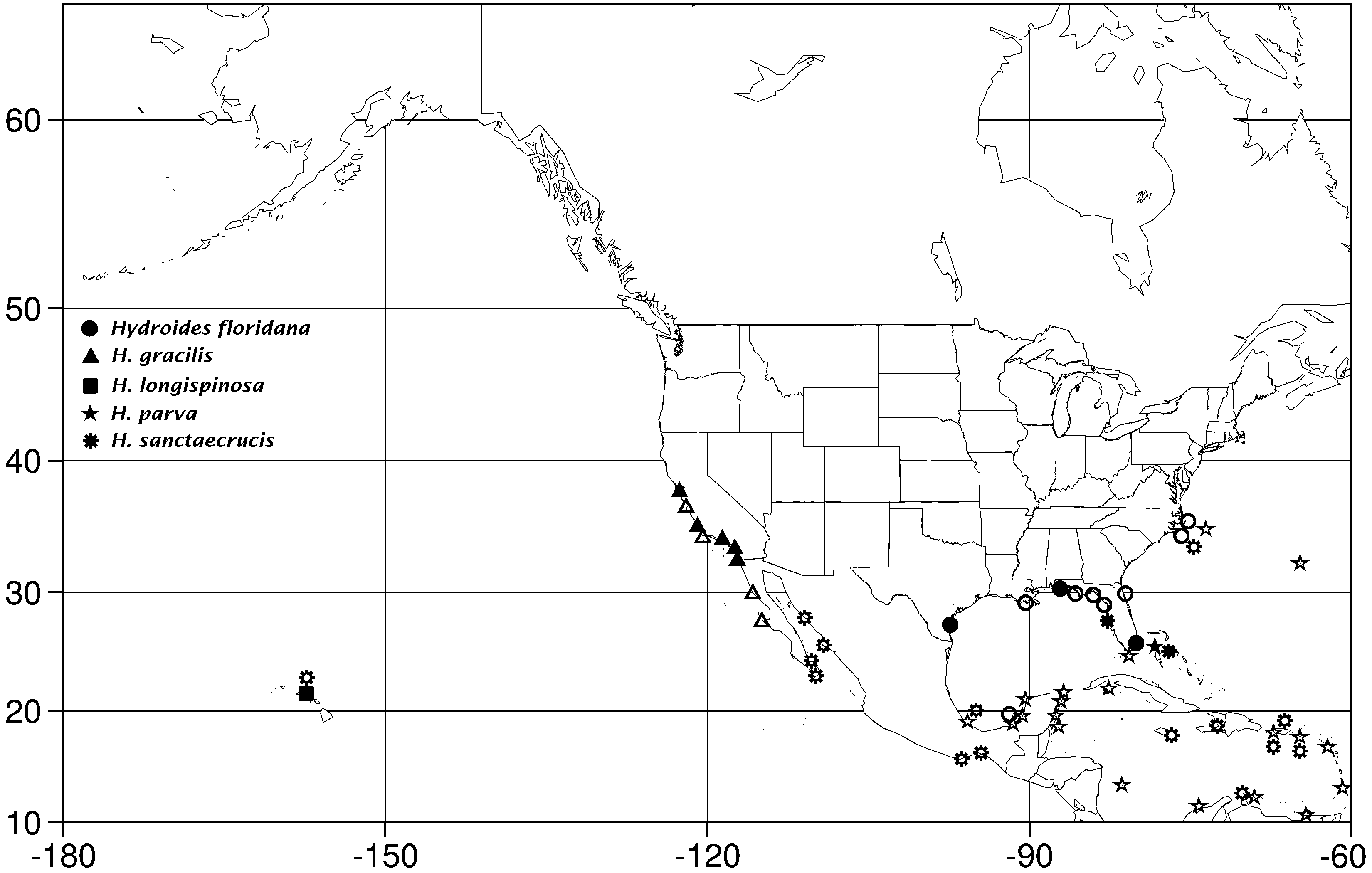
Caribbean Sea, Bermuda, Gulf of Mexico, eastern United States (Florida and North Carolina) and Brazil ( Bastida-Zavala & ten Hove 2002). In this work, only one specimen of Hydroides parva was found on a fouling plate from Biscayne Bay, Florida ( Fig. 6 View Fig ).

No known copyright restrictions apply. See Agosti, D., Egloff, W., 2009. Taxonomic information exchange and copyright: the Plazi approach. BMC Research Notes 2009, 2:53 for further explanation.
|
Kingdom |
|
|
Phylum |
|
|
Class |
|
|
Order |
|
|
Family |
|
|
Genus |

Hydroides parva ( Treadwell, 1902 )
| Bastida-Zavala, J. Rolando, McCANN, Linda D., Keppel, Erica & Ruiz, Gregory M. 2017 |
Hydroides parva
| Diaz-Diaz O. & Linero-Arana I. 2001: 13 |
| Day J. H. 1973: 132 |
Hydroides (Eupomatus)
| Bastida-Zavala J. R. & ten Hove H. A. 2002: 127 |
| Augener H. 1925: 16 |
Eupomatus parvus
| Treadwell A. L. 1902: 210 |
Hydroides dianthus
| Zibrowius H. 1971: 699 |
| Webster 1884: 327 |
Hydroides (Eupomatus) parvus
| Augener 1927: 80 |
| Augener 1934: 116 |
| Bush 1910: 496 |
| Treadwell 1939: 305 |
| Rioja 1958: 251 |
| Wells & Gray 1964: 74 |
| Zibrowius 1970: 6 |
| Rullier & Amoreux 1979: 194 |
| Díaz 1994: 618 |
| ten Hove & San Martín 1995: 16 |
| Carrera-Parra & Vargas-Hernández 1997: 314 |
| Perkins 1998: 95 |
| Dueñas 1999: 14 |
| Bastida-Zavala & Salazar-Vallejo 2000b: 851 |
| Bastida-Zavala & ten Hove 2002: 127 |