
Josephella marenzelleri Caullery & Mesnil, 1896
|
publication ID |
https://doi.org/10.5852/ejt.2017.344 |
|
publication LSID |
lsid:zoobank.org:pub:27AA4538-407D-470A-8141-365124193D85 |
|
persistent identifier |
https://treatment.plazi.org/id/794587B2-FFC7-FFB7-FF70-FB3EFACFFD30 |
|
treatment provided by |
Carolina |
|
scientific name |
Josephella marenzelleri Caullery & Mesnil, 1896 |
| status |
|
Key to shallow-water serpulids from the United States
1. With operculum ................................................................................................................................ 2
– Without operculum ......................................................................................................................... 45
2. Opercular peduncle thin, with pinnules (operculum on one radiole) ............................................... 3
– Opercular peduncle thick and smooth .............................................................................................. 4
3. Five thoracic chaetigers; capillary ( Fig. 9L View Fig ) and sharply-limbate collar chaetae ( Fig. 9M View Fig ) .................... .................................................................................... Josephella marenzelleri Caullery & Mesnil, 1896
– Six to 12 thoracic chaetigers; collar with fin-and-blade chaetae, with basal denticulate expansion and flattened distal blade ( Fig. 9N View Fig ) ................................................... Filogranula calyculata ( Costa, 1861) 1
4. Collar with chaetae ...................................................................................................................................5
– Collar without chaetae .................................................................................................................... 43
5. Operculum funnel-shaped, without chitinous plates ( Figs 2 View Fig A–D, 4A–J, 9A–B) ...................................6
– Operculum with chitinous ( Fig. 7A View Fig ) or calcareous plates ( Fig. 9C, G View Fig ), sometimes fused, sometimes with spines like “deer horns”, never funnel-shaped ....................................................................... 28
– Operculum otherwise ...................................................................................................................... 40
6. Operculum as a simple funnel, calcified ........................................ Pyrgopolon ctenactis ( Mörch, 1863)
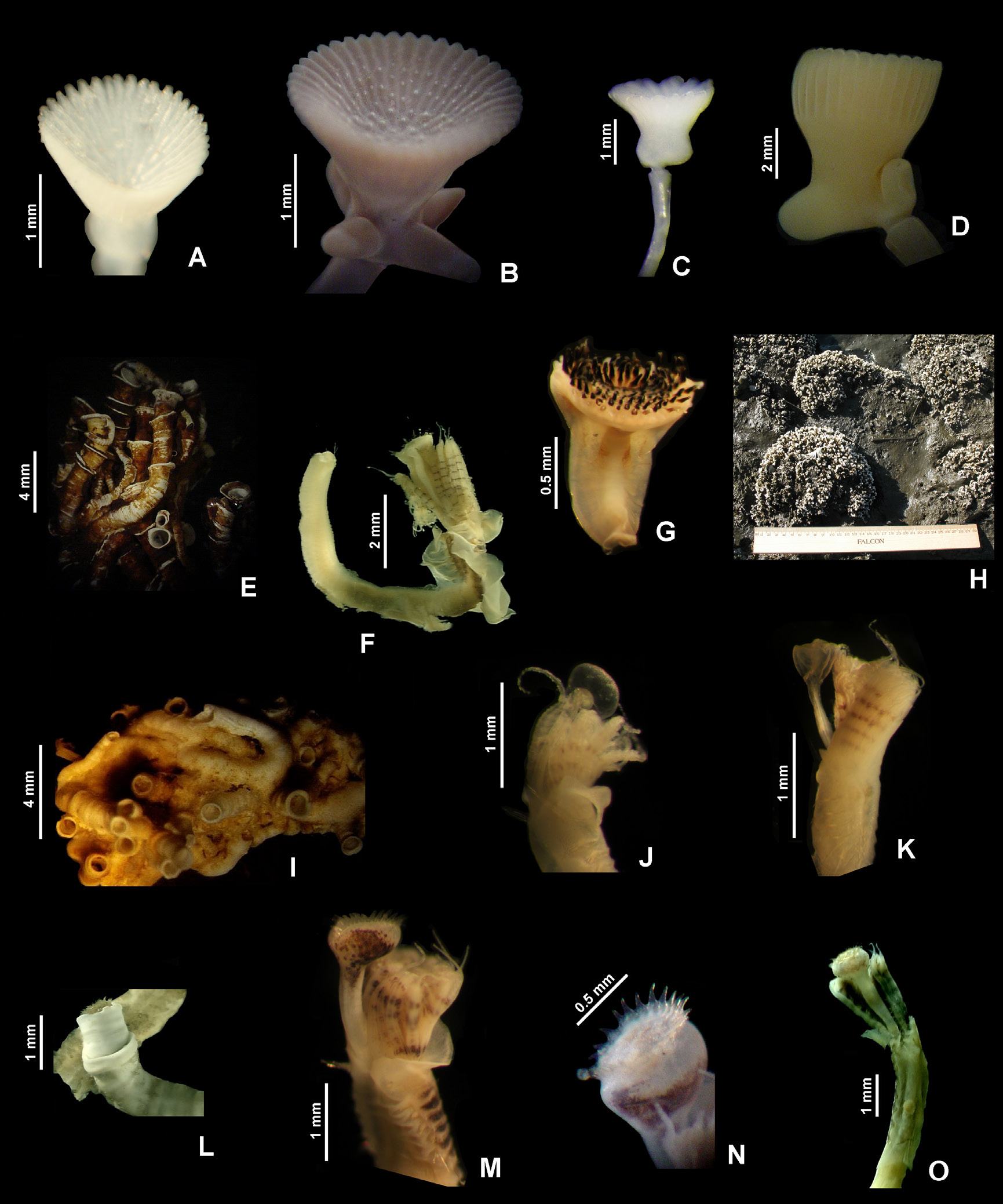
– Operculum as a simple funnel, fleshy ( Fig. 2 View Fig A–D) .......................................................................... 7
– Operculum as a fleshy basal funnel and a distal chitinous verticil ( Fig. 4 View Fig A–J) .................................. ......................................................................................................... Hydroides Gunnerus, 1768 …12
7. Operculum with basal digitate or rounded processes ( Fig. 2 View Fig A–D) ......... Crucigera Benedict, 1887 …8
– Operculum with no basal processes ( Fig. 9 View Fig A–B) ................................ Serpula Linnaeus, 1758 …9 2
8. Operculum with one basal rounded process; inner surface of funnel smooth ....................................................................................................... Crucigera irregularis Bush, 1905
– Operculum with three basal rounded processes, one dorsal and two laterals ( Fig. 2 View Fig C–D), sometimes the dorsal rounded process split in two; inner surface of funnel smooth ........................................... ............................................................................................................. C. zygophora ( Johnson, 1901)
– Operculum peduncle with four basal digitate processes ( Fig. 2B View Fig ); inner surface of funnel with tubercles ( Fig. 2B View Fig ) ................................................................................... C. websteri Benedict, 1887
9. Opercular funnel with less than 20 radii; shallow constriction between peduncle and operculum .......................................................................... Serpula sp. A in ten Hove & Wolf 1984 3
– Opercular funnel with more than 20 radii; deep constriction between peduncle and operculum .. 10
10. Opercular funnel short, with 46–160 radii ( Fig. 9 View Fig A–B), pointed tips, inner surface with numerous tiny conical tubercles ......................................................................... S. columbiana Johnson, 1901 4
– Opercular funnel elongate; with 21–35 radii, rounded tips, inner surface smooth ..........................11
11. Tube with five longitudinal ridges; collar with bayonet chaetae (similar to Fig. 9 View Fig H–J) with five teeth ............................................................................................................... S. watsoni Willey, 1905
– Tube with 6–8 longitudinal ridges; collar with bayonet chaetae with two teeth ................................ ................................................................................................... S. vossae Bastida-Zavala, 2012 2
12. Verticil spines without lateral spinules, with expanded tips, without wings ( Fig. 4D View Fig ) .................. 13
– Verticil spines with lateral spinules, without wings ( Fig. 4A, 4E, 4 View Fig H–I) ....................................... 14
– Verticil spines without lateral spinules ( Fig. 4 View Fig B–C, 4 G), without expanded tips, sometimes with wings ( Fig. 4F, 4J View Fig ) .......................................................................................................................... 21
13. Verticil spines with rounded tips; bayonet chaetae with two teeth and proximal rasp ( Fig. 9K View Fig ) ......................................................................................... Hydroides microtis Mörch, 1863
– Verticil spines with flat almost T - shaped tips ( Fig. 4D View Fig ); bayonet chaetae with two teeth, without proximal rasp ( Fig. 9 View Fig H–I) ......................................................................... H. dirampha Mörch, 1863
14. Verticil spines with only one pair of lateral spinules ( Fig. 4A, 4I View Fig ) ................................................. 15
– Verticil spines with more than one pair of lateral spinules ( Fig. 4E, 4H View Fig ) ....................................... 18
15. Funnel without radii, with 3–6 blunt processes only; verticil with straight spines ............................ ............................................................................................................ H. cf. mucronatus Rioja, 1958
– Funnel formed by radii; verticil spines curving inwards ................................................................ 16
16. Funnel radii with blunt tip ( Fig. 4A View Fig ) ........................................................... H. bispinosa Bush, 1910
– Funnel radii with pointed tip ( Fig. 4I View Fig ) ............................................................................................ 17
17. Verticil spines abruptly curving inwards, with a pronounced distal knob .......................................... ................................................................................................................. H. parva ( Treadwell, 1902)
– Verticil spines curving inwards rather smoothly, without distal knob ...... H. crucigera Mörch, 1863
18. Verticil spines complex, with many lateral and external spinules; dark-brown basally and hyaline distally; internal spinules enlarged ...................................................... H. mongeslopezi Rioja, 1958
– Verticil spines simple, with few lateral and without external spinules; uniform colour pattern; internal spinules short .................................................................................................................................. 19
19. Verticil spines with 2–4 pairs of lateral spinules; central spine short ( Fig. 4E View Fig ) or without this spine ................................................................................................................................................ 20 – Verticil spines with 5–8 pairs of lateral spinules; central spine long ( Fig. 4H View Fig ) .................................. ......................................................................................................... H. longispinosa Imajima, 1976b
20. Verticil spines straight or curving outwards ( Fig. 4E View Fig ) ............................ H. elegans ( Haswell, 1883) – Verticil spines curving inwards ...................................... Hydroides sp. A in ten Hove & Wolf 1984 3
21. Funnel radii with laterally expanded tips, T-shaped ........................... H. gairacensis Augener, 1934 – Funnel radii with pointed tips ( Fig. 4 View Fig B–C, 4 F–G, 4 J) .................................................................... 22
22. Verticil spines straight or curving outwards; bayonet chaetae with two teeth and proximal rasp ( Fig. 9K View Fig ) ............................................................................................. H. protulicola Benedict, 1887
– Verticil with at least dorsal –if not all– spines curving inwards; bayonet chaetae with two teeth without proximal rasp ( Fig. 9 View Fig H–I) .................................................................................................. 23
23. Dorsal spines curving inwards, ventral spines curving outwards ( Fig. 4C, 4J View Fig ) .............................. 24 – All spines curving inwards ( Fig. 4B, 4 View Fig F–G) ................................................................................... 25
24. Verticil spines without external spinule and wings ( Fig. 4C View Fig ) .................. H. dianthus ( Verrill, 1873) – Verticil spines with external spinule (at least ventral ones) and wings ( Fig. 4J View Fig ) ................................ ......................................................................................... H. sanctaecrucis (Krøyer in Mörch, 1863)
25. Verticil with spines long and slender, gradually curving inwards, without wings, all spines similar in shape and size ( Fig. 4G View Fig ) .............................................................................. H. gracilis ( Bush, 1905)
– Verticil with spines short and thick, strongly curving inwards, without wings, 1–5 dorsal spines larger than the others ( Fig. 4B View Fig ) ....................................................................................................... 26
– Verticil with spines long and slender, gradually curving inwards, with wings, all spines similar in shape and size ( Fig. 4F View Fig ) .................................................................................................................. 27
26. Only one dorsal spine, remaining verticil spines equally sized, with subdistal knobs ....................... .......................................................................................................... H. brachyacantha Rioja, 1941a
– Only one dorsal spine, remaining verticil spines equally sized, without subdistal knobs ( Fig. 4B View Fig ) .. ..................................................................................................... H. cf. brachyacantha Rioja, 1941a
– 3–5 dorsal bigger spines, with external tubercles on smaller spines .................................................. ............................ H. cf. amri Sun, Wong, ten Hove, Hutchings, Williamson & Kupriyanova, 2015 5
27. Branchial crown with more than 29 pairs of radioles; funnel with 45–61 radii ................................. ............................................................................................................. H. spongicola Benedict, 1887
– Branchial crown with less than 24 pairs of radioles; funnel with 27–38 radii ( Fig. 4F View Fig ) .................... ................................................................................................................... H. floridana ( Bush, 1910)
28. Operculum with 1–7 distal calcareous plates ( Fig. 9C, 9G View Fig ), sometimes with spines like “deer horns” ....................................................................................... Spirobranchus Blainville, 1818 …29
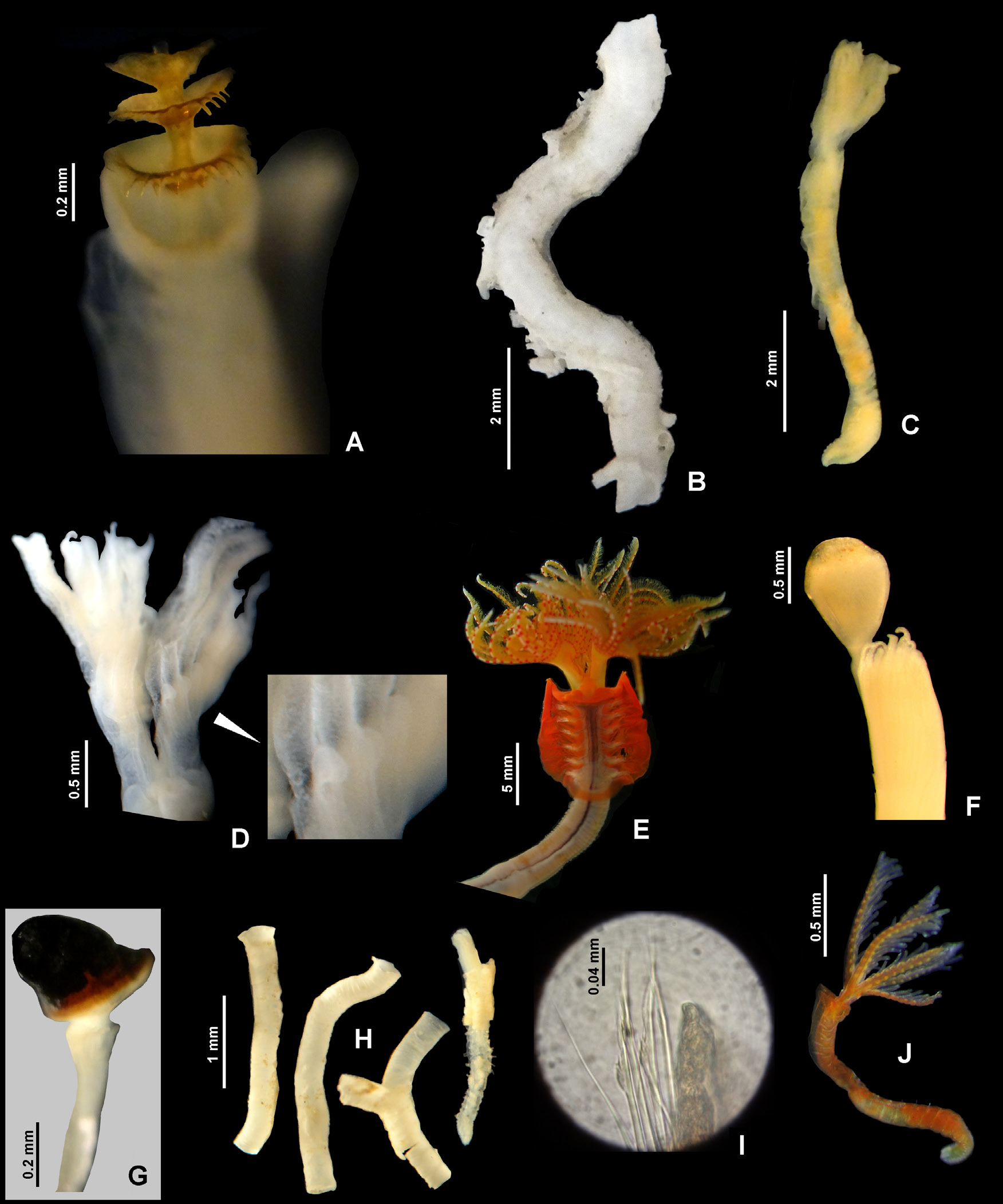
– Operculum with a column of chitinous concentric plates ( Fig. 7A View Fig ), sometimes with a distal stalk stellate ............................................................................. Pomatostegus stellatus ( Abildgaard, 1789)
– Operculum with 1–14 distal chitinous plates fused ( Fig. 7G View Fig ), sometimes with one distal branched spine or a hook ................................................................................................................................ 34
29. Operculum with 1–7 successive calcareous plates, distal spines absent ................................................... ......................................................................................... Spirobranchus latiscapus (Marenzeller, 1885)
– Operculum with one calcareous plate, with spines similar to deer horns, or when the plate is smooth has an ovoid or conical shape ......................................................................................................... 30
30. Operculum lacks spines ( Fig. 9C, 9G View Fig ); with a few limbate collar chaetae ( Fig. 9M View Fig ), sometimes none .........................................................................................................................................................31
– Operculum with spines; collar chaetae always present .........................................................................33
31. Tube with two longitudinal ridges, with spine or flap projection over entrance, lacks alveoli (holes) ( Fig. 9D View Fig ); collar without chaetae ................................................. Spirobranchus kraussii ( Baird, 1865)
– Tube with one or three longitudinal ridges, never two ridges, lacks projection over entrance, with alveoli ( Fig. 9F View Fig ); collar with few chaetae ....................................................................................... 32
32. Operculum ovoid, with a projection; tube with one longitudinal ridge and one line of small alveoli in older sections ..................................................................................................... S. americanus Day, 1973
– Operculum conical ( Fig. 9G View Fig ) or bilobed, with 1–2 small projections; tube with three longitudinal ridges and two lines of large alveoli along tube ( Fig. 9F View Fig ) ........................... S. minutus Rioja, 1941b
33. Operculum with two very large (equal to or larger than opercular plate) and thin horns and one short horn, with several short spines ............................................................... S. giganteus (Pallas, 1766) 6
– Operculum with two large (smaller than opercular plate) and thick horns, sometimes with a third large horn, with few large spines ..................................................... S. corniculatus (Grube, 1862) 6, 7
– Operculum with five short and wide horns, with several large spines ....... S. spinosus Moore, 1923
34. Thoracic membrane extends up to 3–6 chaetigers; thoracic uncini with anterior blunt tooth ...................................................................................... Vermiliopsis Saint-Joseph, 1894 8 …35
– Thoracic membrane extends up to second chaetiger; thoracic uncini with anterior bifurcate tooth ................................................................................................................................................ 36
35. Operculum with 1–7 fused discs ...................................... Vermiliopsis annulata ( Schmarda, 1861) 8
– Operculum with 10–14 fused discs ................................................. V. multiannulata Gravier, 1906 8
36. Insertion of opercular peduncle is at second radiole; thoracic uncini saw to rasp-shaped ................. ......................................................................... Semivermilia pomatostegoides ( Zibrowius, 1969b) 9
– Insertion of opercular peduncle just below and between first and second radioles; thoracic uncini saw-shaped ...................................................................................... Pseudovermilia Bush, 1907 …37
37. Operculum black or dark brown ( Fig. 7 G View Fig ) ..................................................................................... 38
– Operculum yellow or colorless ....................................................................................................... 39
38. Tube with longitudinal ridges and alveoli rows, lacks peristomes and transverse ridges; operculum with tree-shaped spines ............................................... Pseudovermilia multispinosa ( Monro, 1933)
– Tube with longitudinal and transverse ridges, sometimes with peristomes, lacks alveoli; operculum with a simple curved spine, with some minor spines or spines absent ( Fig. 7 G View Fig ) ............................... ......................................................................................................... P. occidentalis ( McIntosh, 1885)
39. Tube with several denticulate ridges and alveoli rows, with transverse brown bands ....................... ............................................................................................................. P. fuscostriata ten Hove, 1975
– Tube smooth, with a longitudinal ridge, without alveoli rows, entirely white ................................... ................................................................................................................. P. conchata ten Hove, 1975
40. Tube with a longitudinal keel, without peristomes; operculum with a smooth convex to conical chitinous cap ( Fig. 7 F View Fig ); collar with fin-and-blade chaetae, with basal denticulate expansion and flattened distal blade ( Fig. 9 N View Fig ) ............................................................... Pseudochitinopoma occidentalis ( Bush, 1905)
– Tube without a longitudinal keel, with peristomes ( Fig. 2 E, 2 I View Fig ); operculum with spines ( Fig. 2 G, 2 N View Fig ) or smooth ( Fig. 2 View Fig J–K); collar chaetae coarsely serrated, without basal expansion ( Fig. 9 O View Fig ) ...................................................................................... Ficopomatus Southern, 1921…41
41. Thoracic membranes dorsally fused ( Fig. 2 M, 2 O View Fig ); opercular spines curved outwards ( Fig. 2 N View Fig ); tropical species ....................................................................... Ficopomatus uschakovi ( Pillai, 1960)
– Thoracic membranes free ( Fig. 2 F View Fig ); opercular spines curved inwards ( Fig. 2 G View Fig ) or absent ( Fig. 2 View Fig J– K) .................................................................................................................................................... 42
42. Operculum concave with black incurving spines ( Fig. 2 G View Fig ), not black or lacking in juveniles; subtropical species .............................................................................. F. enigmaticus ( Fauvel, 1923)
– Operculum bulbous ( Fig. 2 J View Fig ), slightly convex ( Fig. 2 K View Fig ), without spines; tropical species ................ .......................................................................................................... F. miamensis ( Treadwell, 1934)
43. Opaque tube without dorsal ridge, sometimes with brood chambers; thorax with sickle chaetae or “ Apomatus ” chaetae (distally curved) ............................................. Rhodopsis pusilla Bush, 1905 10
– Hyaline tube with dorsal ridge, without brood chambers; thorax without sickle chaetae .................. .......................................................................................................... Placostegus Philippi, 1844 …44
44. Tube without transverse ridges; operculum bulbous proximally, concave and zygomorphic dorsally .............................................................................. Placostegus californicus Hartman, 1969
– Tube with transverse ridges in posterior half section; operculum unknown ...................................... ................................................................................................................... P. incomptus Ehlers, 1887
45. Collar chaetae limbate ( Fig. 9 M View Fig ) or capillaries ( Fig. 9 L View Fig ), without basal denticulate expansion; uncini with long main tooth ....................................................................................................................... 46
– Collar with fin-and-blade chaetae, with basal denticulate expansion and flattened distal blade ( Fig. 9 N View Fig ), or bayonet chaetae with several teeth ( Figs 7 I View Fig , 9 J View Fig ); uncini with short main tooth ........ 49
46. Seven to nine thoracic chaetigers ............................................................... Protula Risso, 1826 … 47
– 11–14 thoracic chaetigers .............................................. Filogranella sp. in Fosså & Nielsen 1996 11
47. Nine thoracic chaetigers; radioles with a single row of pinnules ....... Protula setosa ( Bush, 1910) 12
– Seven thoracic chaetigers; radioles with a double row of pinnules ............................................. 48 13
48. Tube with longitudinal ridges; branchial crown lacks basal round processes; thoracic membrane narrow, reaches fourth chaetiger ........................................................................... P. longiseta Schmarda, 1861 14
– Tube with rough texture, without longitudinal ridges ( Fig. 7 B View Fig ); branchial crown with basal round process on each radiole ( Fig. 7D View Fig ); thoracic membrane wide, reaches seventh chaetiger ( Fig. 7 E View Fig ) ...................................................................................................... P. balboensis Monro, 1933 14
– Tube smooth, sometimes with shallow transverse ridges; branchial crown with 31–51 radioles; thoracic membrane narrow, reaches seventh chaetiger; uncini smooth .............................. P. atypha Bush, 1905
49. Tube with internal longitudinal ridges ..................................... Spiraserpula Regenhardt, 1961 …50
– Tube without internal longitudinal ridges ....................................... Salmacina Claparède, 1870 …51
50. Tube with dorsal internal ridge serrated, ventral ones with Y-shape .................................................. ................................................................................. Spiraserpula ypsilon Pillai & ten Hove, 1994 15
– Tube with dorsal internal ridge not serrated, ventral ones serrated .................................................... .............................................................................................. S. caribensis Pillai & ten Hove, 1994 15
51. Collar chaetae with many small teeth ............................................................................................. 52
– Collar chaetae with 4–8 large teeth ( Fig. 7 I View Fig ) .................................................................................. 53
52. Three, sometimes four, pairs of radioles ( Fig. 7 J View Fig ); thoracic uncini with 8–9 rows of teeth and 3–4 teeth per row ................................................................. Salmacina tribranchiata ( Moore, 1923) 16, 17
– Four pairs of radioles; thoracic uncini with seven rows of teeth and 2–3 teeth per row .................... .................................................................................................................. S. dysteri ( Huxley, 1855) 16
– Five pairs of radioles; thoracic uncini with more than 10 rows of teeth ............................................ ................................................................................ Salmacina sp. A in ten Hove & Wolf 1984 3, 16, 17
53. Without prostomial eyes; teeth of collar chaetae distally increasing regularly in size ( Fig. 7 I View Fig ); 20 or fewer abdominal segments ( Fig. 7 H View Fig ) ....................................................... S. huxleyi ( Ehlers, 1887) 16
– With prostomial eyes; collar chaetae with 4–6 large teeth of similar size; up to 40 abdominal segments ......................................................................................... S. incrustans Claparède, 1870 16


| S |
Department of Botany, Swedish Museum of Natural History |
| G |
Conservatoire et Jardin botaniques de la Ville de Genève |
| H |
University of Helsinki |
| H |
University of Helsinki |
| A |
Harvard University - Arnold Arboretum |
| J |
University of the Witwatersrand |
| S |
Department of Botany, Swedish Museum of Natural History |
| V |
Royal British Columbia Museum - Herbarium |
| G |
Conservatoire et Jardin botaniques de la Ville de Genève |
| P |
Museum National d' Histoire Naturelle, Paris (MNHN) - Vascular Plants |
| F |
Field Museum of Natural History, Botany Department |
| N |
Nanjing University |
| E |
Royal Botanic Garden Edinburgh |
| I |
"Alexandru Ioan Cuza" University |
| O |
Botanical Museum - University of Oslo |
| M |
Botanische Staatssammlung München |
| K |
Royal Botanic Gardens |
| L |
Nationaal Herbarium Nederland, Leiden University branch |
| P |
Museum National d' Histoire Naturelle, Paris (MNHN) - Vascular Plants |
| B |
Botanischer Garten und Botanisches Museum Berlin-Dahlem, Zentraleinrichtung der Freien Universitaet |
No known copyright restrictions apply. See Agosti, D., Egloff, W., 2009. Taxonomic information exchange and copyright: the Plazi approach. BMC Research Notes 2009, 2:53 for further explanation.
|
Kingdom |
|
|
Phylum |
|
|
Class |
|
|
Order |
|
|
Family |
|
|
Genus |