
Austrocyphon quadridens, Zwick, Peter, 2013
|
publication ID |
https://dx.doi.org/10.11646/zootaxa.3706.1.1 |
|
publication LSID |
lsid:zoobank.org:pub:486DF839-3C97-4B16-9E2D-9E06F4D85F8F |
|
persistent identifier |
https://treatment.plazi.org/id/5424570C-FF84-891A-CED2-FDF7CF0DFB02 |
|
treatment provided by |
ImsDioSync |
|
scientific name |
Austrocyphon quadridens |
| status |
sp. n. |
Austrocyphon quadridens , sp. n.
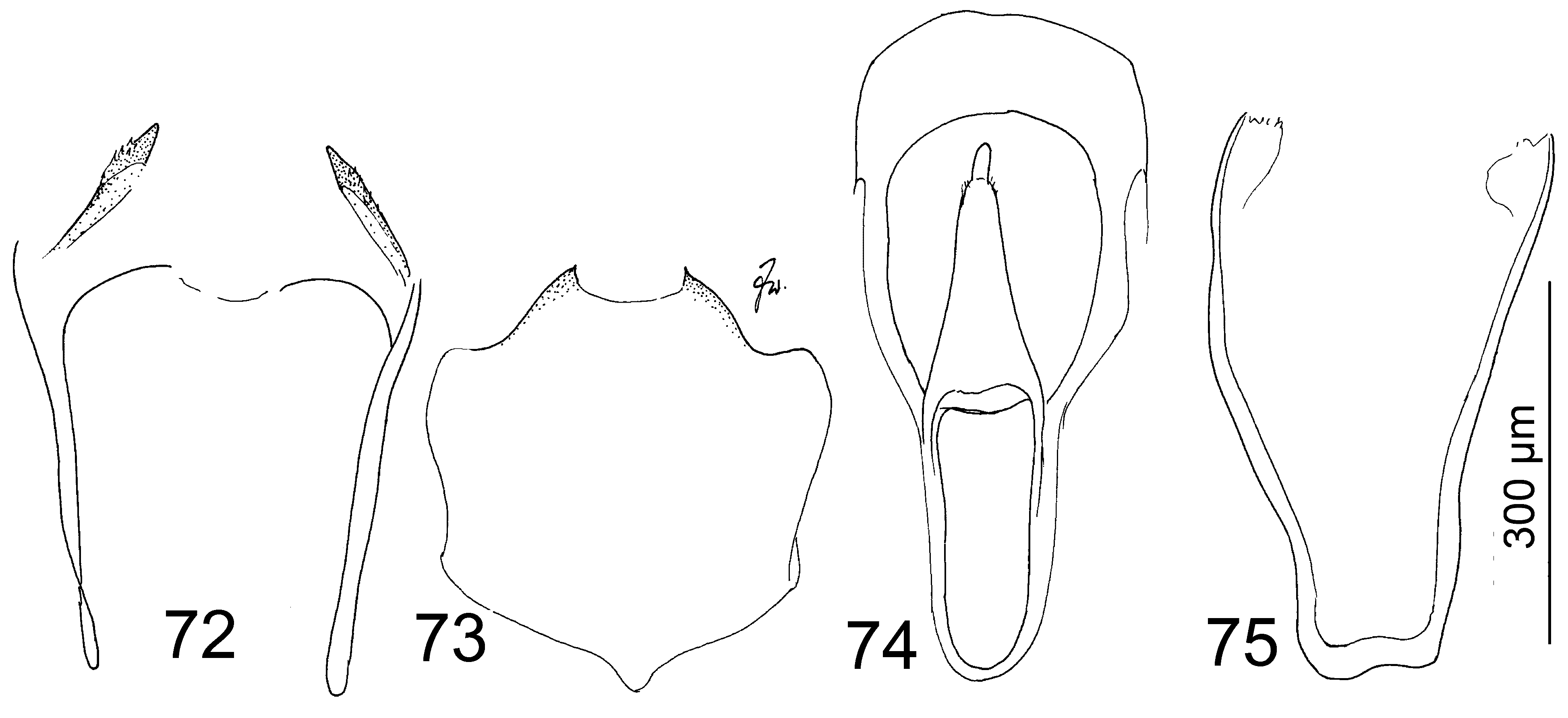
( Figs. 72–75 View FIGURES 72 – 75 )
Type material. Holotype: ♂, Illawarra, N. S. Wales G.E.Bryant 4.x.08 / G.Bryant coll. 1919 - 147 / pictus Blkb. ? Compared with type G. J. A. / Cyphon pictus Blackb. Id. by J.Armstrong ( NHML). Paratype: ♂, fenestratus Bl. (no other labels, body in poor shape; SAMA).
Habitus. BL 2.9 mm, elongate oval, BL/BW ~ 1.9. Uniformly brown, pronotal margin a bit rufous. Antennae (only the base is preserved) and legs light brown.
Male. T 9 with long widely separated apodemes, disc completely transparent and soft, only two caudo-lateral spinulose tips clearly pigmented and visible. S 9 short and wide, base triangular, sides widening caudad in a curve, then abruptly restricted towards the sclerotized narrow caudal margin with two sharp points separated by a shallow U-shaped notch.
Penis with narrow pala. Caudal part beyond base of trigonium much wider, forming a wide arch with narrow lateral and wide caudal sclerite strips. The membranous foramen inside this arch is much larger than the conical trigonium which carries a strong centema and some delicate apico-lateral spicules.
Parameres long slender struts originating from a transverse bar-like capulus and ending in delicate sharp tips which are medially connected to transparent membranous lobes.
Female. Not known.
Etymology. Before dissection, the tips of T 8 and S 9 were superimposed, appearing like four sharp teeth. The specific name (derived from Latin quatuor, four, and dens, tooth) is treated like a noun in apposition.
No known copyright restrictions apply. See Agosti, D., Egloff, W., 2009. Taxonomic information exchange and copyright: the Plazi approach. BMC Research Notes 2009, 2:53 for further explanation.