
Calyptomyrmex
|
publication ID |
https://doi.org/10.5281/zenodo.276598 |
|
persistent identifier |
https://treatment.plazi.org/id/286F87FD-2601-9F3D-528C-FF5EFA16414E |
|
treatment provided by |
Plazi |
|
scientific name |
Calyptomyrmex |
| status |
|
Key to species of South-east Asian and Oceanian Calyptomyrmex based on workers
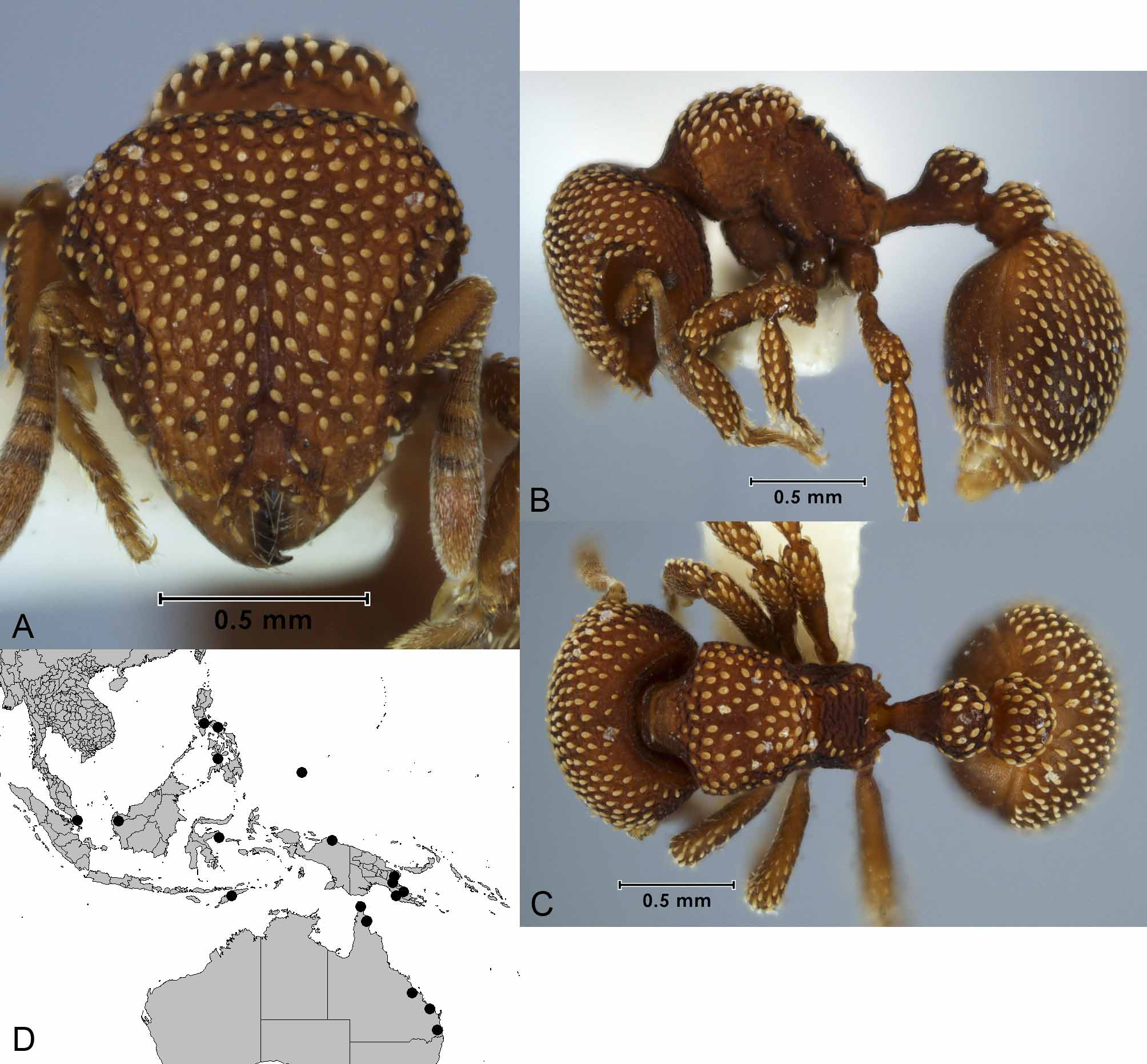
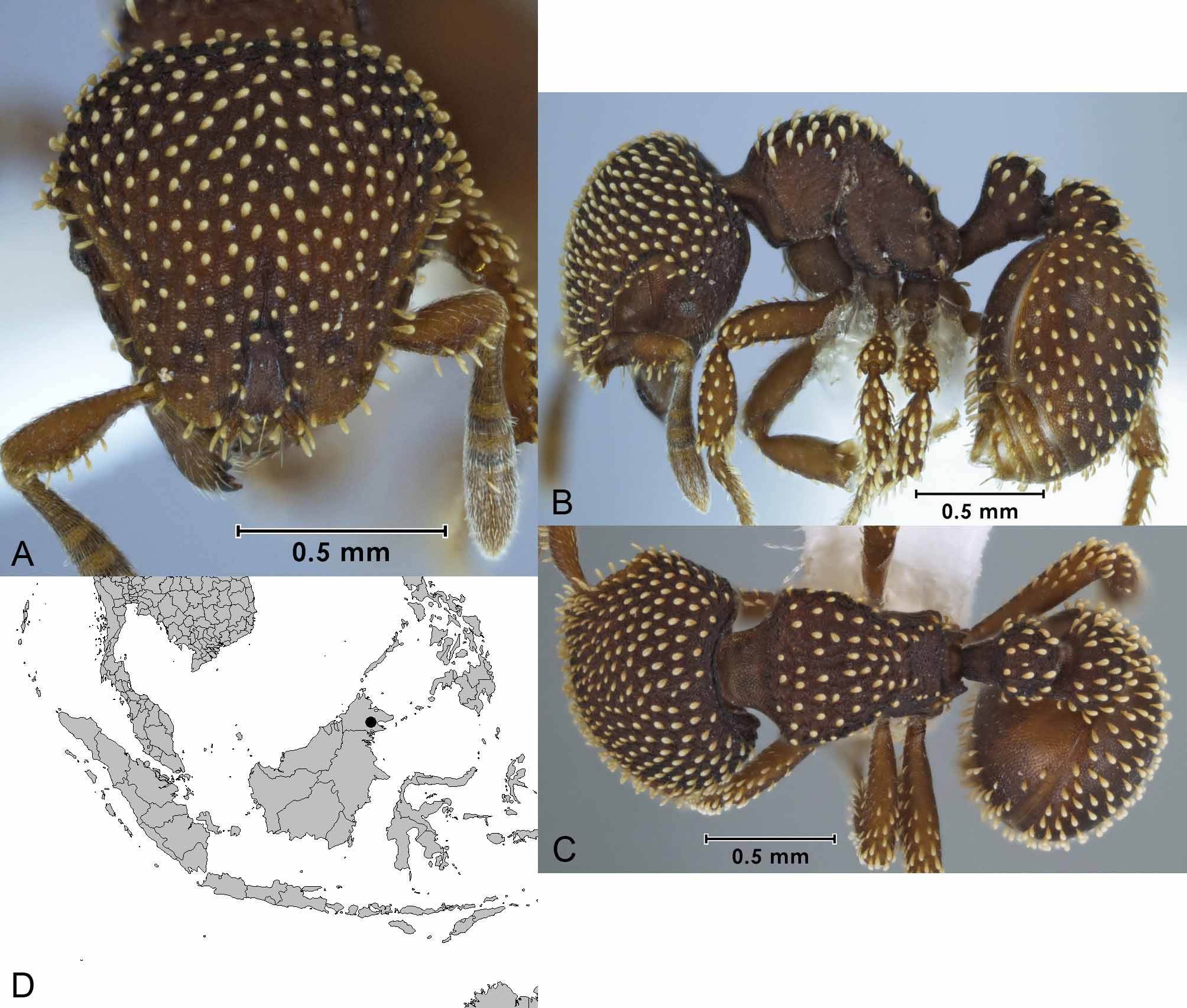
1. Hairs on head and body spatulate (noticeably narrower near the body and expanded distally and with a rounded tip, Fig. 3 View FIGURE 3 ) … 2
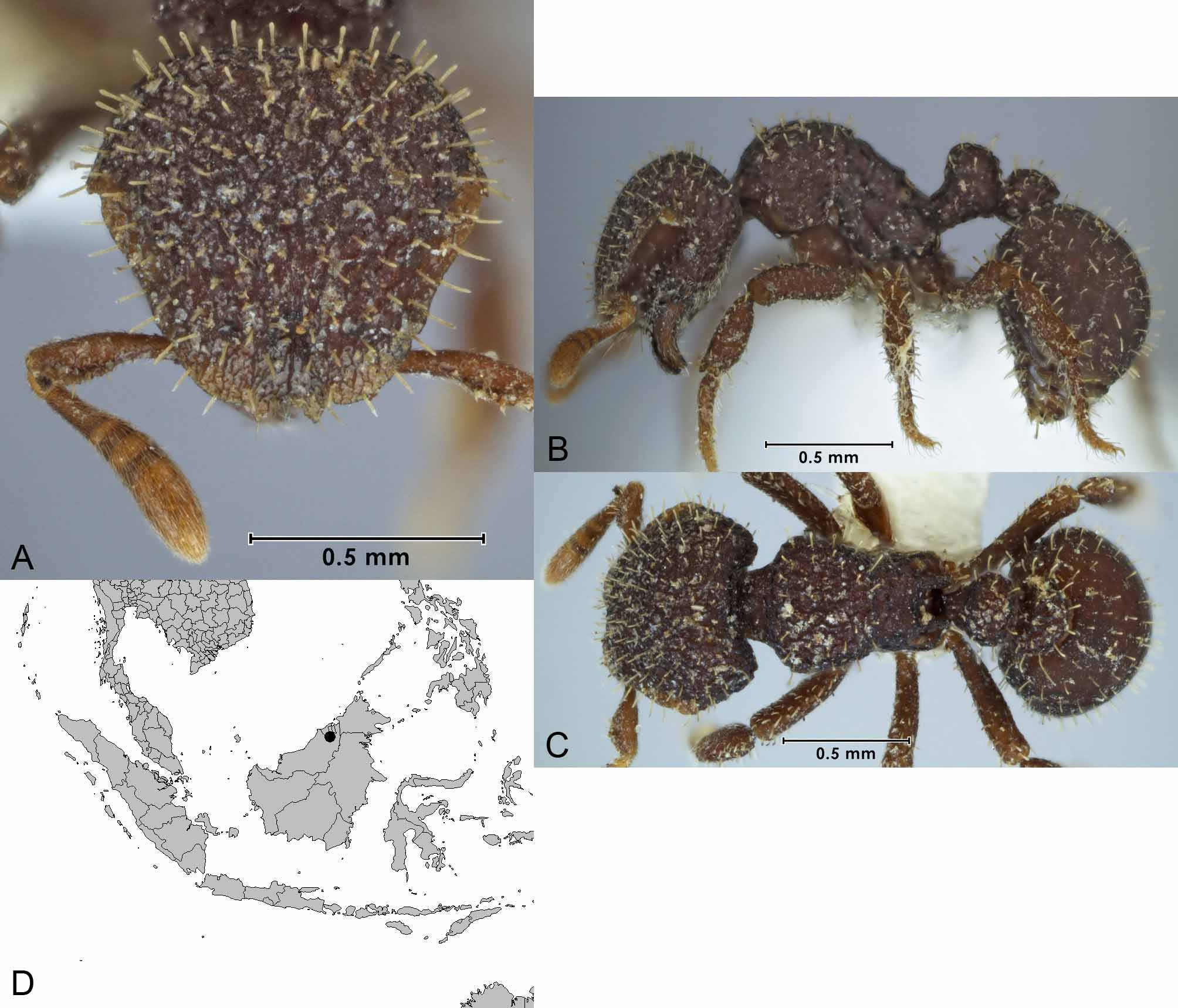
-. Hairs on head and body thin (essentially the same width along entire length, or only slightly and gradually expanded distally, and with blunt tips, Fig. 14 View FIGURE 14 )............................................................................. 8
2. Gaster with low longitudinal striations running between the spatulate hairs ( Australia)........................ fragarus
-. Gaster smooth to shallowly punctate...................................................................... 3
3. Propodeum armed with short angular teeth ( Fig. 5 View FIGURE 5 B)........................................................ 4
-. Propodeum unarmed ( Fig. 14 View FIGURE 14 B)......................................................................... 6
4. In dorsal view node of petiole much broader than long and rectangular in shape; body smaller (HW < 0.82mm) ( Australia)................................................................................................ fritillus
-. In dorsal view node of petiole only slightly broader than long and oval in shape; body larger (HW> 1.00mm)............ 5
5. Body larger (HW> 1.12); head longer than broad (CI < 98); spatulate hairs on posterior section of head and mesonotum appressed closely to the underlying body surface; propodeal spines larger and more strongly angled (angle between faces approximately 90 °) ( Australia)..................................................................... sparsus
-. Body smaller (HW < 1.12); head broader than long (CI> 104); spatulate hairs on posterior section of head and mesonotum rising above the underlying body surface; propodeal spines shorter and broader (angle between faces greater than 90 °) ( Malaysia)............................................................................................... danum
6. Hairs on head narrowly spatulate and rising well above the underlying body surface; in dorsal view node of petiole rectangular, in lateral view relatively thin; body smaller (HW < 0.82mm) ( Australia)..................................... taylori
-. Hairs on head broadly spatulate and appressed closely to the underlying body surface; in dorsal view node of petiole rounded, in lateral view relatively thick; body larger (HW> 0.90mm).................................................. 7
7. Posterior margin of head above the level of antennal scrobes broader, the lateral corners more angular; body larger (HW> 1.13mm); spatulate hairs broader and more rounded ( Malaysia, Philippines).................................. loweryi
-. Posterior margin of head above the level ov antennal scorbed narrower and the lateral corners more rounded; body smaller (HW < 1.10mm); spatulate hairs narrower and more linear (widespread).................................... beccarii
8. Gaster heavily sculptured with striations or a network of low rugae............................................. 9
-. Gaster weakly (and sometimes indistinctly) punctate........................................................ 10
9. Sculpturing on gaster consisting of a network anteriorly and striations posteriorly, the individual rugae very closely spaced; body larger (HW> 1.20mm) ( Australia).............................................................. lineolus
-. Sculpturing on gaster a series of widely spaced longitudinal striations; body smaller (HW <1.00mm) ( Malaysia).................................................................................................... retrostriatus
10. Propodeum lacking or essentially lacking spines or angles (although slightly convex rugae may be present near the angle) ( Malaysia).......................................................................................... 11
-. Propodeum armed with short, triangular or narrow spines.................................................... 12
11. Lateral surfaces of mesosoma and dorsal surface of head with a limited number of well defined, broad rugae which are well separated; hairs on mesonotum relatively short and tending to be weakly spatulate; petiolar node in dorsal view only slightly wider than long (PetI approx. 115); body larger (HW> 1.05mm)............................................ asper
-. Lateral surfaces of mesosoma and dorsal surface of head with numerous narrow, ill-defined rugae which are more closely spaced; hairs on mesonotum relatively long and only slightly swollen distally; petiolar node in dorsal view noticeably wider than long (PetI> 130); body smaller (HW < 1.05mm)................................................... ryderae
12. Setae on leading edge of scape long, about as long as scape width; propodeal spines broadly triangular; legs rugo-reticulate ( Malaysia)................................................................................... sabahensis
-. Setae on leading edge of scape short, shorter than scape width; propodeal spines narrower and more spine-like; legs punctate................................................................................................... 13
13. Mesonotum and dorsal face of propodeum forming a single, continuous surface; petiolar node more upright and block-like, in dorsal view longer than broad ( New Caledonia)..................................................... caledonicus
-. Mesonotum and dorsal face of propodeum separated by an angle; petiolar node leaning slightly posteriorly, the anterior face rounding into the dorsal face, in dorsal view broader than long............................................... 14
14. Rugae on dorsum of head widely spaced, the underlying punctate surface clearly visible, the rugae fading posteriorly and essentially absent near the posterior margin ( Vietnam)............................................... rectopilosus
-. Rugae on dorsum of head closely spaced and largely obscuring the underlying surface, the rugae strongly developed across the entire length of the head ( Australia)..................................................................... 15
15. Mesonotum rugo-reticulate but with rugae running longitudinally; propodeal spines shorter; petiolar node in dorsal view broader and thinner............................................................................. grammus
-. Mesonotum rugo-reticulate but lacking longitudinal rugae; propodeal spines longer; petiolar node in dorsal view narrower and thicker....................................................................................... ocullatus
No known copyright restrictions apply. See Agosti, D., Egloff, W., 2009. Taxonomic information exchange and copyright: the Plazi approach. BMC Research Notes 2009, 2:53 for further explanation.
|
Kingdom |
|
|
Phylum |
|
|
Class |
|
|
Order |
|
|
Family |