
Neohydatothrips
|
publication ID |
https://doi.org/10.5281/zenodo.185353 |
|
persistent identifier |
https://treatment.plazi.org/id/03FF879D-3332-DC5F-FF39-FD8131F836D6 |
|
treatment provided by |
Plazi |
|
scientific name |
Neohydatothrips |
| status |
|
Key to Neohydatothrips from Australia
1. Body and wings largely pale, abdominal tergites II –VII with variably brown antecostal ridges and brown lateral areas, pronotal blotch light brown ............................................................................................................................... 2
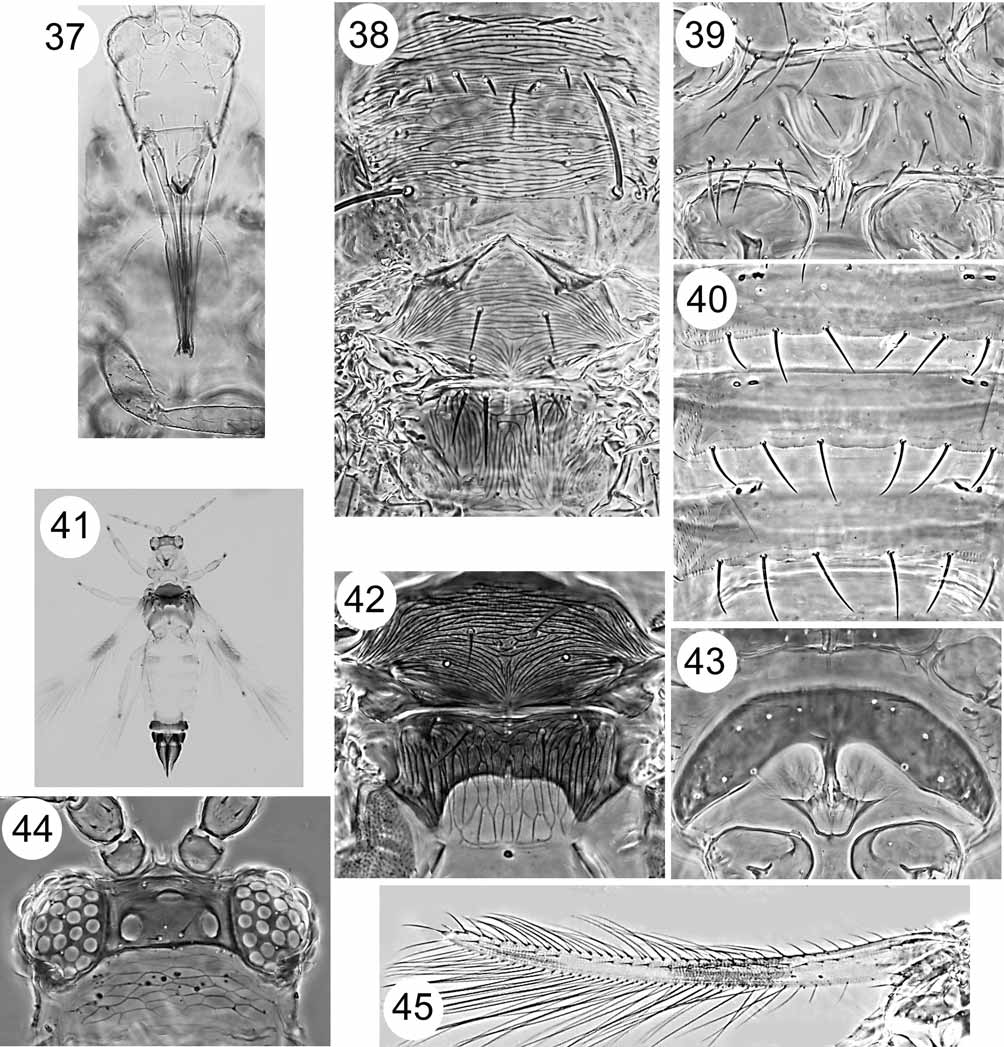
-. Either the wings or the body sharply bicoloured or largely brown ( Fig. 41 View FIGURES 37 – 45 , 73 View FIGURES 67 – 79 ) ........................................................ 3
2. Sternites IV –VI with discal microtrichia complete across sternite, posterior margins with long microtrichia between each marginal seta ( Fig. 53 View FIGURES 46 – 55 ); mouth cone extending between fore coxae; male not known; on Sida leaves ................................................................................................................................................................................... N. gracilipes
-. Sternites IV –VI with no discal microtrichia mesad of marginal setae S 2, and no marginal microtrichia except lateral to S 3 ( Fig. 40 View FIGURES 37 – 45 ); mouth cone exceptionally long, extending to metasternum ( Fig. 37 View FIGURES 37 – 45 ); male not known ..................................................................................................................................................................................... N. barrowi sp.n.
3. Forewing with strongly contrasting brown and white bands, extreme apex paler than sub-apical shaded area ( Fig. 73 View FIGURES 67 – 79 ) ................................................................................................................................................................................ 4
-. Forewing not strongly banded, but sub-basal area pale before median darker area and sometimes with indistinctly paler area before dark apex .......................................................................................................................................... 6
4. Antennae 7 -segmented ( Fig. 68 View FIGURES 67 – 79 ); mesonotum with median and submedian pairs of setae almost in transverse straight line ( Fig. 69 View FIGURES 67 – 79 ); male with large transversely oval glandular area on sternites III –VII ( Fig. 67 View FIGURES 67 – 79 ); on Ipomoea aquatica leaves...................................................................................................................................................... N. plynopygus
-. Antennae 8 -segmented; mesonotum with submedian pair of setae arising well posterolateral to median pair ( Fig. 75 View FIGURES 67 – 79 ); male without sternal glandular areas on III –VI.................................................................................................... 5
5. Body largely brown, pronotal anterior area yellow, median abdominal segments bicoloured ( Fig. 73 View FIGURES 67 – 79 ); tibiae and femora brown with apices yellow; abdominal sternites discal area covered with microtrichia, posterior margins with long fringe ( Fig. 76 View FIGURES 67 – 79 ); ocellar setae pair III on anterior margins of ocellar triangle ( Fig. 74 View FIGURES 67 – 79 ); three pairs of postocular setae, median pair elongate; occipital apodeme well separated from eyes; on Tagetes ........................ N. samayunkur
-. Body largely whitish yellow ( Fig. 41 View FIGURES 37 – 45 ), but dark brown on anterior part of head, meso and metanota, metasternum, tergites VII –VIII and lateral areas of tergite III; legs pale; sternites without microtrichia on disc and posterior margins; ocellar setae pair III arise between hind margins of posterior ocelli; two or three pairs of postocular setae; occipital apodeme confluent with eyes................................................................................................... N. bellisi sp.n.
6. Ocellar setae III clearly anterolateral to ocellar triangle ( Fig. 70 View FIGURES 67 – 79 ); tergites II –VI posterior margin with fringe of microtrichia medially ( Fig. 72 View FIGURES 67 – 79 ); metasternum anterior margin forming a shallow broad V-shape ( Fig. 71 View FIGURES 67 – 79 ) .. N. poeta
-. Ocellar setae III within ocellar triangle ( Fig. 46 View FIGURES 46 – 55 ); tergites II –VI posterior margin without fringe of microtrichia medially ( Fig. 48 View FIGURES 46 – 55 ); metasternum anterior margin only weakly emarginate ( Fig. 49 View FIGURES 46 – 55 ); forewings with sub-apical lobe ( Fig. 51 View FIGURES 46 – 55 ); on leaves of various Fabaceae .................................................................................................................... 7
7. Metanotal reticulation almost equiangular, with internal linear markings ( Figs 47, 50 View FIGURES 46 – 55 ); male with no sternal glandular areas........................................................................................................................................................... N. diana
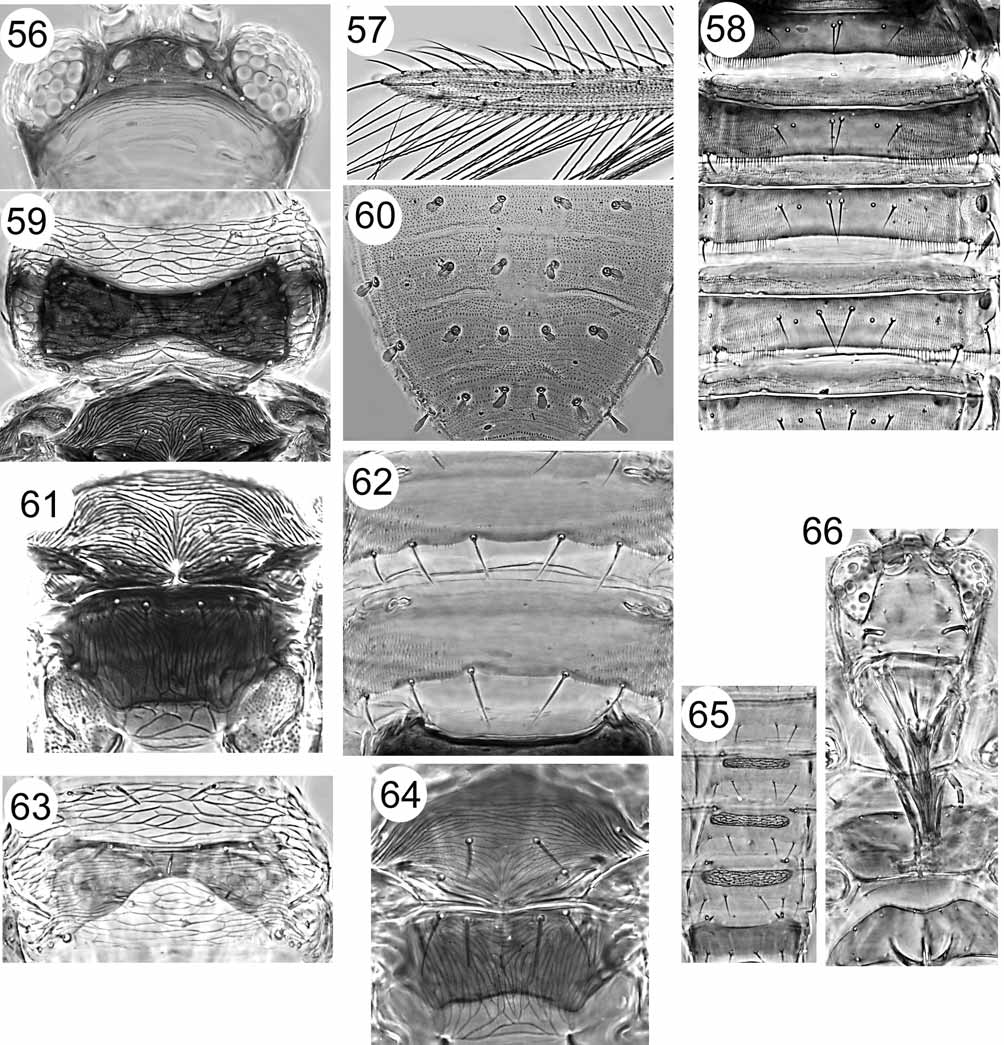
-. Metanotal sculpture linear, with internal dot-like markings ( Figs 61, 64 View FIGURES 56 – 66 ); male with transverse glandular area on sternites V –VII ( Fig. 65 View FIGURES 56 – 66 ).............................................................................................................................................. 8
8. Mouth cone extending to mesosternum ( Fig. 66 View FIGURES 56 – 66 ); pronotal dark area with posterior margin deeply emarginate, posteromedian discal setae arise behind blotch ( Fig. 63 View FIGURES 56 – 66 ); metanotum sharply pale on posterior third ( Fig. 64 View FIGURES 56 – 66 ); tergites IV –V medially with few discal microtrichia; sternites V –VII with microtrichial fields not extending mesad of S 2............................................................................................................................................................ N. katherinae sp.n.
-. Mouth cone extending to fore coxae; pronotal dark area with posterior margin weakly concave, posteromedian discal setae arise on blotch ( Fig. 59 View FIGURES 56 – 66 ); metanotum brown on posterior third; tergites IV –V medially with many discal microtrichia; sternites V –VII with microtrichia fields extending to setae S 1 ( Fig. 62 View FIGURES 56 – 66 ).................................. N. haydni


No known copyright restrictions apply. See Agosti, D., Egloff, W., 2009. Taxonomic information exchange and copyright: the Plazi approach. BMC Research Notes 2009, 2:53 for further explanation.
|
Kingdom |
|
|
Phylum |
|
|
Class |
|
|
Order |
|
|
Family |