
Opeatocerata cooperi Smith
|
publication ID |
https://dx.doi.org/10.11646/zootaxa.3846.4.2 |
|
publication LSID |
lsid:zoobank.org:pub:71A80CC3-CDC1-4291-863B-FA7501D60AF5 |
|
persistent identifier |
https://treatment.plazi.org/id/03F6943F-E079-FF92-C7C7-F92BAB38126F |
|
treatment provided by |
ImsDioSync |
|
scientific name |
Opeatocerata cooperi Smith |
| status |
|
( Figs 58–63 View FIGURES 58 – 63 )
Opeatocerata cooperi Smith, 1989: 515 ; Yang et al., 2007: 146 (cat.); Câmara & Rafael, 2011: 37 (cit.).
Diagnosis. Dark yellow species abdominal tergites 3–6 with paramedian subtriangular, brown spots ( Fig. 60 View FIGURES 58 – 63 ); sternite 8 wider and V-shaped at base, rounded and narrower at apex ( Fig. 61 View FIGURES 58 – 63 ); genital fork with anterior constriction and arms separated at apex ( Fig. 62 View FIGURES 58 – 63 ); tergite 10 divided into two subtriangular plates ( Fig. 61 View FIGURES 58 – 63 ).
Re-description. Female ( Fig. 58 View FIGURES 58 – 63 ). Head: Frons dark brown, shiny, as wide as superior margin of the face. Face dark brown, shiny, slightly convergent toward the proboscis, about 3 X longer than lower width. Ocellar tubercle dark brown with brown pruinescence; ocelli brown. Scape and pedicel brown with black bristles. Proboscis yellow longer than head height. Thorax dark yellow, shiny ( Fig. 58 View FIGURES 58 – 63 ). Legs yellow, except for hind femur and tibial with apical black ring and all tarsomeres 4–5 black. Hind tibia and tarsus with anterodorsal and posterodorsal row of long bristles. Wing ( Fig. 59 View FIGURES 58 – 63 ) hyaline, pterostigma brown, conspicuous, about 2.3 X longer than wide. Halter yellow. Abdomen dark yellow; tergites 3–6 with paramedian subtriangular, brown spots ( Fig. 60 View FIGURES 58 – 63 ). Terminalia: Tergite 8 subretangular ( Fig. 61 View FIGURES 58 – 63 ). Sternite 8 wider and V-shaped at base, rounded and narrower at apex ( Fig. 61 View FIGURES 58 – 63 ). Genital fork ( Fig. 62 View FIGURES 58 – 63 ) with anterior constriction and arms separated at apex. Tergite 10 divided into two subtriangular plates, with approximately half the length of tergite 8 ( Fig. 61 View FIGURES 58 – 63 ). Sternite 10 with straight base and convex apex ( Fig. 61 View FIGURES 58 – 63 ). Receptacle of spermatheca spherical ( Fig. 63 View FIGURES 58 – 63 ). Specimen length: 3.0 mm; wing length: 3.5 mm. Male. Unknown.
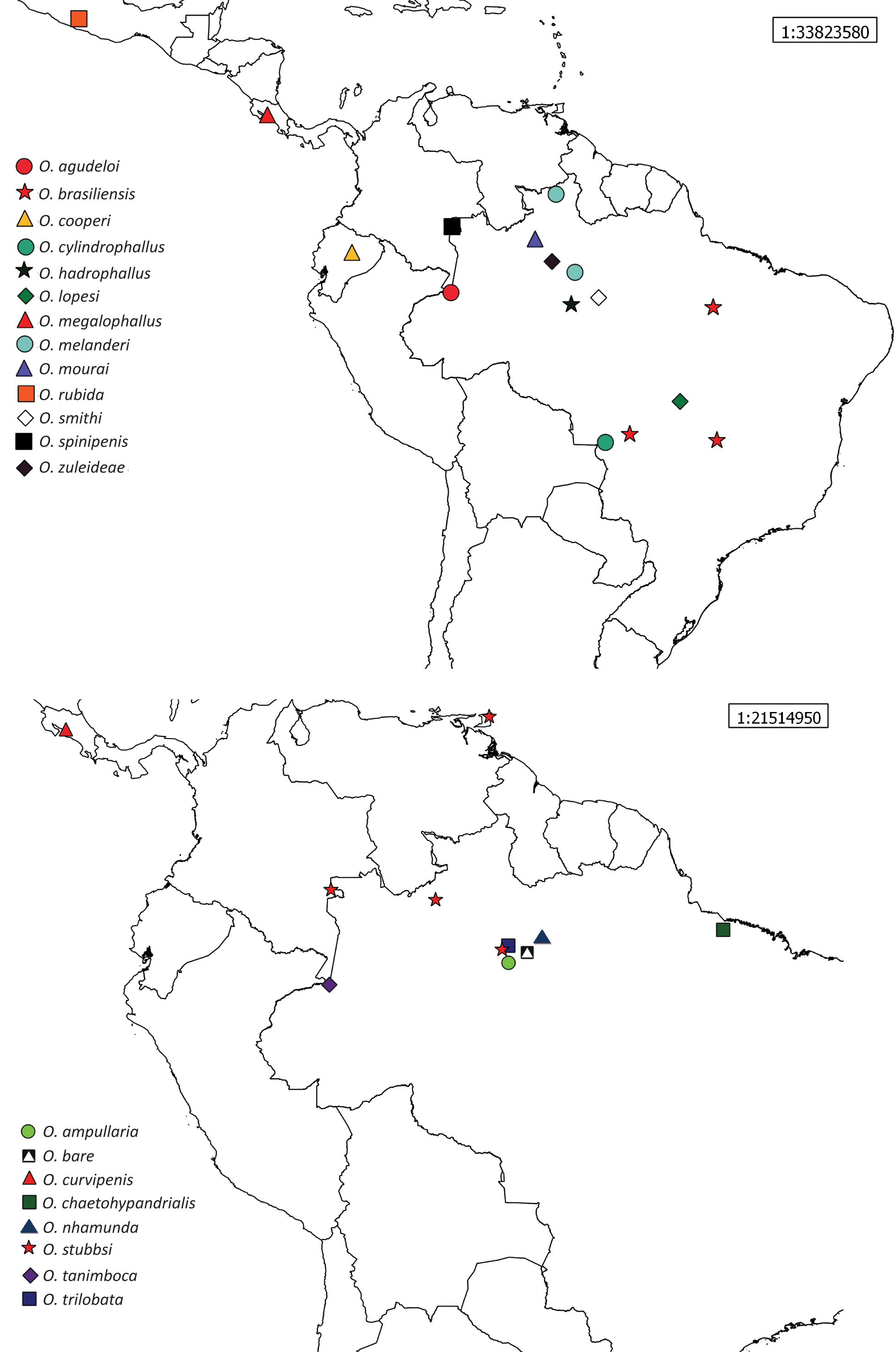
Geographical distribution. Ecuador ( Fig. 211 View FIGURE 211 ).
Type material. HOLOTYPE ♀, labelled: Ecuador, Morona-Santiago, Cord[illera] of Cutucu, 6 km east of Macas, 1100 m. 8.v. 1981. M. Cooper ( BMNH). Paratypes: Ecuador. Same data as holotype, 15.vi. 1981 ( 1 ♀, BMNH); Napo Mayuna 5 km W of Tena, 550 m, M. Cooper / 25.viii. 1979 ( 1 ♀, BMNH).
Holotype condition. Ocellar bristles, styles and first flagellomere lost; left wing on microslide; abdomen in microtube with glycerin.
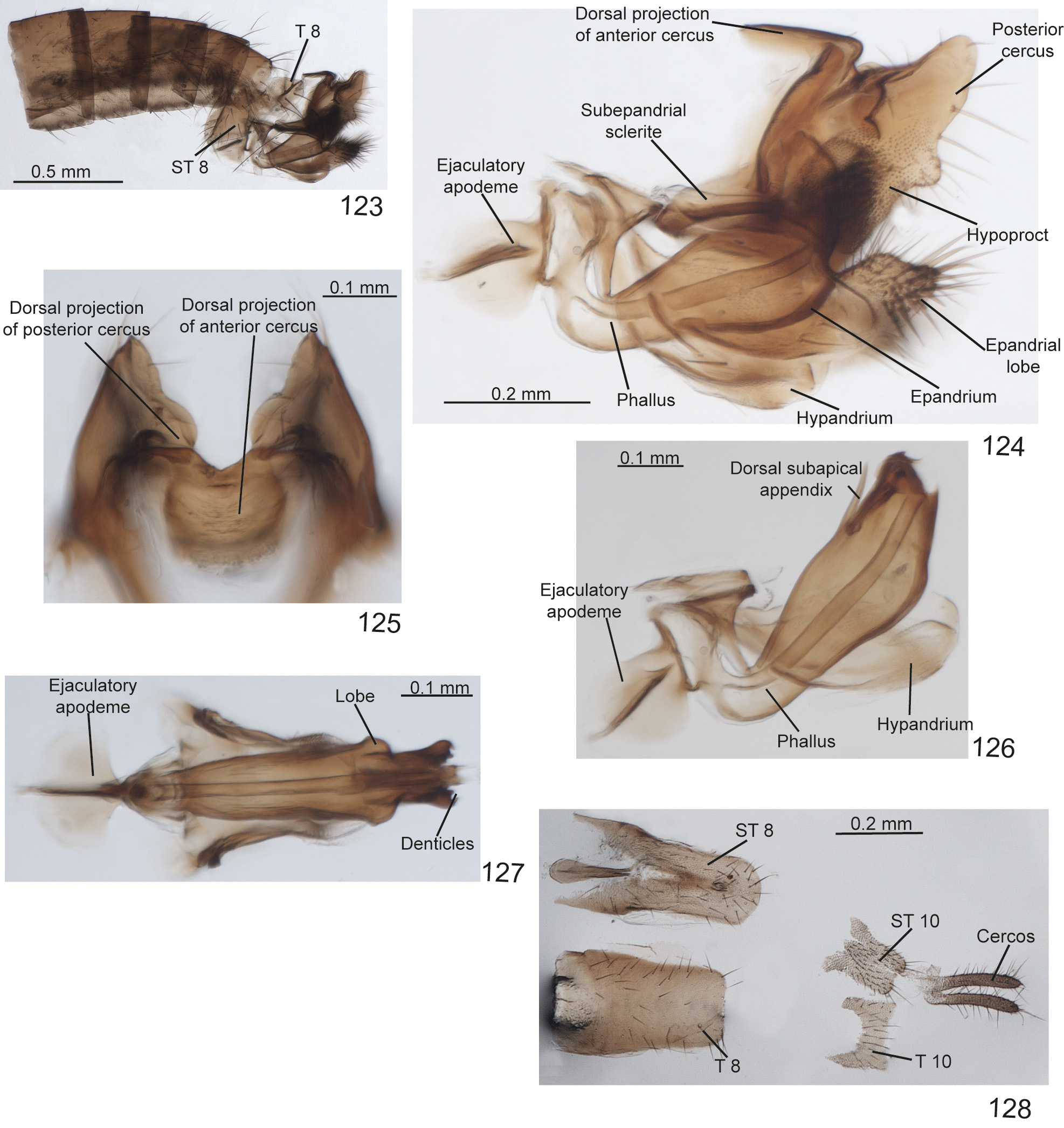
Remarks. Opeatocerata cooperi has sternite 8 wider and V-shaped at base and rounded at apex, similar to O. melanderi . Differs from the latter by tergites with paramedian subtriangular, brown spots ( Fig. 60 View FIGURES 58 – 63 ), tergite 10 divided into two subtriangular plates ( Fig. 61 View FIGURES 58 – 63 ) and genital fork with arms longer than length of the base ( Figs 61, 62 View FIGURES 58 – 63 ). Opeatocerata melanderi has spots on the lateral margins of the tergites, an undivided tergite 10 ( Fig. 128 View FIGURES 123 – 128 ) and genital fork with arms shorter than the length of the base.

No known copyright restrictions apply. See Agosti, D., Egloff, W., 2009. Taxonomic information exchange and copyright: the Plazi approach. BMC Research Notes 2009, 2:53 for further explanation.
|
Kingdom |
|
|
Phylum |
|
|
Class |
|
|
Order |
|
|
Family |
|
|
Genus |

Opeatocerata cooperi Smith
| Câmara, J. T. & Rafael, J. A. 2014 |
Opeatocerata cooperi
| Camara 2011: 37 |
| Yang 2007: 146 |
| Smith 1989: 515 |