
Chaeropus yirratji, Travouillon, Kenny J., Simões, Bruno F., Miguez, Roberto Portela, Brace, Selina, Brewer, Philippa, Stemmer, David, Price, Gilbert J., Cramb, Jonathan & Louys, Julien, 2019
|
publication ID |
https://doi.org/10.11646/zootaxa.4566.1.1 |
|
publication LSID |
lsid:zoobank.org:pub:4D8BAEF5-AED6-4973-897C-96C5945E3710 |
|
persistent identifier |
https://treatment.plazi.org/id/03EE2B15-D956-FF81-4C81-B1BDA1F026BA |
|
treatment provided by |
Plazi |
|
scientific name |
Chaeropus yirratji |
| status |
sp. nov. |
Chaeropus yirratji sp. nov.
( Figs. 8–11 View FIGURE 8 View FIGURE 9 View FIGURE 10 View FIGURE 11 )
urn:lsid:zoobank.org:act:
Holotype. NMV C468 About NMV , adult male, spirit specimen, with associated skull and dentaries, from Northern Territory.
Paratype. MNHN ZM MO-1853-824 , taxidermy, tentatively associated with MNHN ZM AC-1880-422 , skull and dentaries ; NHMUK ZD 1857.10 About NHMUK .24.19, juvenile, partial skull and dentaries ; NMV C469 About NMV , adult male, spirit specimen ; NMV C470 About NMV , adult male, spirit specimen with associated skull and dentaries ; NMV C471 About NMV , juvenile male, spirit specimen ; NMV C5857 About NMV , adult female, spirit specimen ; NMV C5858 About NMV , adult male, spirit specimen ; NMV C5859 About NMV , pouch young female, spirit specimen ; NMV C5860 About NMV , adult female, spirit specimen ; NMV C5861 About NMV , adult female, spirit specimen ; SAMA M1618 About SAMA , adult male, study skin with associated skull and dentaries ; SAMA M2425 About SAMA , adult female, taxidermy ; SAMA M2426 About SAMA , adult female, taxidermy ; SAMA M3971 About SAMA , juvenile female, spirit specimen with associated skull and dentaries .
Referred specimens (modern). MAGNT U1814, left dentary; SAMA M3997, three spirit preserved pouch young.
Referred specimens (fossil). From Cattle Camp, QMF55183 View Materials , right M1; from Muldiva Cave, QMF55215 View Materials , right M1 with broken talon, QMF55216 View Materials , right broken M3; from Broken River, Left Wing unit 2, QMF58985 View Materials , right m1; Dusty Drain, QMF58991 View Materials , left M1; Big Ho, QMF58992 View Materials , right M2; QMF58993 View Materials , left M3; QMF58990 View Materials , left m1; Beehive, QMF58987 View Materials , left maxilla with dP3, P3, M1–2; QMF58988 View Materials , right broken M1; QMF58986 View Materials , left M1 stylar shelf; QMF58989 View Materials , Left M2/3; Geologists’ Find Cave, QMF58996 View Materials , right M1; Rock On A Rock passage (Beehive Cave), QMF58994 View Materials , right m2; QMF58995 View Materials , right m3; from Puntutjarpu, WAM A18624 View Materials , left edentulous maxilla, A20810 View Materials , left maxilla with broken M3, A20575 View Materials , left edentulous dentary; from Chambers Gorge, J Cave, CHG.1.2.4a, partial skull; CHG.1.2.4b, left maxilla with P1–2; CHG.1.2.4c, right edentulous dentary; CHG.1.2.4d, left dentary with m4 erupting; CHG.1.2.4e, right dentary with m4 erupting; D Cave, CHG.6.2.3a, right edentulous dentary; CHG.6.2.3b, left dentary with p1, p2, m1–2; CHG.6.2.3c, right dentary with m2; CHG.6.2.3d, left dentary with m1–3; CHG.6.2.3e, left edentulous dentary; CHG.6.2.3f, partial skull; CHG.6.2.3g, left maxilla with M1; CHG.6.2.3h, right maxilla with P3 erupting, M1–3; CHG.6.2.3i, right maxilla with P2–3, M1; from Uluru, Cave above Fertility Cave, KJT 0001, right broken M3; KJT 0002, broken left edentulous maxilla; Ikari Cave, KJT 0003, right broken molar; from Kintyre Range, sample 9, KJT 0004, right edentulous dentary; sample 1B, KJT 0005, right edentulous dentary, KJT 0006, right edentulous maxilla; sample 5, KJT 0007, left edentulous maxilla; KJT 0008, right dentary with roots of p1; from Gibson Desert, Manton Knob, KJT 0017, left maxilla with M1–2; KJT 0018– KJT 0019, right edentulous dentary; Mount Johnson, KJT 0037, right maxilla with P2, M1; KJT 0038, left maxilla with P2, dP3, M1–2; KJT 0039, left edentulous maxilla; KJT 0040, left edentulous dentary; KJT 0041, left p1; KJT 0042, right p2; KJT 0043, left m1; KJT 0044, right m2; KJT 0045, right m4; KJT 0046, right m1; KJT 0047, left m2 talonid; KJT 0048, right m3; KJT 0049, left edentulous dentary.
Diagnosis. Chaeropus yirratji differs from C. ecaudatus in having longer hindfeet and tail; lacking maxillary fenestrae; lacking distinct medial accessory palatal fenestrae; having a more developed metaconule on M1–3, making the molars more rectangular in shape; carotid foramen opens laterally; StD1 present on M1; metacone of M4 is reduced; and the paracristid on m1 is not continuous.
Etymology. Yirratji, Warlpiri (Aboriginal dialect of the Alice Springs area) word for the local Pig-footed Bandicoot.
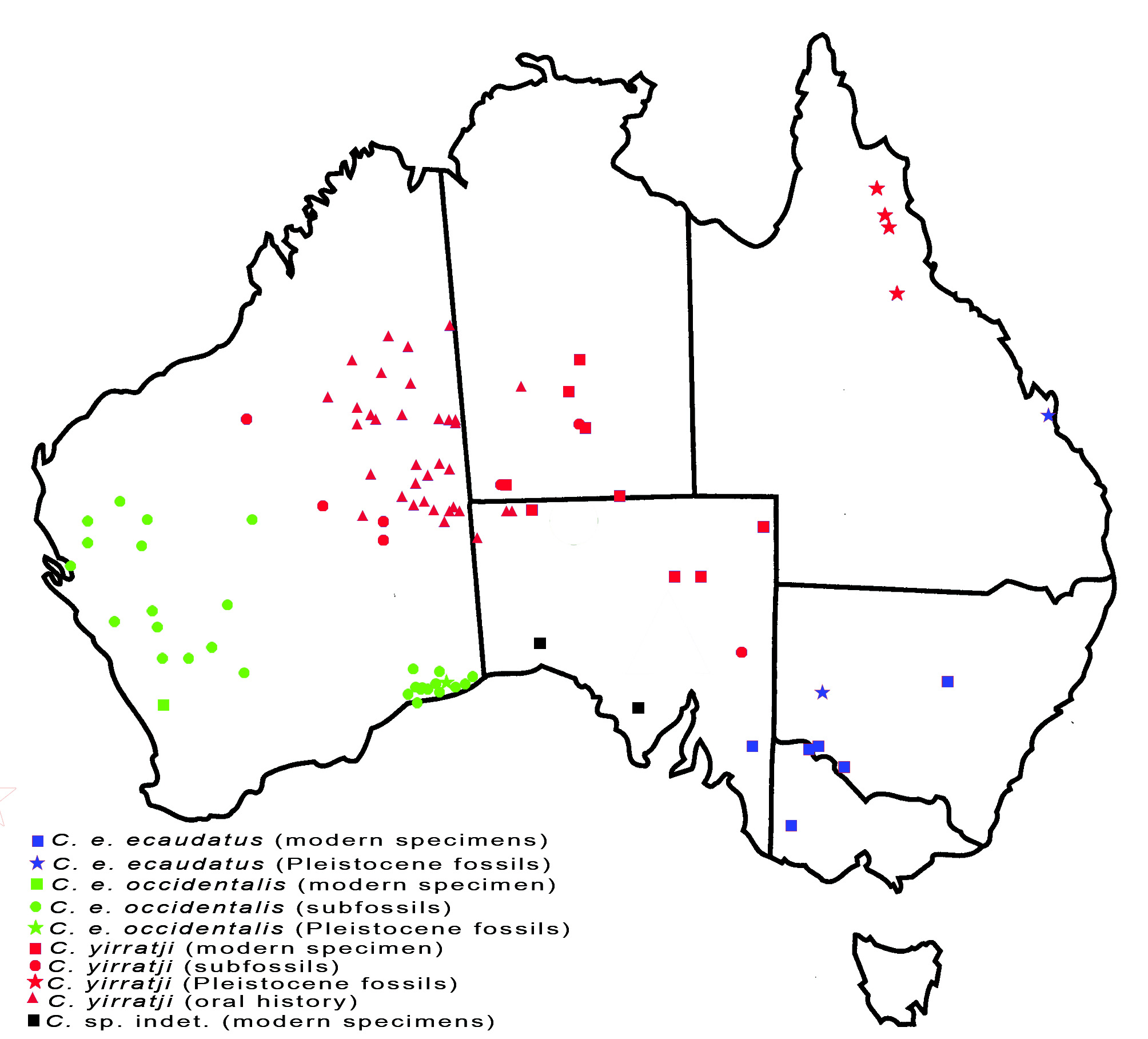
Distribution. Arid zone of the Flinders Ranges ( South Australia), central Australia ( Northern Territory) and the deserts of Western Australia ( Fig. 1 View FIGURE 1 ).
Description. The description is that of the holotype, with reference to the paratypes to illustrate the variation in morphology within the species. Pelage is chestnut on the dorsal side, light greyish brown on the lateral and ventral sides, and limbs (also in NMV C470). The ventral side is cream or white in colour in MNHN ZM MO-1853-824, SAMA M1618, NMV C469, C471, C5857, C5858, C5860, and C5861. The pelage in SAMA M2425, M2426 and M3971 is very different. It is golden dorsally, and beige laterally and ventrally. We do not think that this is a result of fading, as fading would have not occurred in the same way in dry (SAMA M2425 and M2426) and wet (SAMA M3971) specimens. Instead, it is more likely that this taxon exhibits two pelage forms, as in many mammals in Australia (e.g., Wallabia bicolor, Hemibelideus lemuroides, Trichosurus vulpecula, Hipposideros ater). We extracted the skull of SAMA M3971 to make sure that the skull morphology was consistent with the dark form, which it was. The tail is lightly furred laterally, with a dark crest of fur dorsally becoming paler posteriorly, and a shorter light crest of fur ventrally. Tail is on average longer than in Chaeropus ecaudatus (> 120 mm in adults), though it is unclear how much tail breakage has occurred in some specimens Hind feet are longer than in C. ecaudatus , > 70 mm in adults. The morphology of the feet and head does not differ from C. ecaudatus otherwise.
Pouch young morphology is represented by SAMA M3997 and NMV C5859. In SAMA M3997, a portion of the pouch nipples have been cut away from the mother, showing three active nipples. Two of the pouch young are still attached, and the third fell off. The pouch young are most likely only a few days old based on the external developmental stage. Their heads are elongated as in all bandicoots. The fore and hind paws are well-developed with three large toes, unlike in the adult. NMV C5859 is a female and older than the pouch young. The snout is shorter on this specimen than on SAMA M3997, but the fore and hind paws have the adult morphology of two large toes on the forepaw (the third toe is reduced to a nob), and a large toe on the hind paw (the other toes are present but highly reduced).
The skull, in dorsal view, is very similar to that of Chaeropus ecaudatus . The nasals are narrower posteriorly than in C. ecaudatus . The maxillary-frontal suture is crooked as in C. ecaudatus , but more curved. The lacrimal is more massive than in C. ecaudatus and is longer laterally. In lateral view, the incisivomaxillary canal is smaller in size and more posteriorly positioned relative to C. ecaudatus , within the entrance of the infraorbital foramen (except in NHMUK ZD 1857.10.24.19, where it is more anteriorly positioned). The ventral margin of the premaxilla is shorter, but taller, than in C. ecaudatus . The bullae are more evenly rounded ventrally, compared to C. ecaudatus . In ventral view, the lateral accessory palatal fenestrae are shorter than in C. ecaudatus , not extending anteriorly past the anterior tip of P1 (except in MNHN ZM AC-1880-422, on the right side only, and NHMUK ZD 1857.10.24.19, left side only), and narrower anteriorly than posteriorly (it is similar in width along its length in C. ecaudatus ). The medial accessory palatal fenestrae are poorly developed, representing only a few small irregularly shaped fenestrae. The maxillary fenestrae are absent. The maxillopalatine fenestrae are more posteriorly positioned; anteriorly, they are level with the anterior of M1 (level with the middle of P 3 in C. ecaudatus ), and posteriorly, level with the posterior of M2 (level with the middle of M 2 in C. ecaudatus ). The palatine fenestrae are more regular (more rounded) in shape than in C. ecaudatus . The presphenoid and the basisphenoid are in contact (not fully contacting in C. ecaudatus ). The carotid foramen is oval, with a distinct ventral wall of basisphenoid, so that the foramen opens laterally, as in all other peramelemorphians (except C. ecaudatus in which it opens ventrally). The secondary foramen ovale is separated from the primary foramen ovale by a longer portion of alisphenoid, resulting in a more anterolateral position relative to C. ecaudatus . The promontorium of the petrosal is straighter and more laterally directed than in C. ecaudatus (where it is more curved and more ventrally directed) and transitioned more smoothly with the basioccipital. The dentary does not differ from that of C. e. ecaudatus , except in having a more anteriorly positioned anterior mental foramen; anterior to p1 instead of level with the midpoint of p1 (also in C. e. occidentalis ).
The dentition is particularly worn on the holotype, and so SAMA M1618 and M3971 are described here. The I1–5, C1, and P1–3 do not differ in morphology to that of C. ecaudatus . On the M1, the paracone and StA only connect as a result of wear (there is no crest connecting these two cusps in unworn teeth). StB is more massive than in C. ecaudatus , extending more anterolingually. A large StD1 is present anterior to StD, and connected to the premetacrista. The metaconule is larger and the postmetaconulecrista ends posterior to the metacone (lingual to metacone in C. ecaudatus ). The M2 and M3 only differ from that of C. ecaudatus in having a larger metaconule with a postmetaconulecrista ending posterior to the metacone, making the tooth shape more square (more triangular in C. ecaudatus ). The M4 is similar to that of C. ecaudatus but StB and the metacone are reduced in size, shortening the length of the tooth.
The i1–3, c1, and p1–3 do not differ in morphology to that of C. ecaudatus . The m1 trigonid is longer than in C. ecaudatus , and the paracristid is not continuous, and does not connect to the protoconid in unworn teeth (similar condition seen in Perameles pallescens ). The m2–4 are indistinguishable to those of C. ecaudatus .


No known copyright restrictions apply. See Agosti, D., Egloff, W., 2009. Taxonomic information exchange and copyright: the Plazi approach. BMC Research Notes 2009, 2:53 for further explanation.
|
Kingdom |
|
|
Phylum |
|
|
Class |
|
|
Order |
|
|
Family |
|
|
Genus |