
Pseudodendrothrips mori (Niwa)
|
publication ID |
https://doi.org/10.11646/zootaxa.4362.3.5 |
|
publication LSID |
lsid:zoobank.org:pub:B205D4BC-2EBD-437F-AF72-F1B9F6DDD2F2 |
|
persistent identifier |
https://treatment.plazi.org/id/03ED87AF-FFD2-FFE9-FF68-F9CB6674F847 |
|
treatment provided by |
Plazi |
|
scientific name |
Pseudodendrothrips mori (Niwa) |
| status |
|
Pseudodendrothrips mori (Niwa)
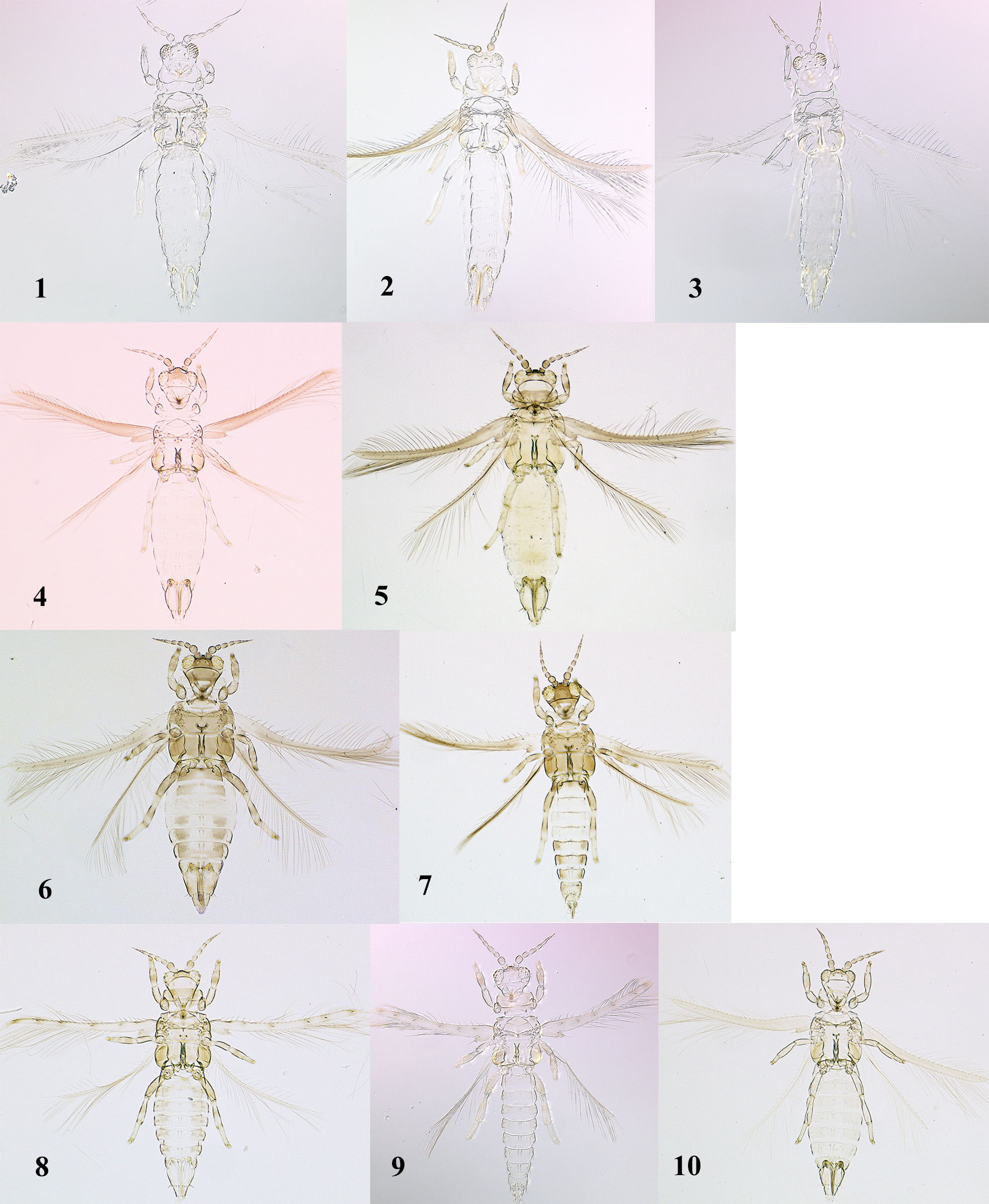
( Fig. 10 View FIGURES 1–10 )
Belothrips mori Niwa, 1908: 180 .
This species is very similar to P. bhattii but can be distinguished from that species by the almost uniformly pale, never dark, head and fore wing ( Fig. 10 View FIGURES 1–10 ). Moreover, the female of P. mori and P. bhattii are distinguishable from P. darci by the shape of setae on abdominal segment IX as indicated above. P. mori is common on Morus leaves from Hokkaido to Kyushu, Japan and also recorded from Taiwan, Korea, China, Taiwan, Philippines, Australia and Chile ( Kudo 1984; ThripsWiki 2017), although the record from Australia may be based on unpigmented individuals of darci ( Mound & Tree 2016) .
No known copyright restrictions apply. See Agosti, D., Egloff, W., 2009. Taxonomic information exchange and copyright: the Plazi approach. BMC Research Notes 2009, 2:53 for further explanation.
|
Kingdom |
|
|
Phylum |
|
|
Class |
|
|
Order |
|
|
Family |
|
|
Genus |

Pseudodendrothrips mori (Niwa)
| Masumoto, Masami & Okajima, Shûji 2017 |
Belothrips mori
| Niwa 1908: 180 |