
Cixiidae, Spinola, 1839
|
publication ID |
https://doi.org/10.5852/ejt.2021.744.1295 |
|
publication LSID |
lsid:zoobank.org:pub:E5B1C00A-1863-4076-8415-FE55CED1F9BA |
|
persistent identifier |
https://treatment.plazi.org/id/03D77A7D-FFCF-F71D-FF79-D982B460FC12 |
|
treatment provided by |
Plazi |
|
scientific name |
Cixiidae |
| status |
|
Key of Madeiran Cixiidae based on males
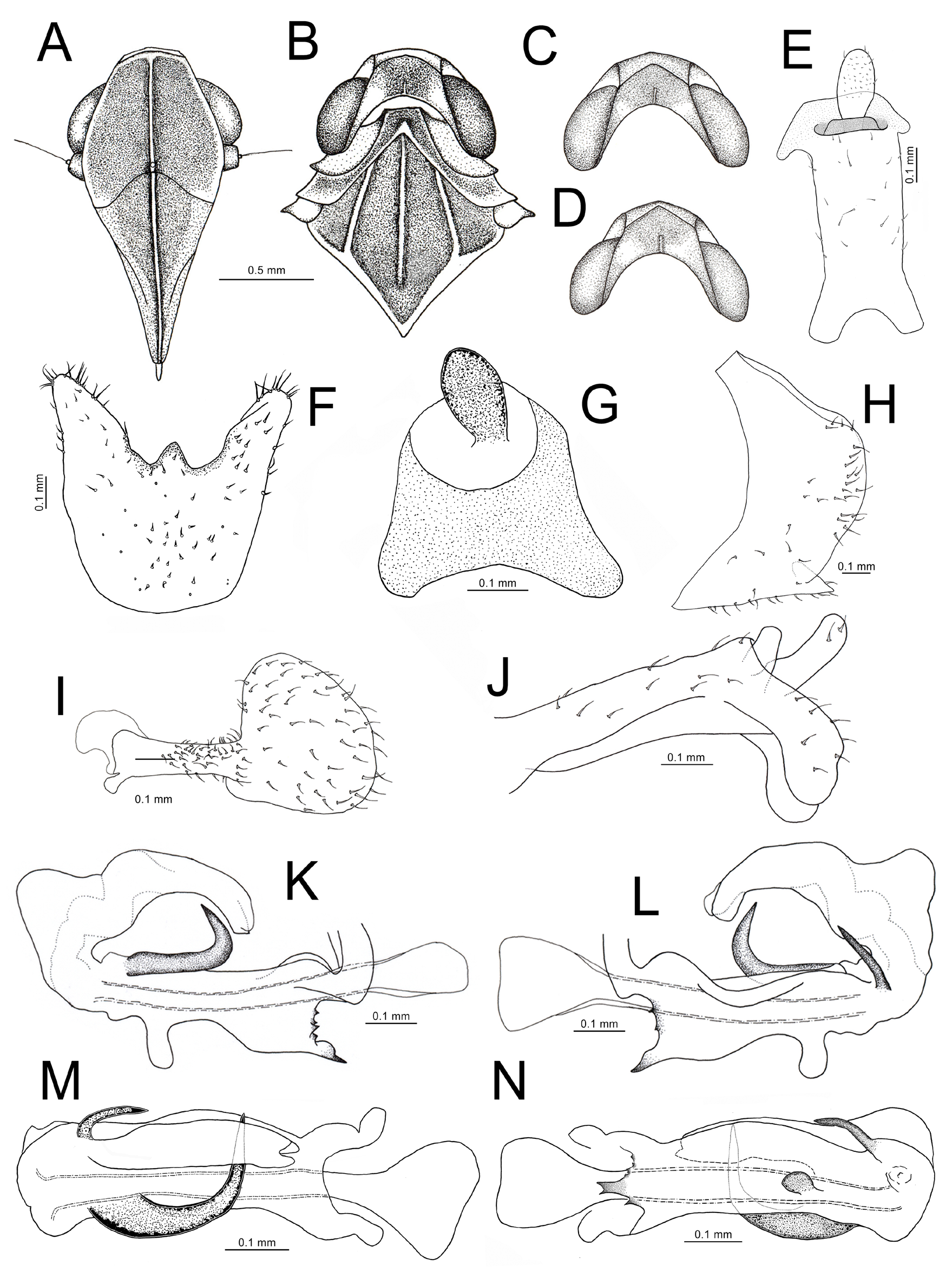
1. Mesonotum with 3 carinae ( Figs 4B View Fig , 7B View Fig , 9B View Fig , 10B View Fig ) ......................................................................... 2
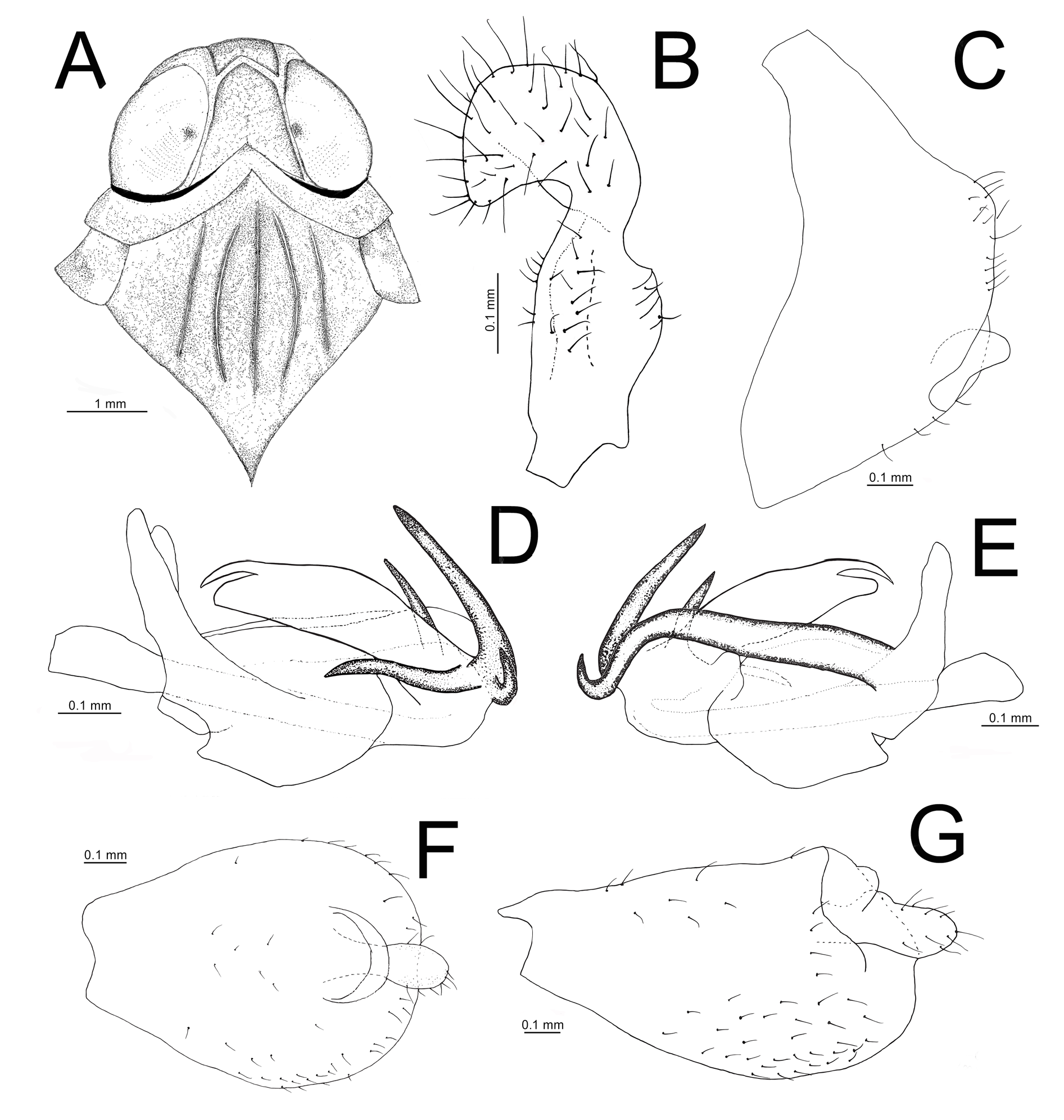
– Mesonotum with 5 carinae ( Figs 11B View Fig , 12B View Fig , 13A View Fig ) ............................................................................ 5
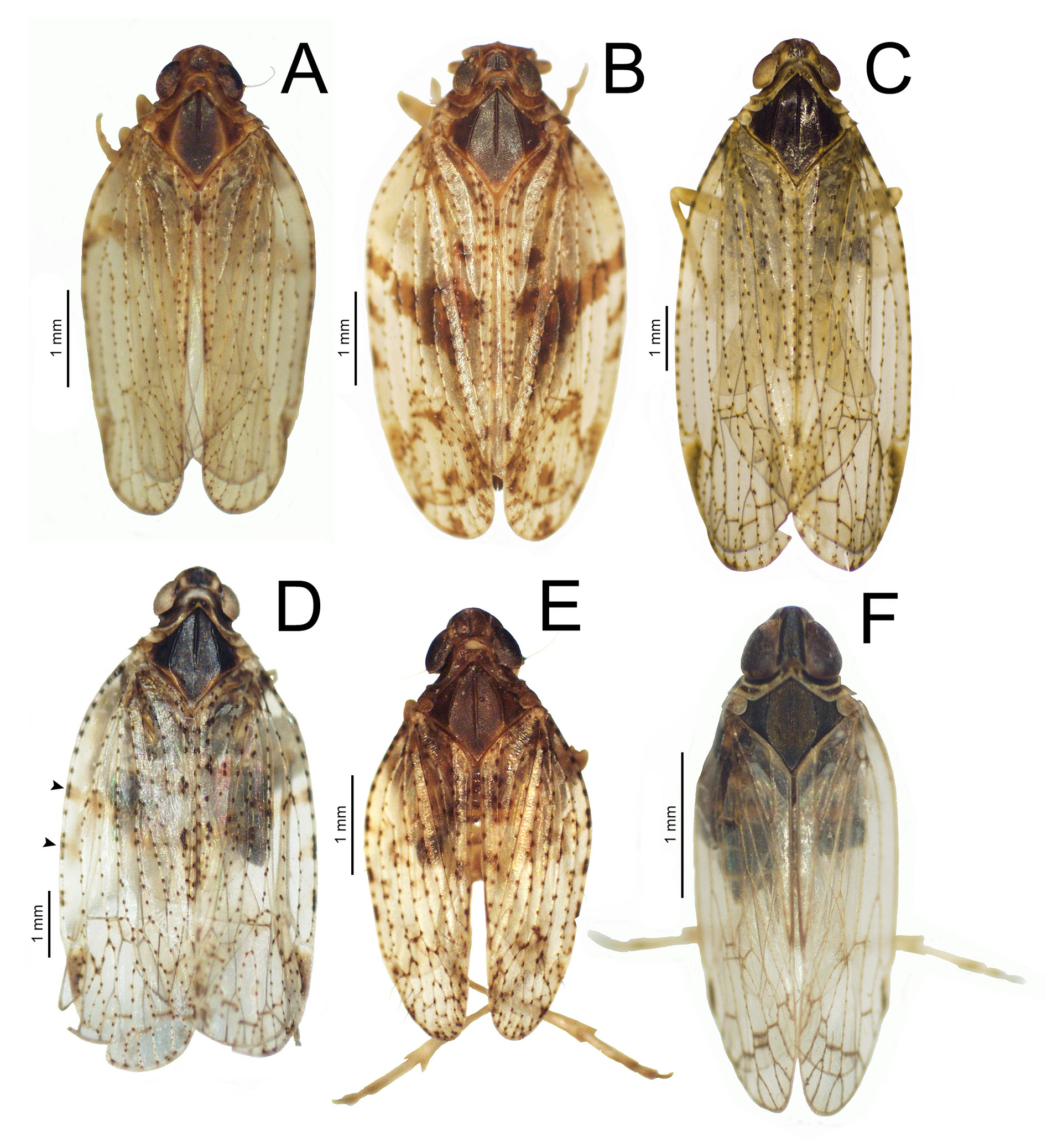
2. Body length < 5 mm; vertex tongue-shaped, posterior margin quadrangular ( Fig. 10B View Fig ); medial carina of frons smooth, reaching the posterior margin of the postclypeus ( Fig. 10A View Fig ); apical margin of tegmina oval with tubercles on the apical margin between the veins ( Figs 3E View Fig , 10I View Fig ); first metatarsus with 6 spines distally .............................................................. Tachycixius chaoensis ( China, 1938)
– Body length> 5 mm; shape of vertex different, posterior margin concave ( Figs 4B View Fig , 7B View Fig , 9B–D View Fig ); medial carina of frons distinctively ridged, extending along the frons and the clypeus ( Figs 4A View Fig , 7A View Fig , 9A View Fig ); apical margin of the tegmina rounded, usually without tubercles on the apical margin between veins, if present they are few ( Fig. 5A–C View Fig ); first metatarsus with 8 spines distally .......................... 3
3. Body length 5.06–5.67 mm; light brown body ( Fig. 3A–B View Fig ); anterior margin of the vertex rounded or slightly acute, slightly concave at the back ( Fig. 9B–D View Fig ); mesonotum light brown; tegmina light golden brown, almost 2 times as long as wide, with small brown setiferous tubercles along the longitudinal veins ................................................................................... C. madeirensis China, 1938
– Body length> 5.90 mm; light blackish to dark brown body; anterior margin of the vertex acute and posterior margin distinctively concave ( Fig. 4B View Fig , 7B View Fig ); mesonotum black; tegmina whitish, 2.75 times as long as wide, with large black setiferous points along the longitudinal veins ............................. 4
4. Body length> 7.20 mm. Vertex slightly acute at the anterior margin and concave at posterior margin ( Fig. 7B View Fig ); ventral margin of the aedeagus with a finger-shaped expansion; the largest lateral thorn curves distally forming an angle of 90º; vellum gibbous, without dorsal denticle and the ventral margin distinctively curved distally ( Fig. 7K–N View Fig ) ................................. C. verticalis Noualhier, 1897
– Body length < 7.20 mm. Vertex distinctly acute at the anterior margin and tongue-shaped at the posterior margin ( Fig. 4B View Fig ); ventral margin of the aedeagus with a wave-shaped expansion; the larger lateral thorn is curved and does not form a 90º angle distally; vellum subtrapezoid, with a small dorsal denticle and the ventral margin almost straight distally ( Fig. 4K–N View Fig ) .... C. wollastoni sp. nov.
5. Body length> 5 mm; first metatarsus with more than 10 spines. Aedeagus with a long, hook-shaped thorn along the right lateral side and 3 smaller thorns distally on the left side of the aedeagus, two of them much longer ( Fig. 13D–E View Fig ) ....................................... Pentastiridus leporinus ( Linnaeus, 1761)
– Body length < 5 mm; first metatarsus with less than 10 spines. Aedeagus with two long, thin thorns on the left lateral side ( Figs 11I–M View Fig , 12I–M View Fig ) ..................................................................................... 6
6. Vertex often short, lateral margins usually converging anteriorly ( Fig. 11B View Fig ); in lateral view, dorsal thorn of aedeagus wider and longer than the ventral thorn, both converging distally ( Fig. 11I–M View Fig )... .................................................................................................... H. madeires Remane & Hoch, 1986
– Vertex often long, lateral margins usually parallel ( Fig. 12B View Fig ); in lateral view, dorsal thorn of aedeagus more slender and shorter than the ventral thorn, both distally parallel or divergent ( Fig. 12I–M View Fig ) .... ............................................................................................... H. portonoves Remane & Hoch, 1986





No known copyright restrictions apply. See Agosti, D., Egloff, W., 2009. Taxonomic information exchange and copyright: the Plazi approach. BMC Research Notes 2009, 2:53 for further explanation.