
Anopheles ( Cellia ) pharoensis Theobald 1901a
|
publication ID |
https://doi.org/10.11646/zootaxa.5394.1.1 |
|
publication LSID |
lsid:zoobank.org:pub:6D86633F-0167-414D-B511-550BCBE578CD |
|
DOI |
https://doi.org/10.5281/zenodo.10438141 |
|
persistent identifier |
https://treatment.plazi.org/id/03D45C56-1424-0F5D-178C-852BFAC4A694 |
|
treatment provided by |
Plazi |
|
scientific name |
Anopheles ( Cellia ) pharoensis Theobald 1901a |
| status |
|
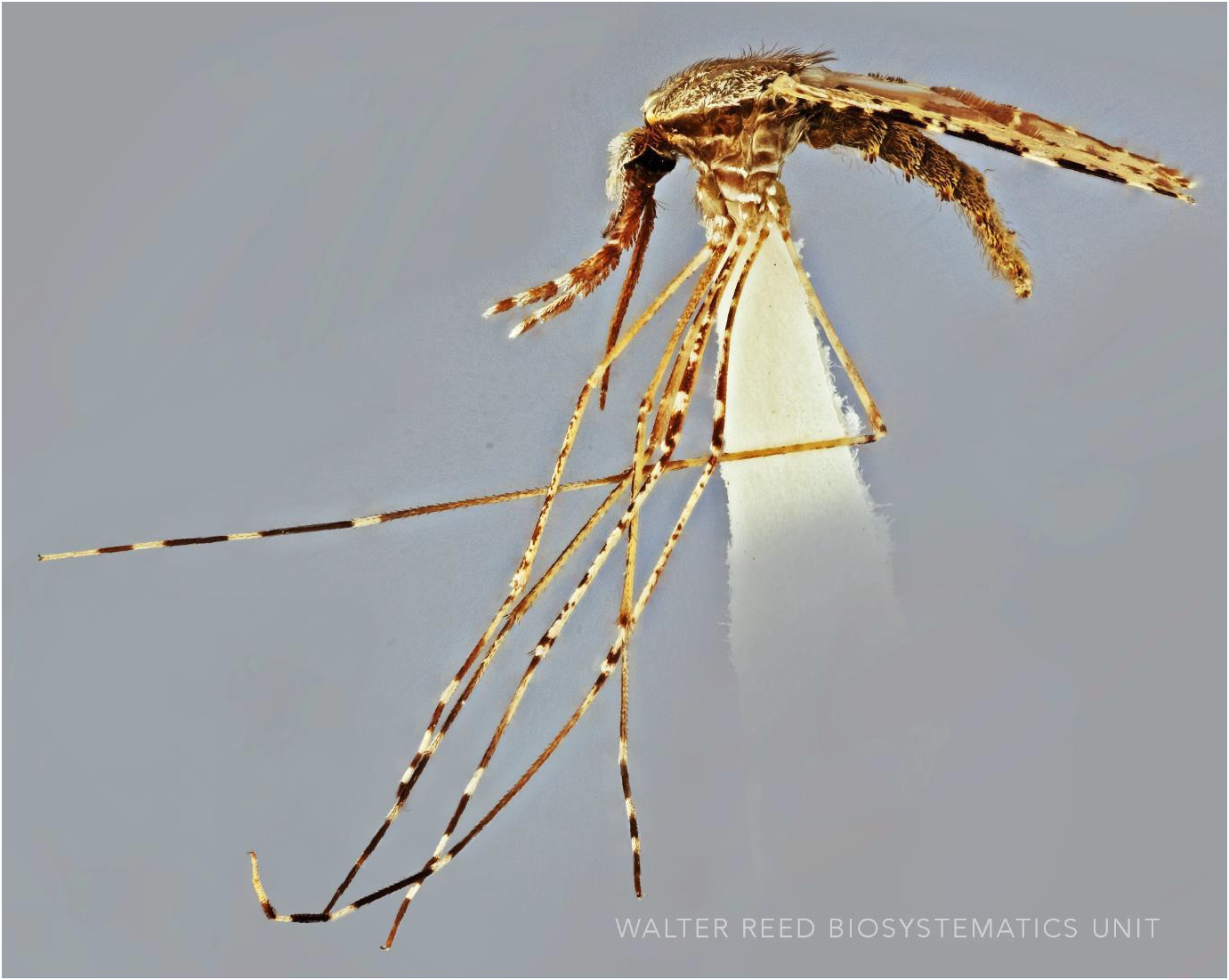
Anopheles ( Cellia) pharoensis Theobald 1901a View in CoL ( Fig. 10 View FIGURE 10 )
Type locality. Cairo, Egypt .
Distribution. This species is found in the Afrotropical and Palaearctic Regions ( Wilkerson et al. 2021). In the Middle East and North Africa, it occurs in Egypt, Israel, Jordan, Kuwait, Libya, Palestine, Saudi Arabia, Syria and Yemen ( Knight 1953b; Mattingly & Knight 1956; Kouznetsov 1976; White 1980; Harbach et al. 1989; Minář 1991; Glick 1992; Morsy et al. 1995; Al-Houty 1997; Brunhes et al. 2000; Tantely et al. 2016, 2017; Lemine et al. 2017; Irish et al. 2020; Wilkerson et al. 2021). Anopheles pharoensis was recorded for the first time in Saudi Arabia by Mattingly & Knight (1956).
Remarks. Gillies & de Meillon (1968) noted some morphological variation in the mesonotal scaling, the ornamentation of the wings, the hindtarsal bands, the male genitalia and the pharynx of females. An o pheles pharoensis may be a species complex because of its variation in vector status and behaviour, as well as chromosomal inversions ( Miles et al. 1983).
Medical importance. Despite the fact that this species is zoophilic and it is not considered to be a malaria vector in Saudi Arabia, studies have shown that it is a proven vector in Senegal and a possible vector in Yemen ( Kouznetsov 1976; Dia et al. 2008). Also, An. pharoensis was able to experimentally transmit Rift Valley fever virus in Egypt ( Gad et al. 1987). Additionally, the species is involved in the transmission of the nematode Wuchereria bancrofti and the Babanki, Bangui, Birao, Ngari, Sanar and Wesselsbron viruses in Africa ( Tantely et al. 2016).
No known copyright restrictions apply. See Agosti, D., Egloff, W., 2009. Taxonomic information exchange and copyright: the Plazi approach. BMC Research Notes 2009, 2:53 for further explanation.