
Arrhopalites vazquezae PalaciosVargas & Zeppelini, 1995 : 14
|
publication ID |
https://doi.org/10.5281/zenodo.171788 |
|
publication LSID |
lsid:zoobank.org:pub:FA5DEAB7-B7ED-416E-B1AB-E101B5294CCC |
|
persistent identifier |
https://treatment.plazi.org/id/03C387C2-FFE9-FFC8-FE9C-46A1A93B377E |
|
treatment provided by |
Plazi |
|
scientific name |
Arrhopalites vazquezae PalaciosVargas & Zeppelini, 1995 : 14 |
| status |
|
Arrhopalites vazquezae PalaciosVargas & Zeppelini, 1995: 14 –16, figs. 25–32.
Material examined: Holotype Ψ and 2 paratypes ΨΨ, 7 xii 1993. MEXICO, Oaxaca, Acatlan. De la Culebra cave. Sprouse coll. Christiansen leg., LESM.
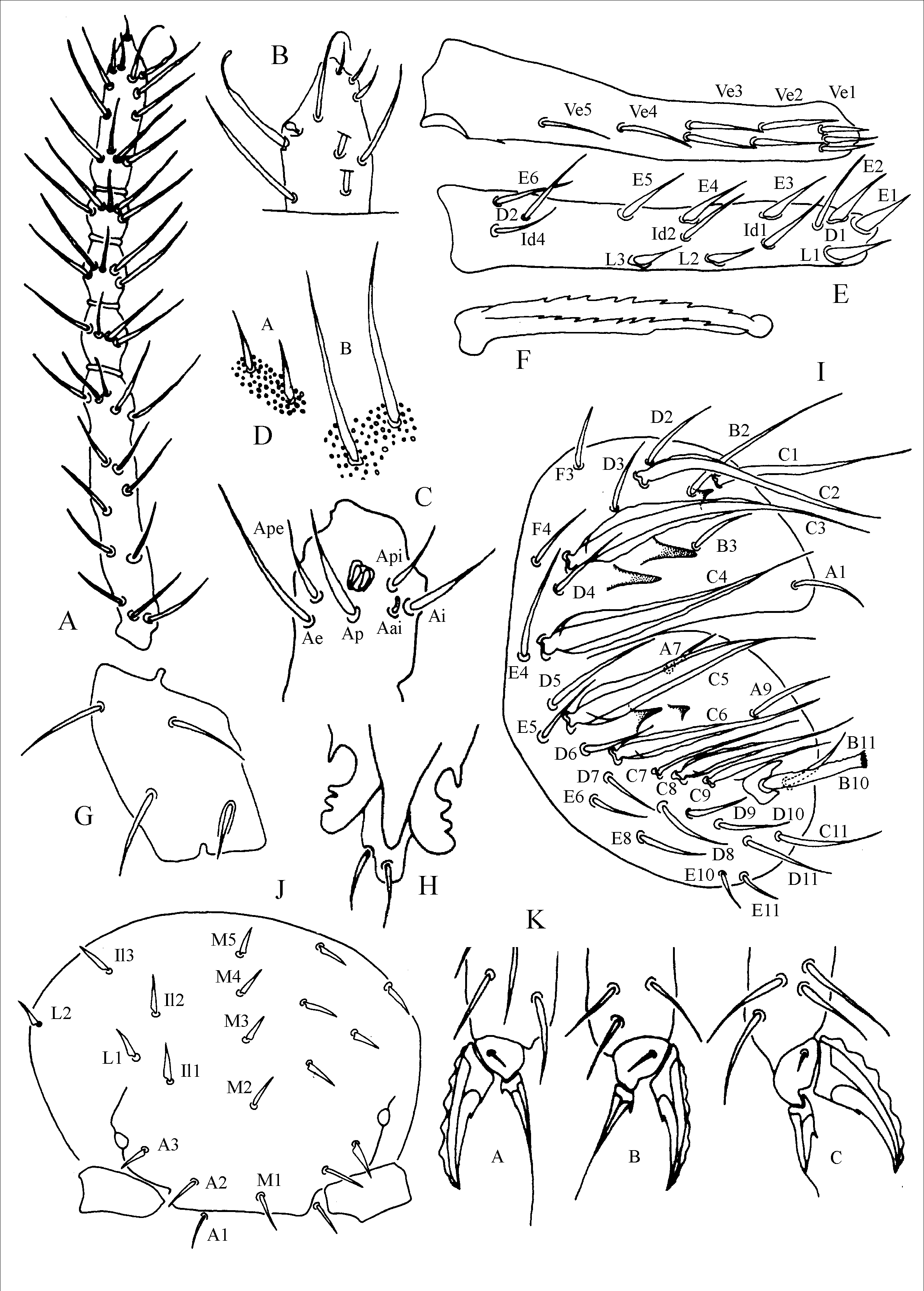
Caecus group ( Fig. 7 View FIGURE 7. A , A–K). Body setae as shown in figure D. Antennae of holotype 1.6 X as long as the cephalic diagonal. Ant. IV with five ringed subsegments (Fig. A), apex with a capitate sense rod (Fig. B). Ant. III without basal swelling; sense organ (Fig. C) with sense rods in a single pit; seta Aai short, clubshaped and blunt; Api and Ape short and slender and acuminate with apical bristle; Ae, Ap and Ai normal elongate setae. 1 + 1 eyes, no traces of pigments in mounted specimens. Dorsal cephalic setae spinelike, chaetotaxy as figure J and table 3. Metatrochanteral organ (seta D 2) present (Fig. G). All ungues with a small inner tooth and tunica. All unguiculi with corner tooth and apical filament exceeding unguis tip (Figs. K, a–c). Corpus tenaculum with two setae (Fig. H). Dens 3,2,2,1, 1 ventral setae, chaetotaxy as in figure E and table 3. Mucro narrow, gutterlike, both edges serrate (Fig. F). Anal valve with 3 + 2 cuticular spines, s0 present, chaetotaxy as in figure I and table 2. Female subanal appendage flattened and apically serrated.
Biogeographic zone 24 a.
Remarks: This is the only known species of the caecus group from Mexico. The fourth antennal segment is divided into five ringed subsegments; Id 1, Id 2, Id 4, and E 6 present on dens, L 4 missing. The cuticular spine s0 is present in the anal vale.
No known copyright restrictions apply. See Agosti, D., Egloff, W., 2009. Taxonomic information exchange and copyright: the Plazi approach. BMC Research Notes 2009, 2:53 for further explanation.