
Surirella liubingii J.Y.Long, 2023
|
publication ID |
https://doi.org/10.11646/phytotaxa.592.2.11 |
|
DOI |
https://doi.org/10.5281/zenodo.7841441 |
|
persistent identifier |
https://treatment.plazi.org/id/03C387BA-FFB3-FFF6-EFC6-F8DAFD6BFF29 |
|
treatment provided by |
Plazi |
|
scientific name |
Surirella liubingii J.Y.Long |
| status |
sp. nov. |
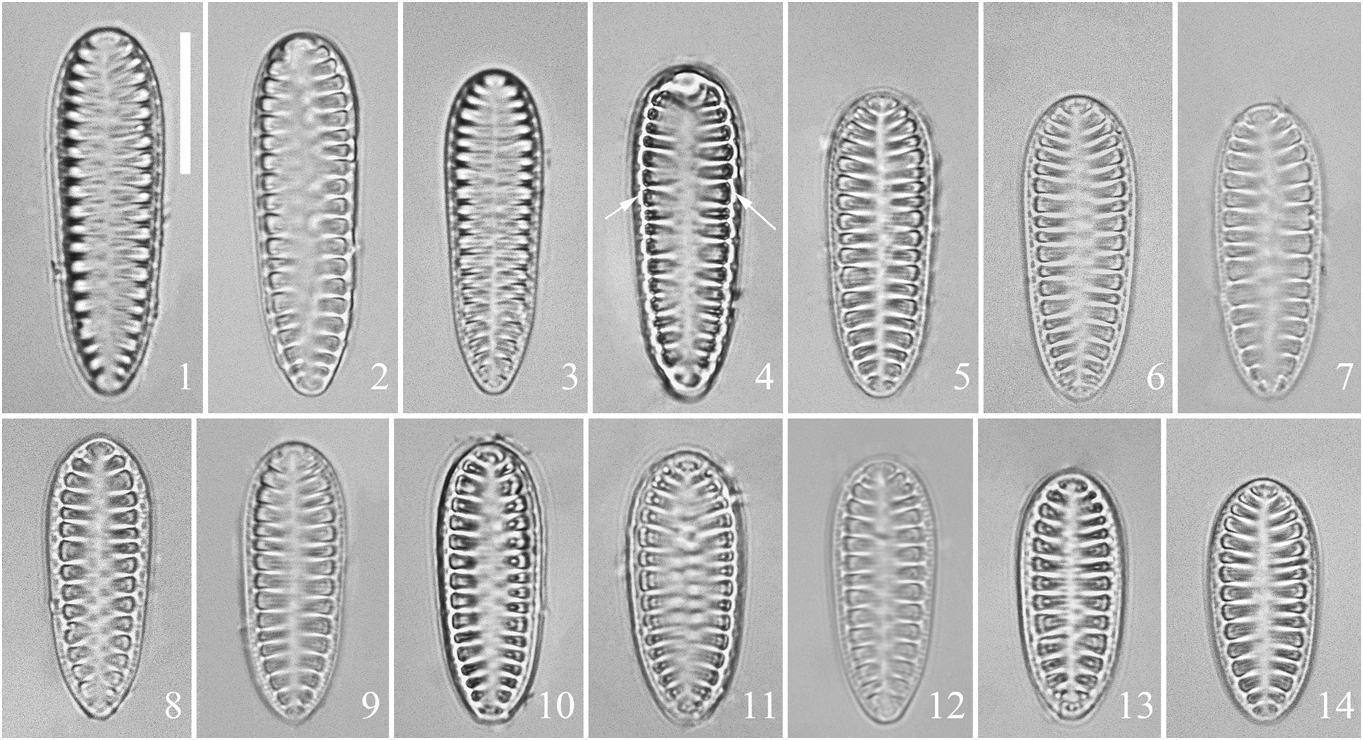
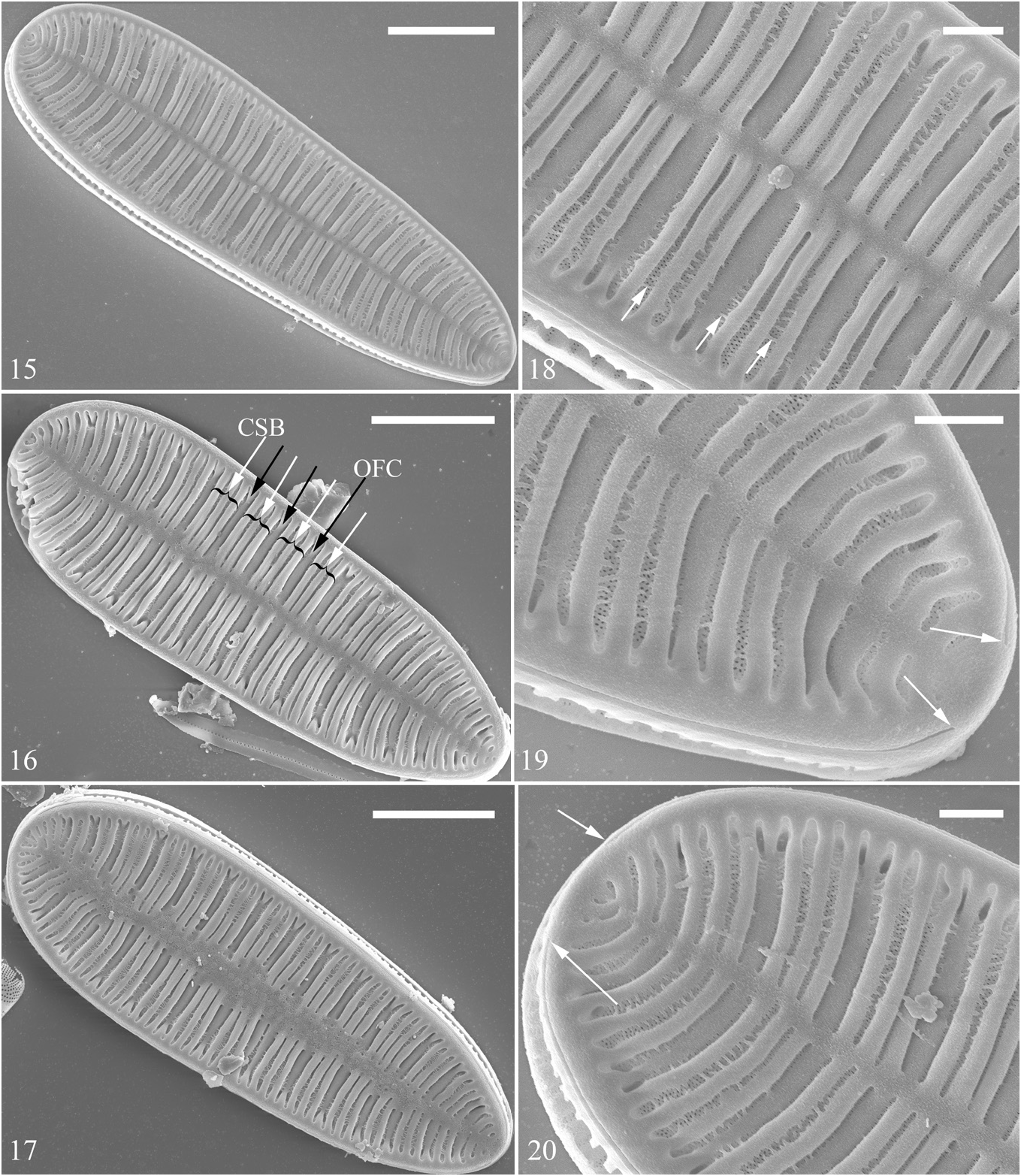
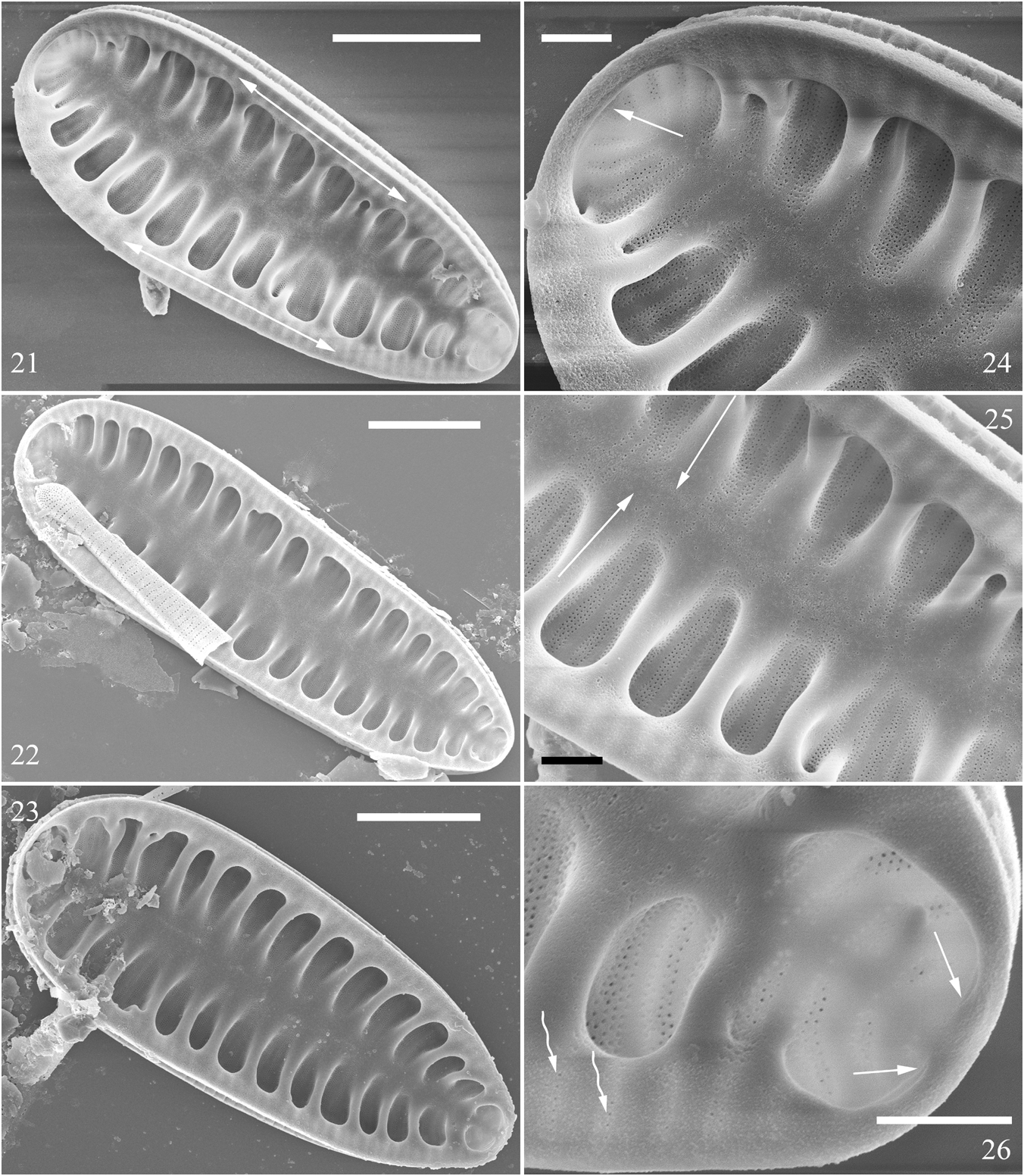
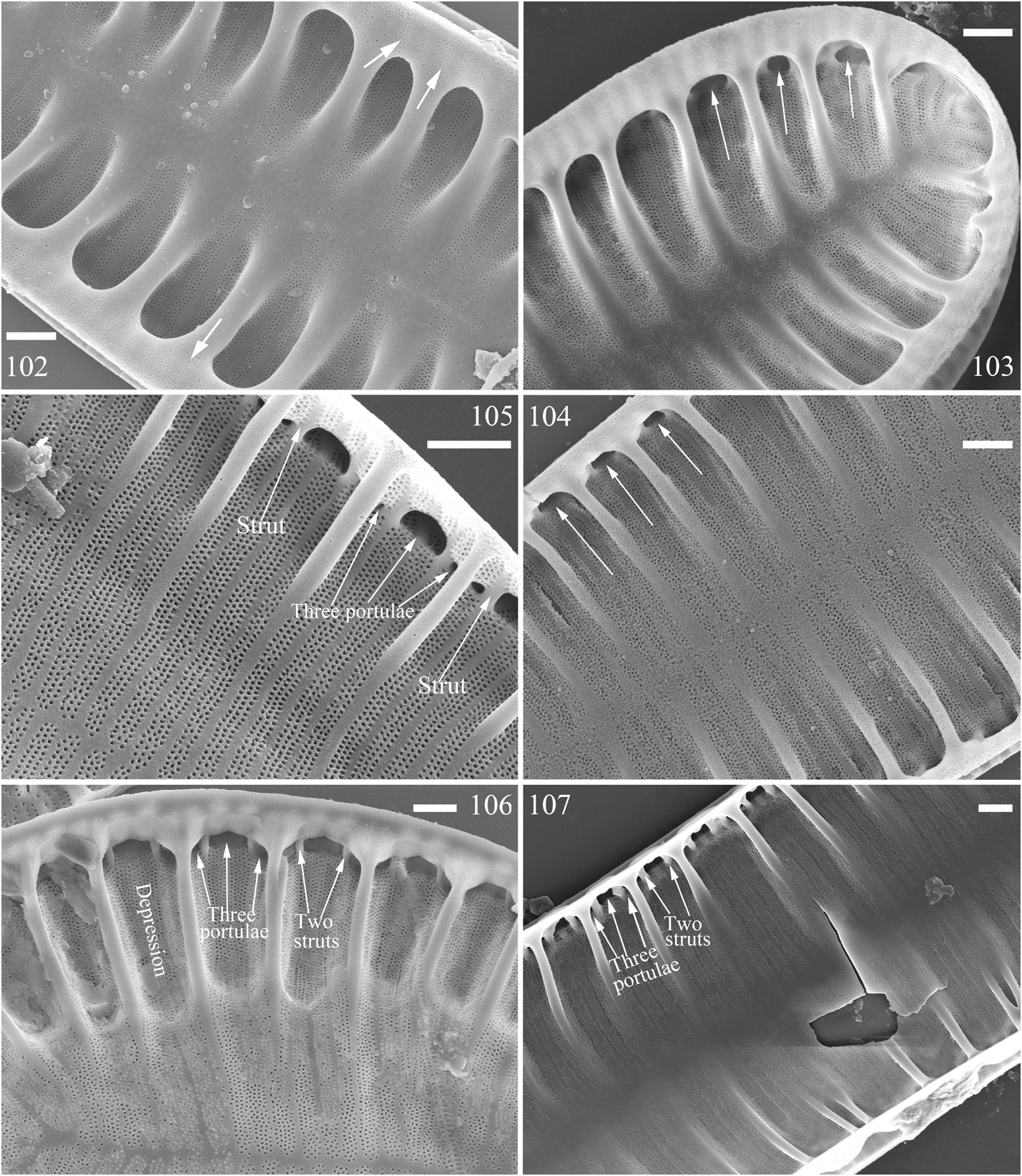
Surirella liubingii J.Y.Long sp. nov. (LM: Figs 1–14 View FIGURES 1–14 , SEM: Figs 15–26 View FIGURES 15–20 View FIGURES 21–26 , 102, 103 View FIGURES 102–107 )
Observations:— LM: Valve outline long-ovate to ovate with broadly rounded headpole and cuneate footpole ( Figs 1– 14 View FIGURES 1–14 ). Valve dimensions (n = 21): length 22–33 μm, width 8.5–9.9 μm (measured at widest part of the valve), length/width ratio 2.3–3.7. Costa-stria bundles (CSBs) distinct, alternated with over-fibula costae (OFCs) from pole to pole. CSBs not reaching valve margins because the internal wall of raphe canal growing into cell cavity to form a “pseudoseptum” from the valve margin (indicated by two arrows in Fig. 4 View FIGURES 1–14 , see also Figs 21–23 View FIGURES 21–26 ). CSBs parallel at the valve middle, slightly radiate approaching apices. Fibulae distinct, extending to midline, 6–7 in 10 μm.
SEM: Each CSB mostly composed of three costae and four striae, but occasionally two costae and three striae or four costae and five striae ( Figs 15–17 View FIGURES 15–20 ). Tiny rib-like thickenings produced externally ( Fig. 18 View FIGURES 15–20 , arrows). Striae multiseriate, composed of 3 or 4 rows of areolae, 24–26 in 10 μm (measured from SEM images, n = 3). Outside openings of areolae round to slit-like ( Figs 18–20 View FIGURES 15–20 ). Raphe canal located directly on mantle. Distal raphe endings simple and interrupting at both apices ( Figs 19, 20 View FIGURES 15–20 , two arrows respectively). Internally, wall of raphe canal growing into cell cavity to the extent that the internal raphe canal wall is developed to form a longitudinal siliceous plate (a “pseudoseptum” from the valve margin, indicated by two double-headed arrows in Fig. 21 View FIGURES 21–26 ), which hides the portula structure. The wall of the raphe canal is striated ( Fig. 26 View FIGURES 21–26 ). Fibulae robust, occasionally bifurcate, extending to valve midline ( Figs 21–23, 25 View FIGURES 21–26 , 102 View FIGURES 102–107 ). Raphe continuous at headpole ( Fig. 24 View FIGURES 21–26 , arrow), but interrupted at footpole ( Fig. 26 View FIGURES 21–26 , two arrows). One portula produced between two adjacent fibulae ( Fig. 103 View FIGURES 102–107 , three arrows).
Type:— CHINA, Qinghai province, Menyuan County: unnamed freshwater river course, sampling point 37°27'28" N, 101°23'15" E, 2940 m asl. Bing Liu , 18 th July 2019 ( holotype slide JIU! DIA202315 About DIA , specimen circled on slide = Fig. 1 View FIGURES 1–14 ) GoogleMaps .
Etymology:— Named after Dr. Bing Liu who is the first author’s supervisor and who collected the samples.
Ecology and distribution:— Epilithic in river. The following environmental parameters were measured. Conductivity was 448 ± 1 μS̔cm –1, pH was 8.36 ± 0.03 and water temperature was 11.9 ± 0.5 °C. So far, Surirella liubingii has only been found in the type locality.
| JIU |
Jishou University |
No known copyright restrictions apply. See Agosti, D., Egloff, W., 2009. Taxonomic information exchange and copyright: the Plazi approach. BMC Research Notes 2009, 2:53 for further explanation.
|
Kingdom |
|
|
Phylum |
|
|
Class |
|
|
Order |
|
|
Family |
|
|
Genus |