
Meriania callosa Rob.Fern., R.Goldenb.& Michelang., Willdenowia
|
publication ID |
https://doi.org/10.11646/phytotaxa.602.1.1 |
|
DOI |
https://doi.org/10.5281/zenodo.8142010 |
|
persistent identifier |
https://treatment.plazi.org/id/03B887DA-FFAF-FFA0-FF62-C6EFFD6AF84C |
|
treatment provided by |
Plazi |
|
scientific name |
Meriania callosa Rob.Fern., R.Goldenb.& Michelang., Willdenowia |
| status |
|
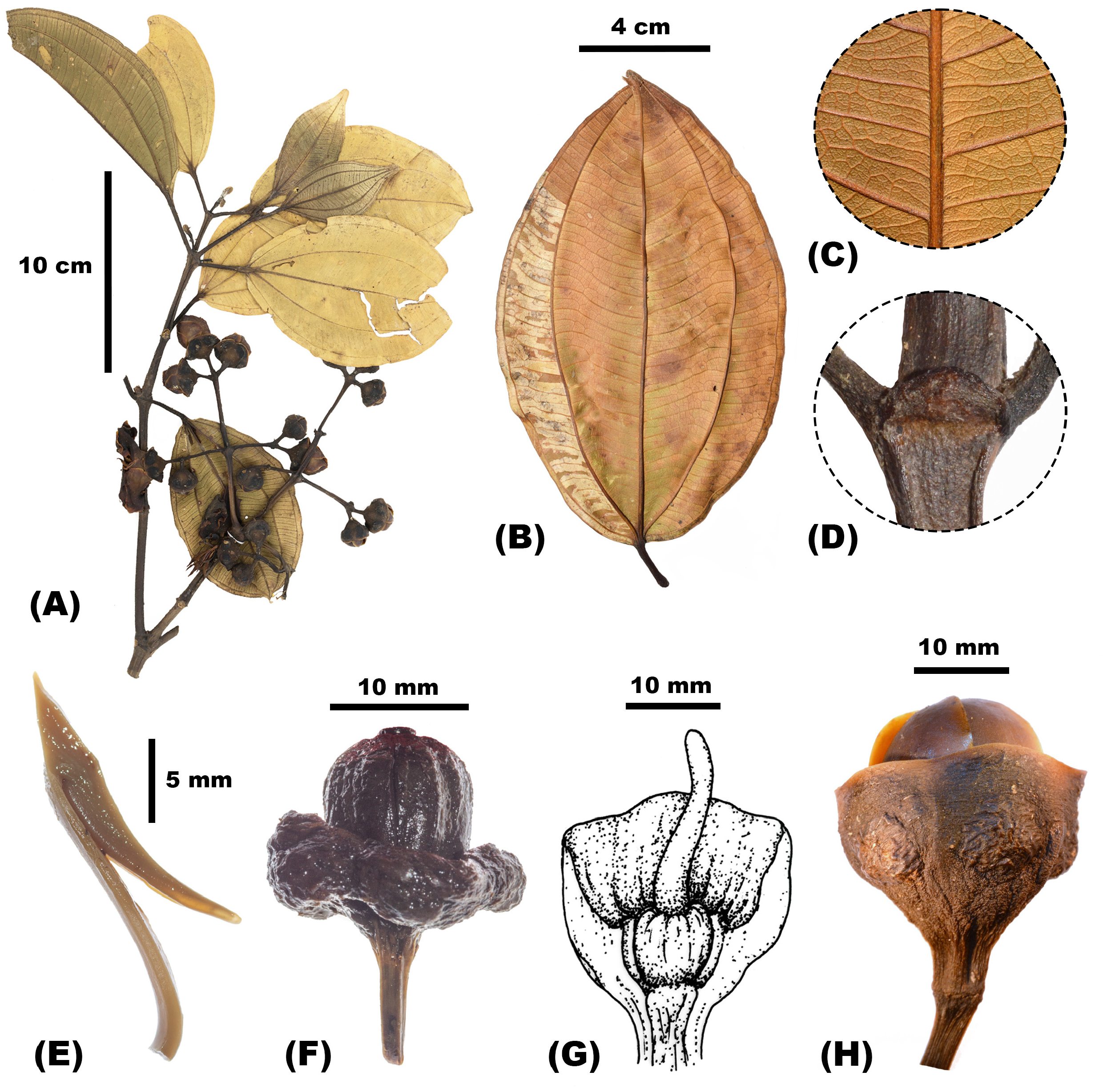
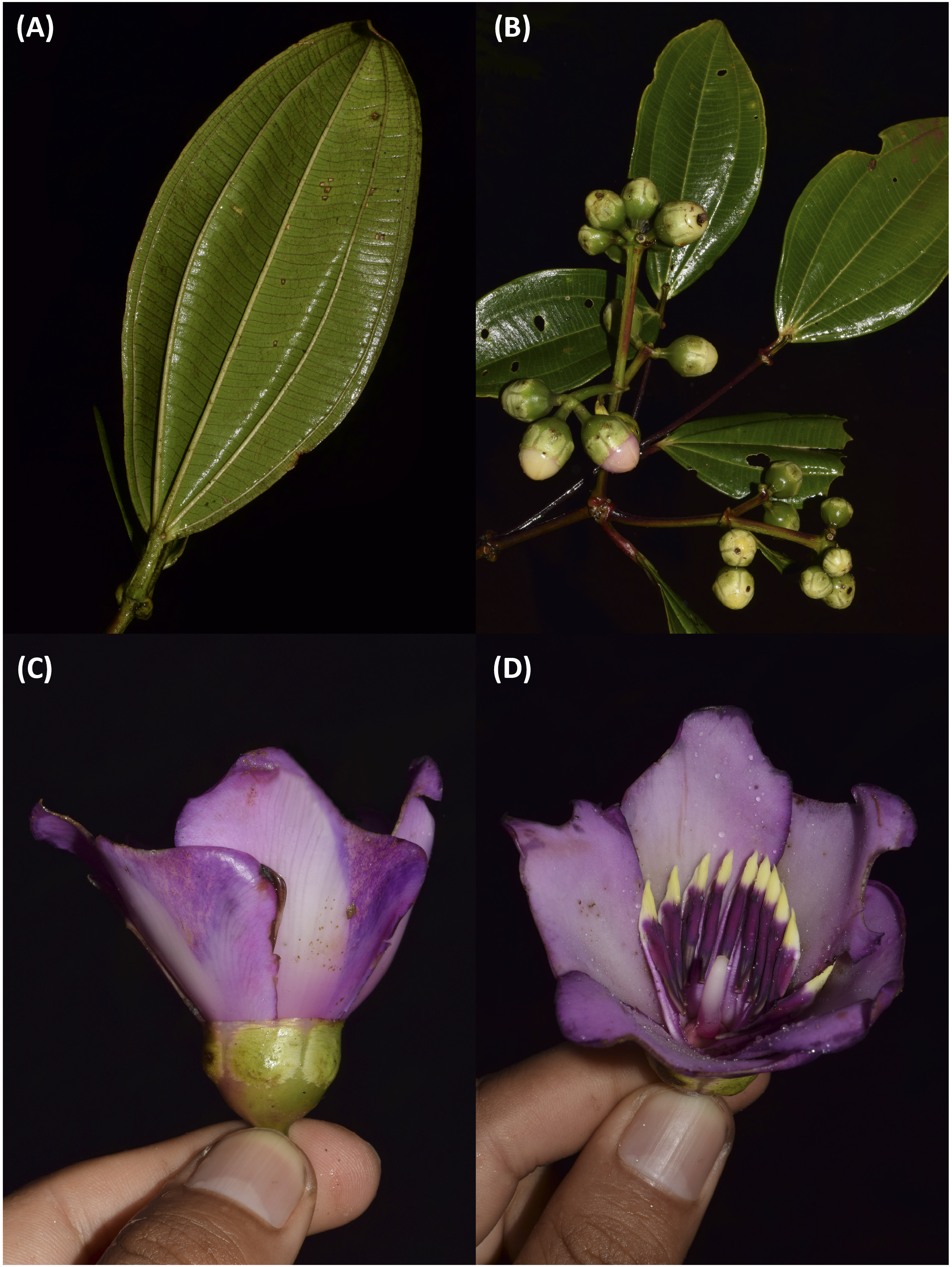
5. Meriania callosa Rob.Fern., R.Goldenb.& Michelang., Willdenowia View in CoL 52(1): 49 (2022). Type GoogleMaps :— PERU. Amazonas: Prov. Bongará, Dist. Yambrasbamba, ruta desde CP Santa Rosa hacia bosque El Toro, 1950 m, 05°40’07.98”S, 77°55’30.04”W, 11 Nov 2020 (fl.), R. Fernandez-Hilario, W. Chuquitucto & A. Wong 2055 ( holotype: MOLF! [barcode 000007]; isotypes: HOXA! [accession no. 077833], KUELAP! [accession no. 971], MOLF! [barcode 000008], NY! [barcode 04239399], UPCB! [accession no. 99412]). ( Figures 17–18 View FIGURE 17 View FIGURE 18 ).
Comments:— This species is distinguishable by the combination of nodes with interpetiolar flaps ( 0.5–3 mm long) ( Fig. 17D View FIGURE 17 ), glabrous hypanthia and calyces, calyces with callose dorsal projections ( Fig. 17H View FIGURE 17 )), spreading, fuchsia corollas, isomorphic stamens, stamen connectives with two appendages ( Fig. 17E View FIGURE 17 ), one triangular descending dorso-basal appendage, and other dorsal appendage as a mere hump (rarely inconspicuous). Among Peruvian species, M. callosa most closely resembles M. zunacensis but differs by the projections on the insertion of the petioles with the leaf blades [absent vs. present (scutum)], petiole length ( 10–22 mm vs. 25–50 mm), and the dorsal projections on calyces (callose vs. absent). A detailed comparison of M. callosa with other related species can be found in Fernandez-Hilario et al. (2022).
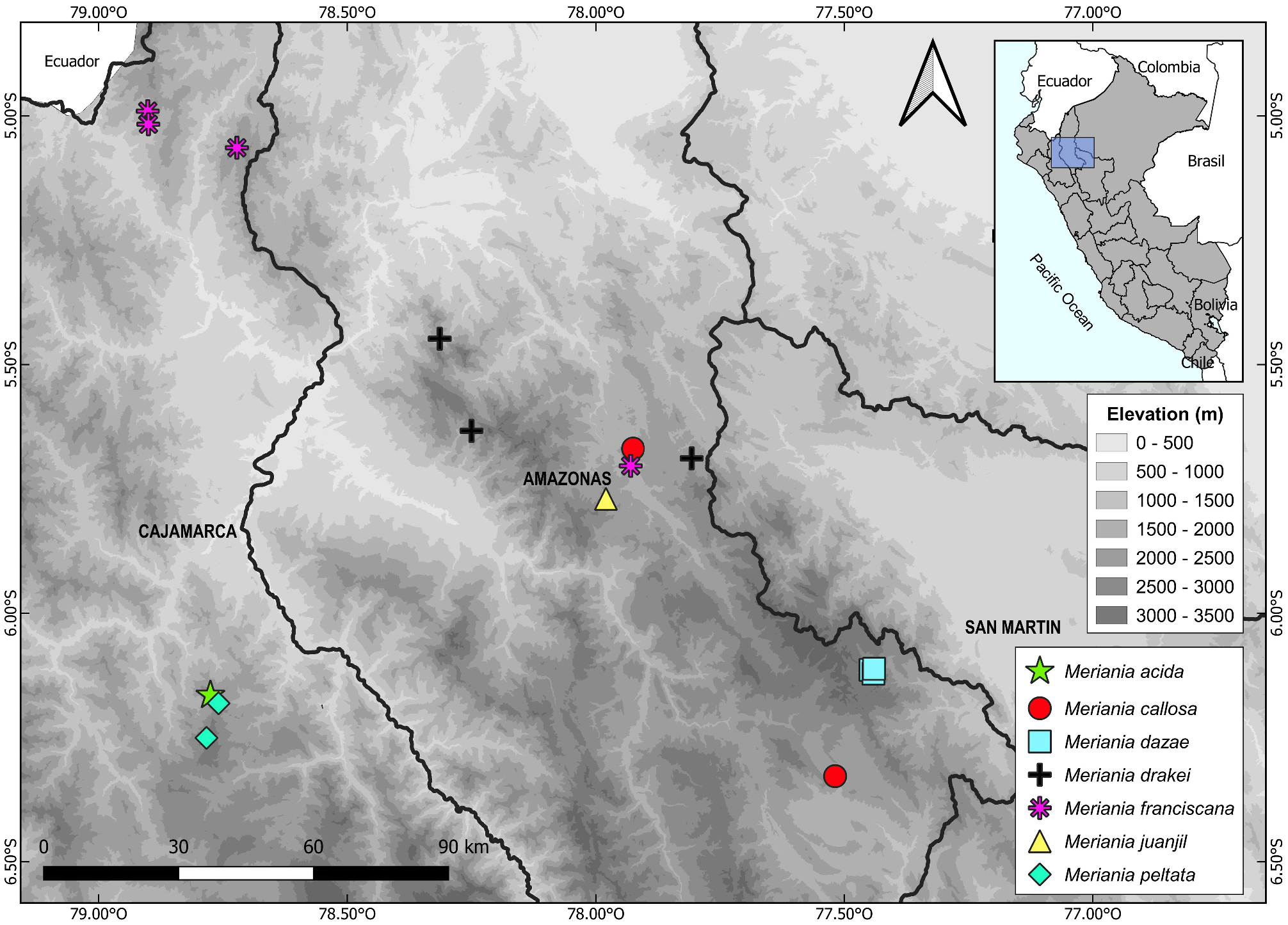
Distribution and phenology:— Meriania callosa is endemic to northern Peru (Department of Amazonas) and grows in montane forests at 1880–1970 m ( Fig. 9 View FIGURE 9 ). It has been collected in flower in April and November, and fruit in August and November.
Specimens examined:— PERU. Amazonas: Prov. Bongará, Dist. Yambrasbamba, ruta desde CP Santa Rosa hacia bosque El Toro, 1970 m, 05°40’09.22”S, 77°55’30.05”W, 11 Nov 2020 (fl. bud, fr.), R GoogleMaps . Fernandez-Hilario et al. 2056 ( HOXA!, MOLF!, NY!, UPCB!); Prov. Rodríguez de Mendoza, Dist. Mariscal Benavides , CP Izcuchaca, 1880 m, 06°19’40”S; 77°31’05”W, 30 Aug 1998 (fr.), R GoogleMaps . Vásquez & J . Campos 25339 ( NY!), same locality, 11 Apr 2001 (fl.), H . van der Werff et al. 16941 ( NY!, USM!) .
| CP |
University of Copenhagen |
| R |
Departamento de Geologia, Universidad de Chile |
| HOXA |
Estación biológica del Jardin Botanico de Missouri |
| NY |
William and Lynda Steere Herbarium of the New York Botanical Garden |
| UPCB |
Universidade Federal do Paraná |
| J |
University of the Witwatersrand |
| H |
University of Helsinki |
| USM |
Universiti Sains Malaysia |
No known copyright restrictions apply. See Agosti, D., Egloff, W., 2009. Taxonomic information exchange and copyright: the Plazi approach. BMC Research Notes 2009, 2:53 for further explanation.
|
Kingdom |
|
|
Phylum |
|
|
Class |
|
|
Order |
|
|
Family |
|
|
Genus |

Meriania callosa Rob.Fern., R.Goldenb.& Michelang., Willdenowia
| Fernandez-Hilario, Robin, Goldenberg, Renato & Michelangeli, Fabián A. 2023 |