
Cosella nudifemoralis, Flechtmann, Carlos H. W. & Etienne, Jean, 2002
|
publication ID |
https://doi.org/10.5281/zenodo.155892 |
|
publication LSID |
lsid:zoobank.org:pub:760F89D6-50B7-4B51-B725-75F92EABB4D6 |
|
persistent identifier |
https://treatment.plazi.org/id/038E8789-4D78-3D56-DD70-FEDF248EFE14 |
|
treatment provided by |
Plazi |
|
scientific name |
Cosella nudifemoralis |
| status |
n.sp. |
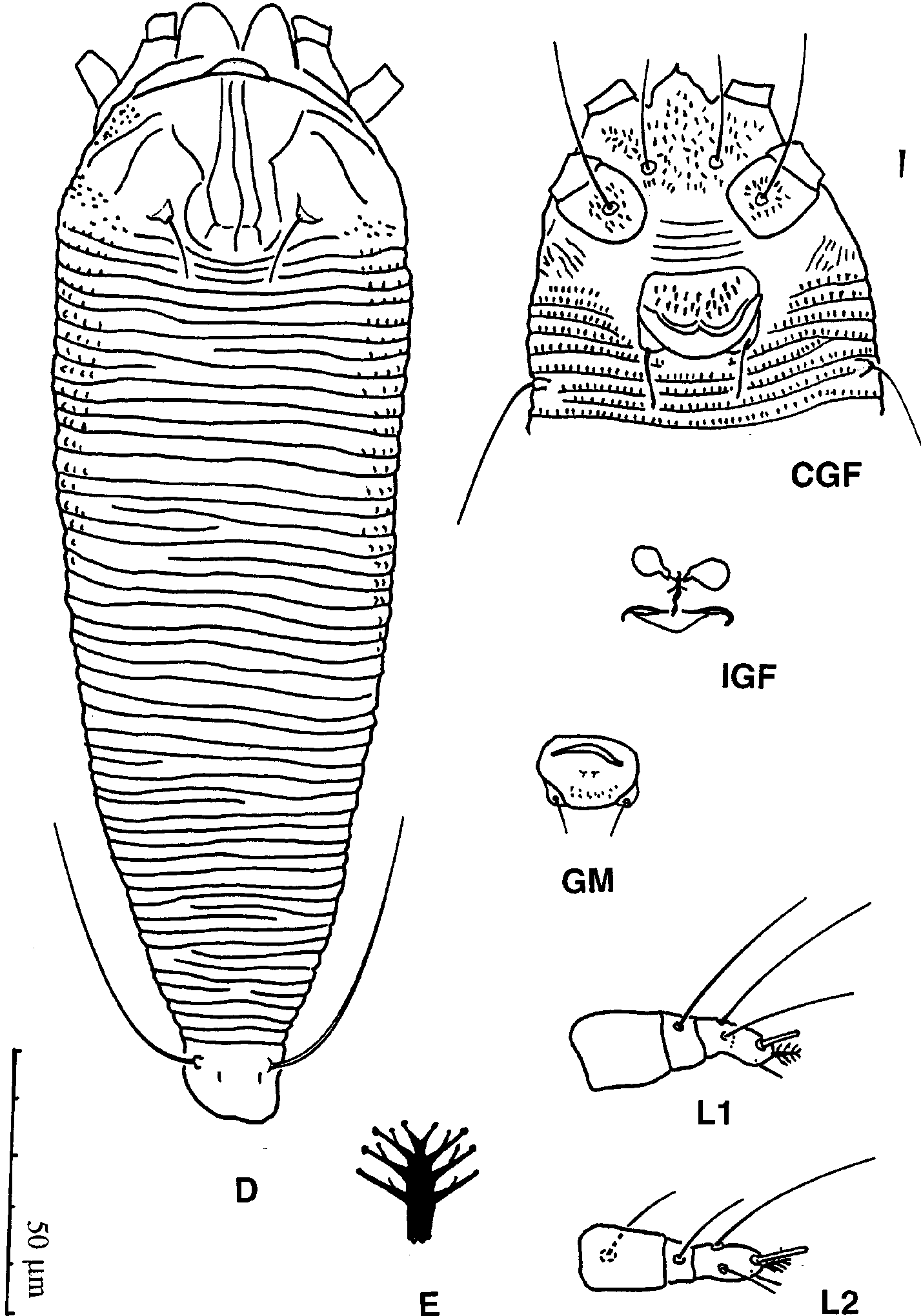
Cosella nudifemoralis n.sp. ( Figs. 1 View FIGURE 1 )
DIAGNOSIS The absence of the forefemoral seta and of the antapical seta is distinct for the new species.
FEMALE (n = 6) From front of shield to terminal lobes 189 ( 176200); 63 ( 5770) wide. Gnathosoma projecting downwards; basal seta 4 ( 34); antapical seta not discernible in 33 specimens examined; chelicerae 15 ( 1316). Prodorsal shield with complete median and admedian lines, connected by a transverse line at level of dorsal shield tubercles. Shield 37 ( 3539), including rounded anterior lobe 3 ( 3). Dorsal tubercles ahead of rear shield margin, 26 ( 2427) apart, directing scapular setae ( sc) convergingly backwards (or upwards?); sc 13 ( 1113). Legs: tibiae I and II absent; forefemoral seta absent. Leg I: 23 ( 2226) from trochanter base to tip of tarsus; femur 9 ( 810), femoral seta ( bv) absent; genu 5 ( 45), genual seta ( l") 25 ( 2225); tarsus (or tibiotarsus?) 7 ( 78), solenidion 4 ( 4), slightly expanded apically, empodium 4 ( 4), 4 rayed, dorsal seta ( ft') 15 ( 1518), lateral seta ( ft") 19 ( 1924), unguinal seta ( u') 4 ( 45). Leg II 22) 2123); femur 9 ( 79), bv 10 ( 9 11); genu 3 ( 3), l" 10 ( 710); tarsus 6 ( 68), solenidion 6 ( 67), empodium 5 ( 45), 4 rayed, ft' 6 ( 57), ft" 22 ( 2123), u' 4 ( 45). Coxae I fused into one structure with hypostom (suboral plate), spinulate; coxal seta I ( 1 b) absent; coxal seta II ( 1 a) 19 ( 1620), 11 ( 1012) apart; coxal seta III ( 2 a) 33 ( 3134), 26 ( 2227) apart. Coxae II with spinules surrounding coxal tubercle. Coxisternal area with faint 4 ( 34) annuli, smooth. Genitalia 22 ( 2123) wide, 16 ( 1318) long, genital seta ( 3 a) 10 ( 1013); epigynium granulated and one arched line parallell to its distal margin. Opisthosoma with a barely noticeable short, anterior ridge; otherwise, annuli evenly arched in cross section. Lateral seta ( c 2) 27 ( 2535), on annulus 2 ( 13) counting from posterior margin of genitalia; ventral seta I ( d) 44 ( 4145), 35 ( 2835) apart, on annulus 13 ( 1113); ventral seta II ( e) 9 ( 911), 21 ( 1621) apart, on annulus 25 ( 2428); ventral seta III ( f) 23 ( 1923), 26 ( 2026) apart, on annulus 40 ( 3842) or 7 ( 78)th from rear. Total dorsal annuli 53 ( 4853), smooth; total ventral annuli 46 ( 44 49), microtuberculate. Caudal seta ( h 2) 57 ( 5358); accessory seta ( h 1) minute.
MALE (n = 1) Smaller than female, 157; 55 wide. Gnathosoma: basal seta 3; antapical seta not discernible; chelicerae 14. Prodorsal shield 35, including frontal lobe, 3. Sc 25, 12 apart. Legs: Leg I: femur 8, bv absent; genu 4, l" 20; tarsus 6, solenidion 4, empodium 4, 4 rayed, ft' 16, ft" 19, u' 4. Leg II 19; femur 8, bv 10; genu 3, l" 8; tarsus 6, solenidion 6, empodium 4, 4 rayed, ft' 5, ft" 19, u' 4. Coxal seta II ( 1 a) 16, 10 apart; 2a 28, 23 apart. Genitalia 20 wide, 11 long, with faint tubercles. Coxisternal area with 3 faint annuli, smooth. Opisthosoma: c 2 37, on annulus 23; d 33, 26 apart, on annulus 910; e 8, 15 apart, on annulus 22; f 18, 21 apart, on annulus 37 or 7 th from rear. Total dorsal annuli 45; total ventral annuli 43. Caudal seta ( h 2) 45; h 1 minute.
TYPE MATERIAL Female holotype, 35 female and one male paratypes, from Randia aculeata ( Rubiaceae ), Les Amandiers, Sainte Rose, Guadeloupe, coll. J. Etienne, 06 Sept. 2001, on nine microscopic preparations in the collection of Departamento de Entomologia, Fitopatologia e Zoologia Agrícola, Universidade de São Paulo, ESALQ, Piracicaba, São Paulo, Brazil. One paratype slide deposited in the New Zealand Arthropod Collection.
RELATION TO HOST Tight leaf edge rolling.
ETYMOLOGY The specific designation nudifemoralis is derived from nudus, Latin, = bare, naked,+ femoralis, referring to the absence of the forefemoral seta. REMARKS This is the only known Cosella species (so far 14 species have been assigned to this genus) without forefemoral and antapical setae. A minute antapical seta was described in C. cissi Keifer, 1978 .
No known copyright restrictions apply. See Agosti, D., Egloff, W., 2009. Taxonomic information exchange and copyright: the Plazi approach. BMC Research Notes 2009, 2:53 for further explanation.