
Glenosema, Kieffer, 1905
|
publication ID |
https://doi.org/10.11646/zootaxa.4585.3.1 |
|
publication LSID |
lsid:zoobank.org:pub:73863C49-9FD2-47C4-9420-B58CCEF92816 |
|
DOI |
https://doi.org/10.5281/zenodo.5687748 |
|
persistent identifier |
https://treatment.plazi.org/id/038C9469-6D24-FFDE-9AB4-FD60FA74FAB7 |
|
treatment provided by |
Plazi |
|
scientific name |
Glenosema |
| status |
|
Key to Afrotropical species of Glenosema (Ƌ)
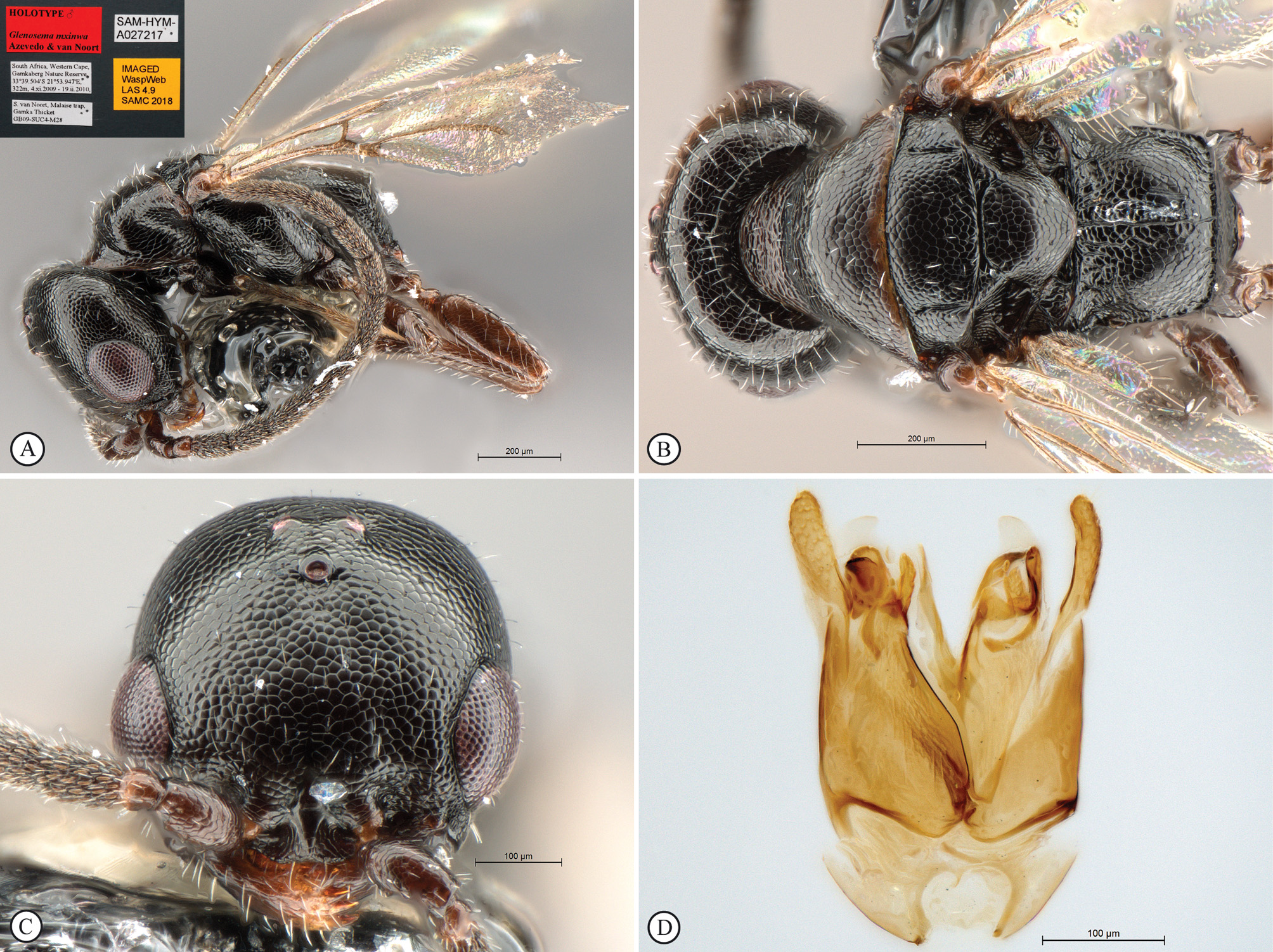
1. Metapectal-propodeal disc distinctly wider than long ( Fig. 11B View FIGURE 11 )................................................ 2
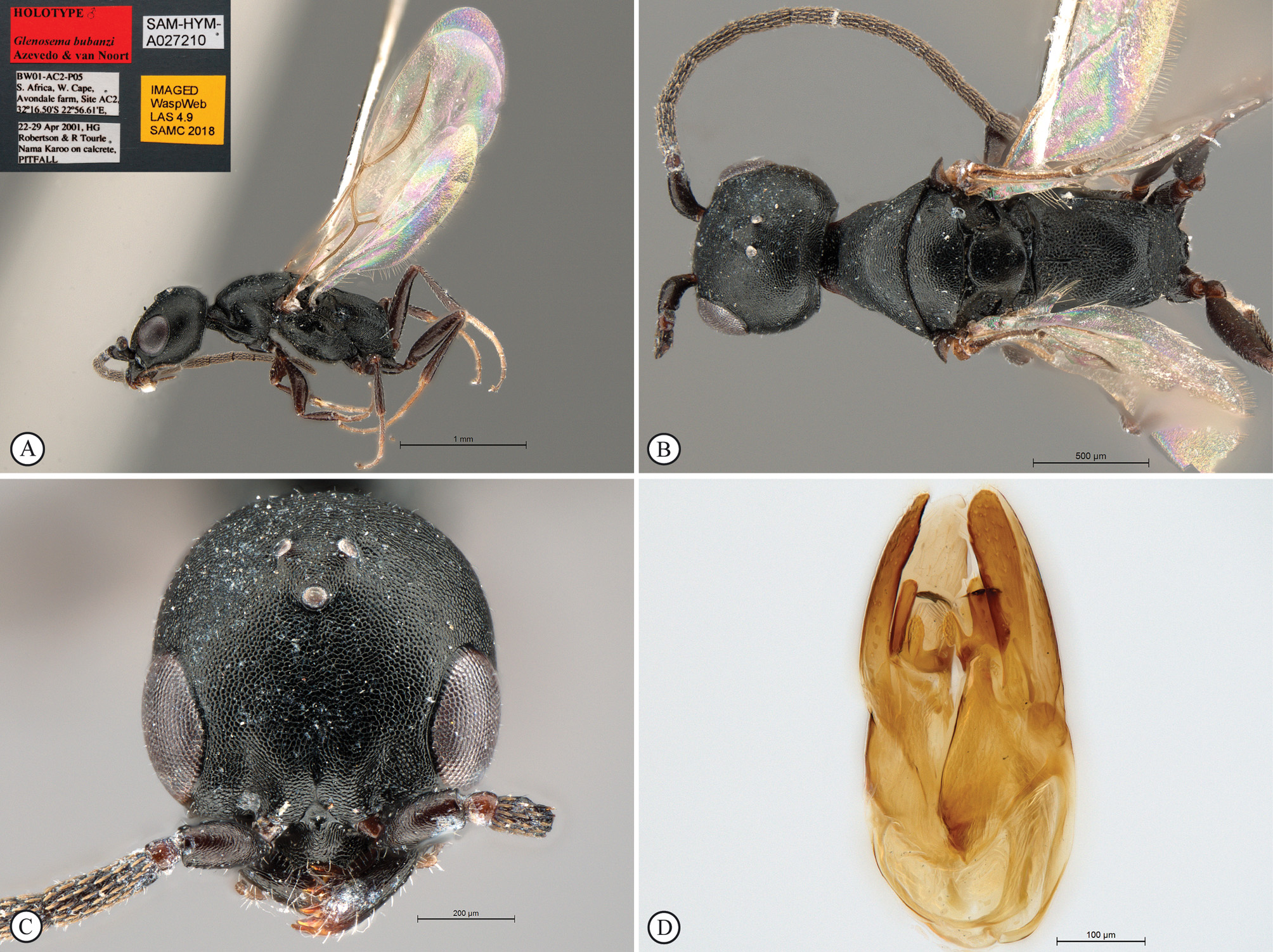
- Metapectal-propodeal disc as long as or longer than wide ( Fig. 9B View FIGURE 9 ).............................................. 5
2. Dorsal arm of paramere about as wide as ventral one ( Fig. 14D View FIGURE 14 )................................................. 3
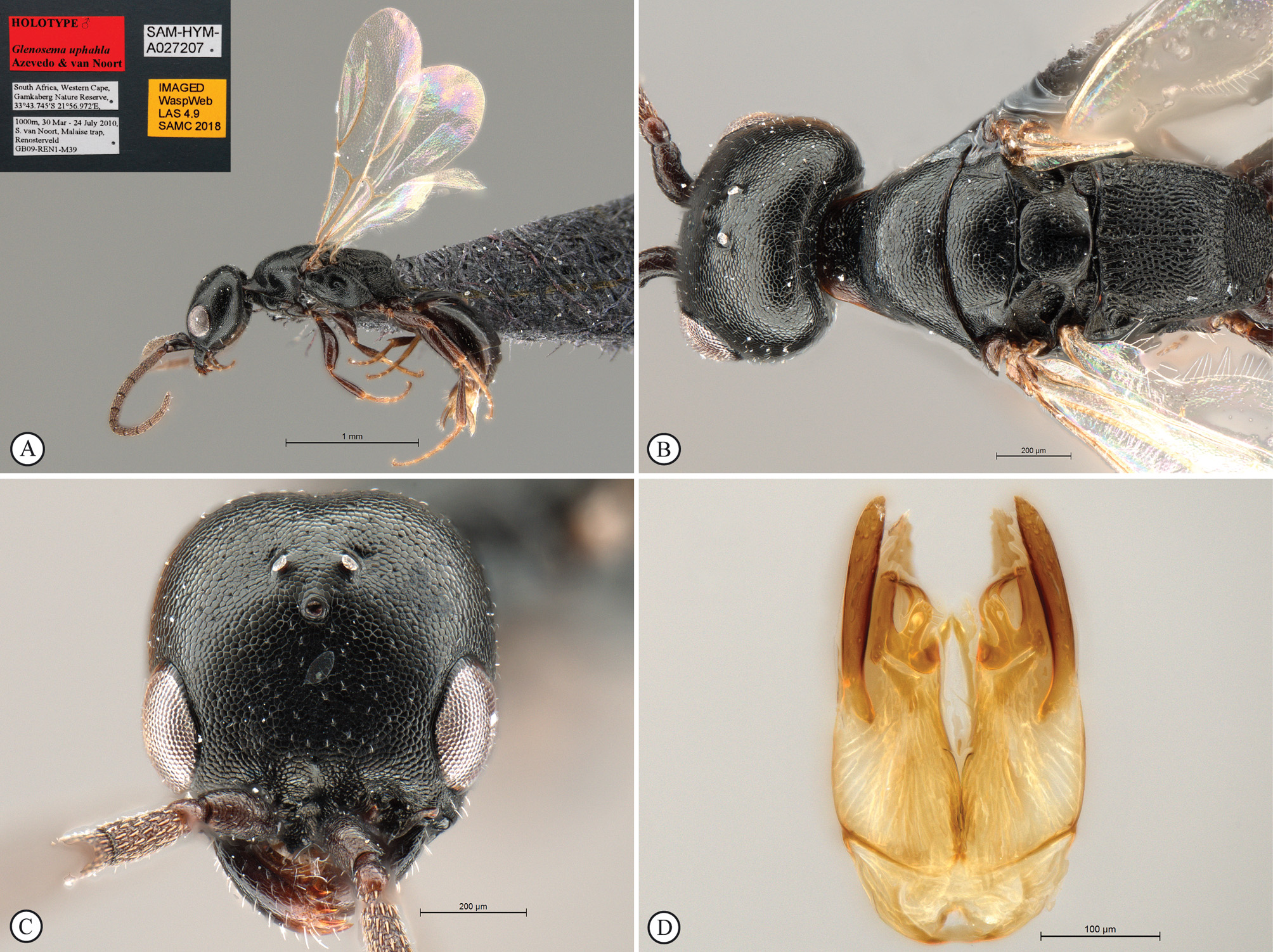
- Dorsal arm of paramere about twice as wide as ventral one ( Fig. 12D View FIGURE 12 )............................................ 4
3. Parameral dorsal arm shorter than ventral one, dorsal margin of parameral ventral arm outcurved ( Fig. 12D View FIGURE 12 ).................................................................................................... G. mxinwa sp. nov.
- Parameral dorsal arm as long as ventral one, dorsal margin of parameral ventral arm angled ( Fig. 13D View FIGURE 13 ).... G. lingana sp. nov.
4. Ventral arm of paramere lanceolate-shaped, almost evenly narrow, apex little sharp; dorsal margin of basiparamere expanded ( Fig. 14D View FIGURE 14 )............................................................................ G. uphahla sp. nov.
- Ventral arm of paramere spatulate-shaped, narrow basally and progressively widening subapically and apex rounded; basiparamere not expanded ( Fig. 11D View FIGURE 11 )........................................................... G. icephe sp. nov.
5. Head and mesosoma yellowish, contrasting with dark castaneous metasoma ( Fig. 15A View FIGURE 15 ).................. G. tyheli sp. nov.
- Head and mesosoma as black as metasoma ( Fig. 10A View FIGURE 10 )........................................................ 6
6. Body robust and large, more than 2.5 mm long; head about as wide as long ( Fig. 8C View FIGURE 8 ); tips of mesoscutellar sulcus blunt; metapectal-propodeal disc as long as wide ( Fig. 8B View FIGURE 8 ).......................................................... 7
- Body slender and small, less than 2.0 mm long; head longer than wide ( Fig. 10C View FIGURE 10 ); tips of mesoscutellar sulcus rounded; metapectal-propodeal disc longer than wide ( Fig. 10B View FIGURE 10 )........................................ G. ahlukileyo sp. nov.
7. Malar space subquadrate and large, about 0.6 × as wide as long and 0.3 × HE; ocellar triangle somewhat compact, OOL about 2.2 × WOT ( Fig. 8C View FIGURE 8 )...................................................................... G. banzi sp. nov.
- Malar space rectangular and small, about 0.4 × as wide as long and 0.5 × HE; ocellar triangle not compact, OOL about 1.5 × WOT ( Fig. 9C View FIGURE 9 )......................................................................... G. bubanzi sp. nov.





No known copyright restrictions apply. See Agosti, D., Egloff, W., 2009. Taxonomic information exchange and copyright: the Plazi approach. BMC Research Notes 2009, 2:53 for further explanation.
|
Kingdom |
|
|
Phylum |
|
|
Class |
|
|
Order |
|
|
Family |